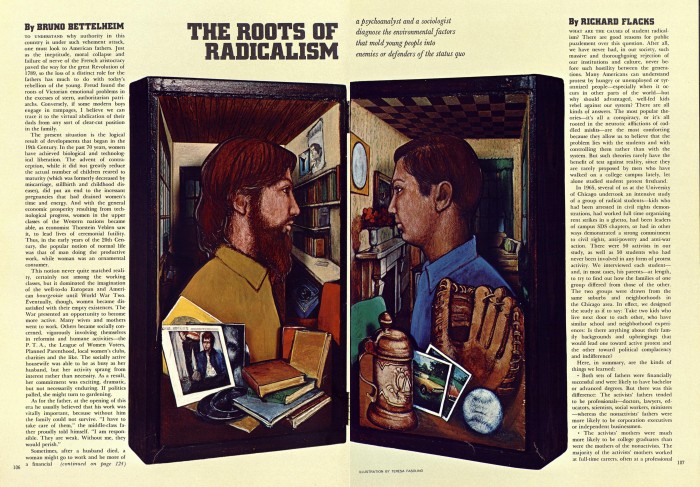
The Roots Of Radicalism
March, 1971
To Understand why authority in this country is under such vehement attack, one must look to American fathers. Just as the ineptitude, moral collapse and failure of nerve of the French aristocracy paved the way for the great Revolution of 1789, so the loss of a distinct role for the fathers has much to do with today's rebellion of the young. Freud found the roots of Victorian emotional problems in the excesses of stern, authoritarian patriarchs. Conversely, if some modern boys engage in rampages, I believe we can trace it to the virtual abdication of their dads from any sort of clear-cut position in the family.
The present situation is the logical result of developments that began in the 19th Century. In the past 70 years, women have achieved biological and technological liberation. The advent of contraception, while it did not greatly reduce the actual number of children reared to maturity (which was formerly decreased by miscarriage, stillbirth and childhood diseases), did put an end to the incessant pregnancies that had drained women's time and energy. And with the general economic prosperity resulting from technological progress, women in the upper classes of the Western nations became able, as economist Thorstein Veblen saw it, to lead lives of ceremonial futility. Thus, in the early years of the 20th Century, the popular notion of normal life was that of man doing the productive work, while woman was an ornamental consumer.
This notion never quite matched reality, certainly not among the working classes, but it dominated the imagination of the well-to-do European and American bourgeoisie until World War Two. Eventually, though, women became dissatisfied with their empty existences. The War presented an opportunity to become more active. Many wives and mothers went to work. Others became socially concerned, vigorously involving themselves in reformist and humane activities—the P. T. A., the League of Women Voters, Planned Parenthood, local women's clubs, charities and the like. The socially active housewife was able to be as busy as her husband, but her activity sprang from interest rather than necessity. As a result, her commitment was exciting, dramatic, but not necessarily enduring. If politics palled, she might turn to gardening.
As for the father, at the opening of this era he usually believed that his work was vitally important, because without him the family could not survive. "I have to take care of them," the middle-class father proudly told himself. "I am responsible. They are weak. Without me, they I would perish."
Sometimes, after a husband died, a woman might go to work and be more of a financial (continued on page 124)Radicalism/Bettelheim(continued from page 106) success than her man had been. In fact, wealth has slowly been accumulating in the hands of women so that today, as a class, they possess more riches than ever before (though, unquestionably, economic power is still a male province). But the fiction of the indispensable father continued to be generally believed. Again, World War Two marked the watershed for this notion. The women who stayed at home had proved their self-sufficiency. The men who had gone forth to conquer fascism came back with a great longing for peace and comfort and were bemused by the increasing complexity of the American corporate economy. Novels of the Forties and Fifties such as The Hucksters and The Man in the Gray Flannel Suit, popular works of sociology such as The Organization Man and The Lonely Crowd tell the story. The American man, having lived through the Depression and the War, having to live now through the Cold War, settled with a sigh into the bar-rackslike suburban developments that mushroomed around the big cities. Since prosperity and personal affluence with its pension plans seemed to assure survival and security, his life was no longer ruled by necessity but by the wish for ever greater comfort. Its purpose seemed directed toward acquiring superfluous adornments, rather than essentials. It's easy to achieve self-respect—and with it the respect of others, which comes from the inner security they feel one possesses—if one's work provides his wife and children with the necessities of life. But when men were not working for survival and were not after real, intrinsic achievements (such as are inherent, for example, in scientific discovery), or at least after power, but merely after luxury, only their busyness prevented them from realizing how devoid of true meaning their lives had become. Today, the children of such fathers are in their late teens and early 20s.
In these affluent families, the father often describes his work as a rat-race. Indeed, the successful businessman scurries through a maze of corporate politics, spurred on by a yearning for such rewards as profit sharing, pension plans, stock options, bonuses, annuities. He is often a minor functionary in a bureaucracy whose purpose, other than to grow larger, tends to be ill-defined. His work often seems pointless to him, as he is shifted from one position to another with little say about his destiny. And if he listens to social critics inveighing against environmental pollution, cultivation of artificial needs, dollar imperialism, war profiteering and related evils, he may begin to suspect the worth of his activities and, with it, his own value.
The effect of these changes in parental attitudes on the children has been drastic. The small child recognizes only what he sees. What he is told has much less of an impact on him. He sees his mother working around the house, for him. He is told only that his father also works for his well-being; he does not see it. In the suburban family, when the father commutes to work, he has to leave early and he comes home when the child is about to be put to bed. More often than not, he sees his father watching TV, hiding behind his paper, maybe taking what to the father is a well-deserved nap but to the boy seems like sheer idleness. Even if the middle-class father takes his son to his place of work some 20 or 30 miles away, it's such a different world from the child's life at home that he cannot bring the two together. And what he sees there of the father's work he cannot comprehend. How can talking on the telephone—which from his experience at home he knows is done mainly to order goodies or for fun—or into a machine secure the family's well-being? Thus, the boy's experience can hardly dispel the notion that his father is not up to much. The father's work remains unseen and seems unreal, while the mother's activities are very visible, hence real. Since he does not see him do important things, the child comes to doubt the legitimacy of the father's authority and may grow up to doubt the legitimacy of all authority.
For ages, the father, as a farmer, as a craftsman working in his shop, had been very visible to his sons and, because of his physical prowess and know-how in doing real things in the real world, was an object of envious adulation. Now, the mother, who traditionally is the one who nurtures the child, becomes ever more the carrier of authority. If for no other reason than that she is with the child during the father's waking hours, the mother becomes the disciplinarian, the value giver, who tells the child all day long what goes and what does not. In short, mother knows best, and father next to nothing. As one boy put it—and there is some truth in the words of the most naive child—"What is my fat-her? Just a fat-her."
Even though the father doesn't think much of his work, he expects the son to follow in his dreary footsteps. The child is sent to the best grammar school, not to satisfy his intellectual curiosity, not to develop his mind, not to understand himself better but to make good marks and to pass examinations so that he can get into the best high school. There he is pushed to compete for the highest grades, so that he can go to a famous college, often not because he can get a better education there but because going to a school with a big name adds to the prestige of the parents. And college is merely a means to an end—admission to graduate school. Graduate work in turn furnishes the "union card," enabling him to get a good job with a big corporation, where he can work until he finally retires on a good pension and then waits to die. Given this distorted, purgatorial picture of the world of education and work, is it any wonder that many young people scornfully reject it?
The American social and economic system, despite its obvious shortcomings, is much more than a gigantic staircase that leads nowhere. American society is creative and progressive and offers unprecedented opportunities for individual fulfillment and achievement. But that's not the way it has been presented to many young Americans born in the Forties and Fifties. The people who taught these youngsters to despise American society were their own parents.
Psychoanalysis asserts that each child, growing up in a family, must choose a parent to emulate. But a son cannot emulate his father's great abilities as a worker if that father seems a little man at home, meekly taking out the garbage or mowing the lawn according to a schedule devised by his wife. The process of becoming a person by emulation is enormously important, because the child doesn't copy just external mannerisms; he tries—as far as his understanding will let him—to think and feel like the chosen parent. For boys in today's suburban society, many fathers offer little with which to identify. The problem is not created by the father's absence due to commuting and the long executive workday—sailors and men at war have been good objects for identification though absent from the home for months and years. The problem arises because the image of the father, in the eyes of the mother and others, has been downgraded.
In order not to have to identify with a superfluous father, many boys in the more affluent reaches of our society try to solve the problem by identifying with their mothers. But, while this solves one problem, it creates another, not for the boys' self-respect as human beings but for their self-respect as males. This emulation of the mother is not, by the way, manifested only in long hair or unisex clothing, which are merely matters of fashion. Boys tend to adopt the consumer mentality, like their mothers, rather than their fathers' producer mentality. A mother's role is also more attractive—at least in England and America—because she is often the more cultured member of the household. She is apt to be more liberally educated, more aware of the arts than her practical husband. This attitude is typified by the couple portrayed in Sin-clair Lewis' Main Street. On the Continent, culture is a male prerogative, and this at least has slowed down the attrition of the father's dominance in the European household.
(continued on page 206)Radicalism Bettelheim(continued from page 124)
In the reformist and revolutionary activities of middle-class American college men, I see a repetition of the behavior patterns of their socially conscious mothers. These boys work for a cause with emotional fervor, rather than with the approach that business or technical activities require. Accomplishment in business—indeed, in politics—demands devotion to logic, long-range planning, practicality, willingness to compromise, acceptance of routine and drudgery. These qualities, indispensable to productive work, are repellent to many young radicals. They engage passionately in a controversy but are ready to withdraw from it the moment it becomes boring or tedious. Ralph Nader has commented bitterly on the waning of student enthusiasm for the ecology movement after the initial hoopla of Earth Day 1970. During the student strike after the Kent State calamity, it was only work that stopped in many colleges, while fun—in the form of movies, rock concerts and the like—went right on. And, of course, immediately after Cambodia and Kent State thousands of young men and women vowed that they would be out the following November to work for peace candidates. A little over six months later, however, the number of students actively working during the 1970 elections was insignificant when compared with those who had claimed they would.
Marx never said that revolution would be fun. The New Left speaks of "revolution for the hell of it" and its values are theatrical. The melodrama becomes tragedy when some young people begin to see themselves as romantic bomb throwers. They shirk the task of educating the people and building a mass movement, those long-established practical strategies of the left. They think they can do their teaching by breaking plate-glass windows, by setting fire to buildings that could be used to educate the people.
The student revolutionary's lack of realism is an important reason for which he is frequently rejected by members of the working class. Typically, he tries to get close to the workers through his dress; he wears blue jeans and a work shirt. Trying to get to people by dressing in a certain way is a feminine, consumer approach, focusing on external attire rather than on basic function. It is the mother who tells a boy he can't go to church without a jacket and tie; he learns the lesson so well that ten years later, he still feels that there is a correct uniform for every occasion and he wouldn't be caught dead in the streets without blue jeans and a work shirt. I remember that in the early days of the Communist Party in Austria, members were taught that you couldn't reach the workers merely by dressing like them; you had to live like them and work like them; you had to learn from them long before you dared to try to teach them. Today, a left-wing student thinks he can walk into a factory wearing the appropriate garb and start lecturing the workers on the way our fascist-pig establishment oppresses the struggling third-world peoples. This is exactly the attitude of the Victorian Lady Bountiful, who feels herself above the men who do dirty work and who don't know about the really important things in life. American workingmen sense that they are being patronized and want to kick the snobbish young sermonizer right out the plant gate.
Such aberrant behavior as this feminized approach to politics does not take place when children are able to identify with the parent of the same sex and to love the parent of the opposite sex. To make such healthy identification possible, it is not important whether the father has all the authority or whether the mother and the father share it; it is important simply that there be specific male authority and specific female authority. It is the attractiveness of each role that makes the child want to identify with it and decide which parent he will want to choose for the object of his love. Hardly a culture in the world does not provide in some way for distinct male and female roles; only in the affluent sector of our own society does the blurring of distinctions make it difficult for the son to identify with his father.
Psychoanalysis has derived its notions of the proper role a male parent should play in his children's lives from the observations Freud made in Vienna in the late 19th Century. His studies, of course, were limited to authoritarian, Victorian families. He learned that psychological problems stemmed from the faults of this type of family. But when the Victorian family worked well, mental health, as Freud understood it, resulted. Today, we are so used to hearing about the oppressive horrors of Victorian life that we forget that many of these families were happy and produced healthy children. The popular idea that the family in the 19th Century was a dreadful institution and the psychoanalytical idea that all families resemble it are both wrong.
In Freud's day, the male personality still developed as Goethe, both statesman and poet, had described his own: "From father is my stately gait, / My sober way of conduct, / From mother is my sunny mind,/ My zeal for spinning tales." As Freud saw it, the paternal influence created the superego—that element in a person's character that laymen call the conscience. The mother, on the other hand, gave the child unconditional love and satisfied his needs, thus teaching him how to gratify those bodily drives and emotional needs that psychoanalysts describe as belonging to the id. A child carries images of his parents in his mind, or, as psychoanalysts say, he internalizes them. If all goes well, the boy acts as he thinks his lather would want him to and he tries to be the kind of person his mother would love. The ego, which is the conscious self, is formed, according to Freud, to mediate between the conflicting images of the judging father and the loving mother.
For a child to form his personality out of interacting masculine and feminine images, the two must be truly different. Today, the mother is both nurturing and demanding, while the father often is neither. The child is not offered the example of one person representing the principle of pleasure and the other person the principle of duty. Out of this confusion, the child develops a conscience, which tells him, "You have a duty to enjoy life." Thus, there are young people who feel that work ought to be all fun and who look on nine-to-five drudgery as somehow immoral. They often try to drop out of the world of work and careers. Other people turn the fun of life into grueling labor: zealous tourists, dogged golf-swing improvers, fanatic car buffs, people who worry diat they're not getting as much pleasure as they ought to out of sex. How impossible the pursuit of pleasure becomes, even in sex, when it assumes the character of a moral duty!
In old Vienna, the male parent unquestionably represented the principle of duty, and sons felt respect, awe, even fear, toward their fathers. And the boys had something to look forward to: the idea of having similar authority and commanding similar respect when they grew up. In adolescence, through revolt against paternal authority, one gained further strength and masculine pride. But how can one revolt against the weak fathers of today? They often do not seem worth the trouble. Instead, the children revolt against the establishment. But this does not work out for them, either. After a successful adolescent revolt, the boy may reidentify with the best in the father. But how can our student revolutionaries reidentify with a distant and anonymous establishment? Either they get stuck, in their adolescent revolt or the establishment defeats them. In either case, they can't reach maturity and deep down they despise themselves for a failure that is not of their own making.
Freud's teachings have generally been taken as the last word on psychodynamics, but he made scientific observations, he did not formulate laws. Freud would never have made the mistake of declaring that people in a different society, such as our own, could follow the Victorian pattern for effective child rearing without appropriate modifications. Families can take many forms as long as they serve the needs of children. A few years ago, I studied the Israeli kibbutzim, the collective communities, for a short time. Here children do not live with their parents; they are raised in groups. One of the most important factors in the lives of the children, though, is that they constantly visit both parents at work. And when the children come, everybody stops working and explains to the children what they're doing and why it is important to them and to the community. Through that experience, the child gains respect for the work of the parents. People have wondered how kibbutz children grow up so well when their parents are distant figures. The answer is that, while there are only a few basic needs, there are many ways to satisfy them.
A child need not be raised by his biological parents. Freud made so much of the Oedipus complex or Oedipal situation that many people believe a male child must have a jealous desire for his mother and an envious hatred for his father in order to grow up normally. But there has been much argument among anthropologists about whether or not this Oedipal relationship really exists in all societies. As I see it, the chief thing is to understand the basic principle underlying the Oedipus phenomenon, which is applicable to any family structure: The human infant for many years is entirely dependent upon and in the power of some individual or individuals. If you're in someone's power, for better or worse you have to come to terms with that person. If the person doesn't abuse his power, you come to love him. But in whose power the child is, and with whom he has to come to terms, can vary greatly.
Consider my own history. Today, I teach psychoanalysis at the University of Chicago and, of course, my students read Freud on the subject of how all-important a child's mother is. After I've let them expound oil the subject, I try to open their minds a bit more by telling i hem some of my personal story. During my early childhood, the person who fed me, took care of me and was with me most of the time was not my mother but a wet nurse. This was a custom among the upper-middle classes in Vienna at the time. The nurse was a peasant girl in her late teens, who had just had a baby out of wedlock. She left the baby with relatives and hired herself out to suckle the child of a well-to-do family. To make sure she gave a lot of milk, she followed the folklore formula of drinking a lot of beer. So my entire care as an infant was entrusted to a girl who had little education, was by our standards a sex delinquent, was a little high on beer most of the time and was so devoid of maternal instinct that she left her own child. I am the deplorable result.
The reasons why a relationship that, according to theory, should have been unpromising worked so well were that the girl had no interest other than me; she took good physical care of me and, being a peasant, was without undue fastidiousness about diapering and toilet training: the beer kept her relaxed and happy; she didn't discipline me excessively and didn't overawe me intellectually. It was not an idyllic upbringing but it certainly was adequate. And because my nurse was awed by my father, I learned to look up to him by observing her. Thus, I acquired respect for him without his having to discipline me directly. My father was a very gentle man, very secure in himself, so convinced of his inner authority that he never needed to make a show of it. I didn't have continual fight with my parents, because (he dos and don'ts came from the nurse, somebody who wasn't much of an authority. An infant learns very early what the power relations are in his family and these hold the key to his development.
My father was a good model for me. As a child, I visited him at his place of work. I spent many hours there, watching him, more often just playing. The pace of life was still leisurely enough to permit my father to drop what he was doing and explain things to me. I saw other strong men work hard. Their respect for my father and his for them, without my being aware of it, made a deep impression on me. Such experiences make identification with his father seem worth while for a boy.
Besides respecting the roles of the two sexes, people should be able to clearly differentiate between them. Dichotomy, duality, is one of the most fundamental characteristics of both nature and philosophy. As Buckminster Fuller says, "Unity is plural and at minimum two." The oracular Chinese book, the I Ching, presents 64 figures made up of six lines. This large number of figures is made of different combinations of just two kinds of lines, solid and broken. The solid lines represent the masculine yang principle and the broken lines, the feminine yin principle. The child selects the characteristics he prefers, inventing his own individual mix. There are many more than six characteristics in the human personality, each of which has its feminine or masculine version: thus, the possible kinds of human personality are infinite.
The trend I've described in today's middle-class family is that the loss of attractiveness and distinctness in the father's role impedes the satisfactory working out of this process. What can be done about this situation? Obviously, we can't turn back the economic or technological clocks. But ideas as much as tangible necessities have caused the decline of the father. We must renew our appreciation of the polarity of the sexes and be enriched by the inner tensions it creates. While I do sympathize with liberated women to a degree, I don't think they should make it their goal to become as much like men as possible or to change the image of men. They should concentrate on finding themselves as women.
We males cannot expect women to find roles for us that are suitably masculine; we have to do this ourselves. The new masculine, heroic ideal may possibly focus on discovery. All through recorded history, the discoverer has been a man, even the discoverer of the pill, which may solve the most pressing problem of mankind: overpopulation. The astronauts who set foot on the moon, and also those who managed to return their crippled spaceship, fired the imagination of the entire world. A new masculine pride can come from discoveries of the mind, from the brain, not from brawn. Our cities need to be rethought and rebuilt, the very pattern of our lives will have to be reshaped so that men will again be able to derive pride from what they are doing on tin's earth, maybe even beyond it. The problems and possibilities are immense.
The task is not one that can be mastered in comfortable leisure. But leisure, the absence of struggle, order, harmony were the ideals the GIs of World War Two adopted, a natural but mistaken reaction to a horribly destructive conflict. The absence of tension is just as deadly as too much of it. This is one meaning of the Zen question "What is the sound of one hand clapping?" One hand alone strikes empty air and makes no sound at all. This is why the young crave confrontations. The college administrators who face student dissenters are too often men who are lacking in masculine security and have based their careers on the principle of harmony at all costs. So, instead of meeting questions and openly recognizing that unavoidable conflict exists, they try to evade it. One reason Dr. Hayakawa has succeeded in restoring some order at San Francisco State College is that he was not afraid of real in place of academic soothing syrup. He stood up to the demonstrators in a manly way, instead of pretending to be on their side while actually trying to undermine them. One of the most compelling testimonies to the life-giving properties of conflict is Sartre's description of how it felt to be in the French Resistance from 1940 to 1945: "We were never more free than during the German occupation.... Because the Nazi venom seeped even into our thoughts, every accurate thought was a conquest. Because an all-powerful police tried to force us to hold our tongues, every word took on the value of a declaration of principles. Because we were hunted down, every one of our gestures had the weight of a solemn commitment."
Freud said that life results from an imbalance and the effort to re-establish balance. If a new imbalance is not created, however, there will be death. Hegel and Marx both summed up life as the conflict between thesis and antithesis, which is resolved in synthesis, which in turn generates a new antithesis for a new conflict. Without this process, life would come to a stop.
Next to sexual pleasure, one of the great experiences of life is climbing a mountain and growing hot and sweaty in the process, then coming upon a cold lake and jumping in. You may be shivering and have to jump out again in a minute, but what delight there is in the sudden change from hot to cool! Compare this with swimming in a tepid pool. Where there is no tension created, none is relieved. The affluent middle-class American wants life to run smoothly, doesn't want any difficulties. He wants the mountain to be level and the pool to be tepid. And then he wonders why his children reject him.
Kant said that aesthetic pleasure of the highest order comes from the fact that the artist creates a unity out of a variety of elements. One of the oldest images of the human soul is this metaphor from Plato's Phaedrus:
Let the figure be composite—a pair of winged horses and a charioteer. Now the winged horses and the charioteers of the gods are all of them noble and of noble descent, but those of other races are mixed; the human charioteer drives his in a pair; and one of them is noble and of noble breed, and the other is ignoble and of ignoble breed; and the driving of them of necessity gives a great deal of trouble to him.
At this point, the naive Utopian asks, "If both horses were alike, wouldn't they pull together better?"
Yes, they might. But how empty, how boring!

