50 Years Of The Harley Sportster
June, 2007
Cruising through half a century of pop culture, land-speed records and death-defying stunts on two wheels
Cruising through half a century of pop culture, land-speed records and death-defying stunts on two wheels
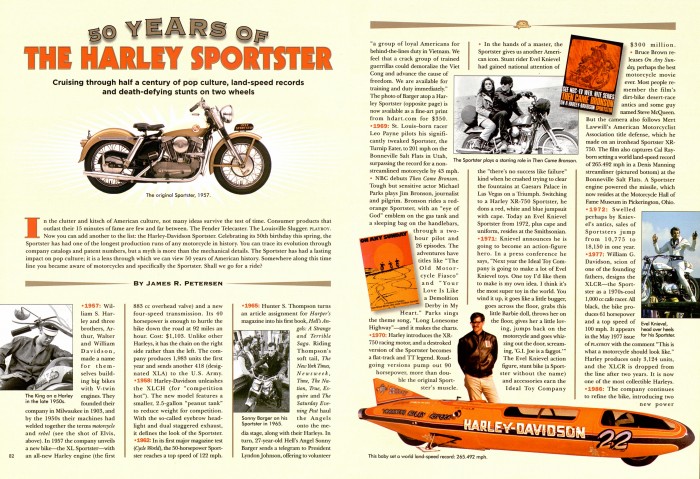
In the clutter and kitsch of American culture, not many ideas survive the test of time. Consumer products that outlast their 15 minutes of fame are few and far between. The Fender Telecaster. The Louisville Slugger, playboy. Now you can add another to the list: the Harley-Davidson Sportster. Celebrating its 50th birthday this spring, the Sportster has had one of the longest production runs of any motorcycle in history. You can trace its evolution through company catalogs and patent numbers, but a myth is more than the mechanical details. The Sportster has had a lasting impact on pop culture; it is a lens through which we can view 50 years of American history. Somewhere along this time line you became aware of motorcycles and specifically the Sportster. Shall we go for a ride?
•1957: William S. Har-ley and three brothers, Arthur, Walter and William Davidson, made a name for themselves building big bikes with V-twin engines. They founded their
company in Milwaukee in 1903, and by the 1950s their machines had welded together the terms motorcycle and rebel (see the shot of Elvis, above). In 1957 the company unveils a new bike—the XL Sportster—with an all-new Harley engine (the first
883 cc overhead valve) and a new four-speed transmission. Its 40 horsepower is enough to hurde the bike down the road at 92 miles an hour. Cost: $1,103. Unlike other Harleys, it has the chain on the right side rather than the left. The company produces 1,983 units the first year and sends another 418 (designated XLA) to the U.S. Army. •1958: Harley-Davidson unleashes the XLCH (for "competition hot"). The new model features a smaller, 2.5-gallon "peanut tank" to reduce weight for competition. With the so-called eyebrow headlight and dual staggered exhaust, it defines the look of the Sportster. •1962: In its first major magazine test (Cycle World), the 50-horsepower Sportster reaches a top speed of 122 mph.
•1965: Hunter S. Thompson turns an article assignment for Harper's magazine into his first book, Hell's An-
gels: A Strange and Terrible Saga. Riding Thompson's soft tail, The New York Times, Newsweek, Time, The Nation, True, Esquire and The Saturday Evening Post haul the Angels onto the me-
dia stage, along with their Harleys. In turn, 27-year-old Hell's Angel Sonny Barger sends a telegram to President Lyndon Johnson, offering to volunteer
"a group of loyal Americans for behind-the-lines duty in Vietnam. We feel that a crack group of trained guerrillas could demoralize the Viet
Cong and advance the cause of freedom. We are available for training and duty immediately." The photo of Barger atop a Har-ley Sportster (opposite page) is now available as a fine-art print from hdart.com for $350. •1969: St. Louis-born racer Leo Payne pilots his significantly tweaked Sportster, the Turnip Eater, to 201 mph on the Bonneville Salt Flats in Utah, surpassing the record for a non-
streamlined motorcycle by 43 mph. • NBC debuts Then Came Bronson. Tough but sensitive actor Michael Parks plays Jim Bronson, journalist and pilgrim. Bronson rides a red-orange Sportster, with an "eye of God" emblem on the gas tank and a sleeping bag on the handlebars,
through a two-hour pilot and 26 episodes. The adventures have
titles like "The Old Motorcycle Fiasco" and "Your Love Is Like ^ a Demolition Derby in My
Heart." Parks sings the theme song, "Long Lonesome Highway"—and it makes the charts. •1970: Harley introduces the XR-750 racing motor, and a destroked version of the Sportster becomes a flat-track and TT legend. Road-going versions pump out 90 horsepower, more than dou-
ble the original Sport-^k^ ster's muscle.
• In the hands of a master, the Sportster gives us another American icon. Stunt rider Evel Knievel had gained national attention of
the "there's no success like failure" kind when he crashed trying to clear the fountains at Caesars Palace in Las Vegas on a Triumph. Switching to a Harley XR-750 Sportster, he dons a red, white and blue jumpsuit with cape. Today an Evel Knievel Sportster from 1972, plus cape and uniform, resides at the Smithsonian. •1971: Knievel announces he is going to become an action-figure hero. In a press conference he says, "Next year the Ideal Toy Company is going to make a lot of Evel Knievel toys. One toy I'd like them to make is my own idea. I think it's the most super toy in the world. You wind it up, it goes like a little bugger, goes across the floor, grabs this
little Barbie doll, throws her on the floor, gives her a little lov-
ing, jumps back on the motorcycle and goes whizzing out the door, screaming, 'G.I. Joe is a faggot.'" The Evel Knievel action figure, stunt bike (a Sportster without the name) and accessories earn the Ideal Toy Company
¦ $300 million. I Bruce Brown releases On Any Sunday, perhaps the best motorcycle movie ever. Most people remember the film's dirt-bike desert-race antics and some guy lamed Steve McQueen.
But the camera also follows Mert Lawwill's American Motorcyclist Association title defense, which he made on an ironhead Sportster XR-750. The film also captures Cal Ray-born setting a world land-speed record of 265.492 mph in a Denis Manning streamliner (pictured bottom) at the Bonneville Salt Flats. A Sportster engine powered the missile, which now resides at the Motorcycle Hall of Fame Museum in Pickerington, Ohio.
•1972: Swelled perhaps by Kniev-el's antics, sales of Sportsters jump from 10,775 to 18,150 in one year. •1977: William G. Davidson, scion of one of the founding fathers, designs the XLCR—the Sportster as a 1970s-cool 1,000 cc cafe racer. All black, the bike produces 61 horsepower and a top speed of 100 mph. It appears in the May 1977 issue
ot playboy with the comment "This is what a motorcycle should look like." Harley produces only 3,124 units, and the XLCR is dropped from the line after two years. It is now one of the most collectible Harleys. •1986: The company continues to refine the bike, introducing two
new power
plants—the Evolution 883 and 1 1 00 —which become the backbone of the Sportster line. •1987: With a featured role in the movie Mannequin, starring Andrew McCarthy and Kim Cattrall, the quintessential
biker s bike goes mainstream. • 1990: Johnny Depp plays a greaser
in the John Waters-directed 1950s biker spoof Cry-Baby. Making cameo appearances: former porn star Traci Lords, Iggy Pop and a Harley Sportster (Depp's choice of ride, naturally). •1991: Can you say "heavy metal"? During the Judas Priest Painkiller tour, frontman Rob Halford rides a Sportster onstage during the tune "Hell Bent for Leather." Blinded
by a dry-ice fog at a Toronto gig, he crashes into a drum riser, tumbles from the stage and then continues, heroically Finishing the show with a busted nose. Now that's what we call rock and roll. •1995: Aspiring television broadcaster Suzanne Maretto (Nicole Kidman) hires three teenagers to kill her husband (Matt Dillon) in Gus Van Sant's To
Die For, based on a true story. Does the title refer to the Harley Sportster that plays a supporting role? •1996: The Sportster gets a meaty l,200cc engine. The top-of-the-line XLH 1200S boasts an $8,360 price tag. •1998: The Guggenheim Muse-
um in New York City launches a groundbreaking exhibition called The Art of the Motorcycle. The show becomes the museum equivalent of a rock tour, playing in Chicago, Las Vegas and Bilbao, Spain. Three Harley Sportsters are featured in the exhibit.
•2004: Harley-Davidson introduces rubber-mounted engines to reduce wear
and smooth the ride. The company sells
more than 70,00(1
Sportsters
in the
calendar year. •2006: Harley-Davidson improbably becomes a bargaining chip in international politics. When Kim Jong II threatens to build and test a nuclear device, the United States announces plans to ban exports of such items as iPods
and Harleys to North Korea. News stories about the ban show pictures of Harley Sportsters. •2007: To celebrate the Sportster's golden anniversary, Harley-Davidson releases the 50th Anni-
versary model (pictured below, $9,780) in the spring, with a five-
speed transmission and l,200cc
Evolution engine. The company will produce only 2,000
ot the anniversary bikes. It you're interested, you'd better move. Like all things Harley, they're going fast.

