Better Living Through Chemistry
March, 2008
BETTER LIVING
THROUGH CHEOXSTRV
ver the past 1Q years molecular gastronomy has burned its way through the culinary world, with chefs applying chemistry-lab principles to their dishes with stunning results. Now the same impulse has taken hold behind the bar, giving rise to so-called molecular mixology. Today a new generation of bartenders is pushing the limits of the cocktail, using esoteric techniques to turn libations into powders, gels, foams and solids while delivering palate-bending flavors and texture combinations. Preparing these potions takes more than a shaker and a swizzle stick; the methods involve equipment like dehydrators and siphons and ingredients like liquid nitrogen and xanthan gum. And they've yielded new and Nobel-worthy tastes for the adventurous boozer. Here, some of the f" transformative thing to happen to the cocktail since the repeal of the 18th Amendment.
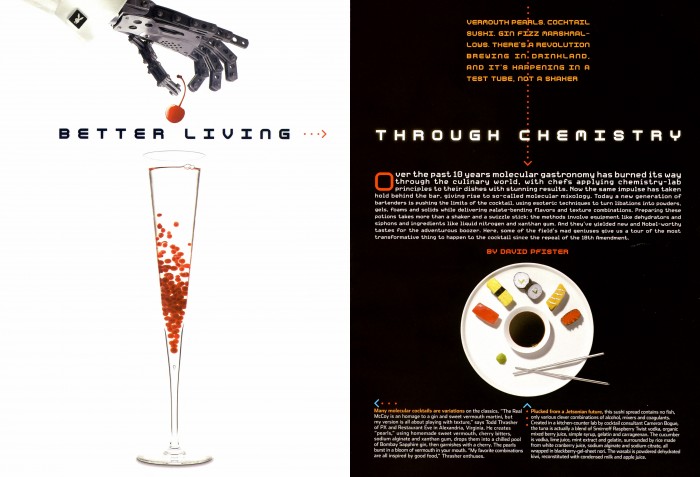
Many molecular cocktails are variations on the classics. "The Real McCoy is an homage to a gin and sweet vermouth martini, but my version is all about playing with texture," says Todd Thrasher of PX and Restaurant Eve in Alexandria, Virginia. He creates "pearls," using homemade sweet vermouth, cherry bitters, sodium alginate and xanthan gum, drops them into a chilled pool of Bombay Sapphire gin, then garnishes with a cherry. The pearls burst in a bloom of vermouth in your mouth. "My favorite combinations are all inspired by good food," Thrasher enthuses.
Plucked from a Jetsonian future, this sushi spread contains no fish, only various clever combinations of alcohol, mixers and coagulants. Created in a kitchen-counter lab by cocktail consultant Cameron Bogue, the tuna is actually a blend of Smirnoff Raspberry Twist vodka, organic mixed berry juice, simple syrup, gelatin and carrageenan. The cucumber is vodka, lime juice, mint extract and gelatin, surrounded by rice made from white cranberry juice, sodium alginate and sodium citrate, all wrapped in blackberry-gel-sheet nori. The wasabi is powdered dehydrated kiwi, reconstituted with condensed milk and apple juice.
To some degree, molecular mixology is about showmanship. For his Carnival Car, a riff on the sidecar, Jamie Boudreau of Seattle's Vessel pours an Armagnac, Benedictine, maraschino and lemon-juice mixture over truffled cotton candy stuffed into a glass rimmed with Amaro Nonino liqueur dust. Boudreau assures us that despite appearances the drink is well-balanced and not overly sweet. "You need an understanding of ingredients and how they work together," he says. "The Amaro rim lends a bitter twist, and I've always found truffles work delightfully with Armagnac."
Though Eben Freeman prefers the title of bartender over mixologist, he's among the most obsessively experimental of the new bar stars. His Flight of Solids [above], created for the recently opened New York molecular hot spot Tailor, betrays a penchant for playing with states of matter. "It's fun to figure out how to turn solids into liquids and vice versa," he explains. From left, we have gin-and-tonic jelly served on a lime chip, White Russian cereal replete with Kahlua-dredged Rice Krispies and a Ramos gin fizz marshmallow made with gin, lemon and lime juices, whipped egg whites, sugar, juniper berries and gelatin.
Among the world's most innovative and well-known molecular bartenders, Eben Klemm has a science degree from Cornell, and he put it to good use when creating the wholly original Earth cocktail for Fiamma in New York City. The concoction consists of Averna liqueur, 10 Cane rum, lemon juice, simple syrup and beet juice. The drink's molecular hook lies in the dust of a dehydrated dark and stormy cocktail, which rims the glass. You can actually make this one at home; the only extra piece of equipment you'll need is a fruit dehydrator. Go to playboy.com/magazine for the recipe.
Extreme freezing is a common technique in molecular mixology.
Antoine Biccherai of Barton G. in Miami Beach uses liquid nitrogen to prepare a frozen Absolut Vanilia vodka ice pop on a rosebud's stem as the base for his Sin-sation. When the -320-degree vodka hits a glass full of rose-petal nectar, the reaction causes the cocktail to fog like dry ice. He then tops the froth with champagne. While dramatic, the Sin-sation is also exceptionally practical. As Biccherai explains, "Frozen vodka lets you keep the drink cold without ice, so it never gets watered down. In fact, it gets stronger."
UERmOUTH PEflRLS. COCHTRIL SUSHI. Gin FIZZ F1FIRSHF1RL-LOUS. THERE'S !r REUOLUTIOn
nnD its HRRPEninG in n
TEST TUBE. HOT R SHRHER

