The Cook
March, 2008
Failure to please the American palate can be deadly
My mother joined the Peace Corps for many reasons. The first of these was because she had suffered in this world, hated her family. Not only did she want to be as far away from them as possible, but she also wanted to punish them with her good acts. But more dian diat, she wanted to see the world in a way she otherwise couldn't afford to and help people less fortunate than she was, even though she felt keenly that she had grown up poor.
My mother was full of stories. There were some that she liked to tell, and others that she did not. She did not like to talk about growing up in Detroit, about the man who had come into her darkened room. But the stories from her time in India were always dancing in my mother's head. Of men on crowded buses who licked her neck, of jumping out of bathroom windows in funny hats with Lenore to escape the
advances of the rich Parsi bankers who wined and dined them. A tale or two from her time before India when she worked in the Baby Ruth factory made her happy. But she always returned to India in her stories, as though through recounting them, she could take herself back there.
A story that made her both happy and sad came from early on in her service in India. Before she arrived in Chikmagalur,
when she was still filled with dreams about making a difference in the world, she had been stationed in a small town in Karnataka, named Hassan. Not far from town was an ancient temple complex called Halebid on a high hill in the forest, and the Halebid temple was seldom visited then, except for Hindu Brahman priests who made offerings in it now and again. Every foot of its acre of black stone was covered with
friezes of dancing girls, and in the great hall was a polished black granite Nandi bull. When the priests were there in their dhotis, they would burn incense and pray to the reclining Nandi.
Hassan was not far from Chikmagalur. where my mother would go on to ride an iron bicycle through the streets for 22 months, teaching untouchable women in the shantytown how to build smokeless ovens so they would not die of lung cancer at the age of 40. The untouchable women would call her Shanti, which means "peace" in Hindi, because they could not pronounce her American name. And that was how my mother would see herself on her headiest days in Chikmagalur, as peace embodied, riding her bicycle, the wind and scents of the flowering trees in her hair.
But before anything ever happened to her in Chikmagalur, my mother was stationed in Hassan with Lenore and a young man named Peter Merchant. Peter had a cot under a mosquito net in one bedroom of their house, and my mother and Lenore had their cots under mosquito nets in the other. They'd onlyjust arrived in India, were coming to terms with the fact that not anything of India was anything like that mock village on the Stockbridge-Munsee Indian Reservation in northern Wisconsin, where they'd done their field training. Who in the world had come up with that idea?
This was the delicate time when many of the volunteers quit and went home in a state of shock about the reality of the world and their limitations in it that they'd never really shake again, and understanding this, the Peace Corps didn't expect the ones who stayed to start projects right away but to simply get used to the heat and poverty, the dust and noise, the languages and latrines, and the psychological burden of being the center of attention.
My mother found that she didn't mind the people's stares, their endless waves and whistles and aggressive invitations to tea. Even their rough hands on her skin when they'd snatch touches of her arms as she moved through the cramped stalls of the Hassan market those first days didn't make her angry. In fact the opposite was often true, the attention elated her. Yes, she couldn't get the damned sari to fit right. The way it kept falling off her shoulder made her have to all but completely redress herself in the middle of the road every 10 feet while half the town folded their arms to grin and watch the show that she was. And no, she didn't think she'd ever get used to the roaches on the walls of the latrine. And yes, the way that some of the men hissed at her was in fact rude. But that girl with the mole on her lip and hold-
ing on her lap the child with the long lashes in the market had smiled at her the day before, and here she was smiling again. "Is this your daughter?" "No, madame. My auntie's daughter." "She's very pretty." "Madame, my auntie will thank you."
Peter and Lenore were different. The heat, the dust, the chaos and danger of the rickshaws banging over the broken streets like racing chariots, the donkey carts, the horned and humpbacked cattle, the smoke-belching Ambassador cars, the ratty and cute beggar children dashing through all these things. The men urinating on the side of the road, smiling and waving even as they did. The men clearing their nostrils with hearty blasts. A woman with an empty eye socket. An emaciated old man moving a pile of stones 10 feet up the road rock by rock, crossing the countryside in his death poop. Bedbugs in the bed-
rooms, rats in the rafters, mangy dogs in the yard, roaches everywhere. All of those people. All of those staring people. So Peter and Lenore took to leaving the house as little as possible, and my mother brought provisions back for them from the market.
They had an Indian cook who lived in their courtyard shed, prepared their meals, a low-caste Hindu named Krishna Arjuna, or was it Rama Krishna? None of them could ever remember, and my mother and Lenore were altruistic Midwestern girls, and Peter had graduated from the University of Virginia with a degree in engineering. This was late 1966, and though my mother and Lenore both wanted to talk about Vietnam with him, the one time my mother found the words coming out of her mouth, "Did you join in case they start up the draft, Pete?" he"d looked at her with such a quickness that she understood that he had. He was a tall boy, blond, not ugly by any means, save for a fullness to his cheeks that made him seem heavier than he really was. They had been drinking Kingfishers by hurricane lamp on their porch in the night when she'd said it. Why had she said that when she'd already known? Peter shook his head, looked at my mother and said, "Fuck you, Denise."
Peter had gone into his room that time, and Lenore had raised her eye-
brows at my mother. Though they were on speaking terms again in a few days as they had to be in those conditions, my mother and Peter both knew, even as they had before, that they were people who would never be friends.
Though my mother was falling for India at that time, when she was honest with herself, there were moments when she hated it. Sometimes she wanted to shout at all of them, "Aren't you ever going to get used to me?" and she quickly learned to ignore the beggars. If she gave money to even one of them, she'd be besieged by a horde of them the rest of the day. Even when she didn't give money to anyone, someone was always there, at every simple transaction she made in the market for bread, for candles, a filthy hungry wretched person just paces away, holding out their hand, trying to shift into her vision, their mouth moving as though they were asleep in it, "Ek rupee. Ek rupee, madame. Ek rupee. Ek rupee, madame." It got so that an old man with stumps for arms and a pail hanging from one of them, who followed her from the market all the way up the road to the house in the functionaries' quarter where they lived and, bleating that refrain like a lamb, couldn't get a paisa out of her when even she knew she had a fistful of them. When the grubby kids of the poorest of the poor ran out from the tent village along the railroad tracks where the working poor of the shanty-town went to shit, she'd yell in Kan-nada, "Don't soil my clothing." In her first days there, she had picked those children up. Even now if she looked at their faces, it was hard, but as my mother did or didn't realize at that time, falling in love with India required being careful about what you looked at.
Lenore listened to my mother's catalog of sights at night before bed. In the dark of their room with their nets around them like curtains, my mother would talk about going into the shan-tytown, what the shanties were like inside, how they were cleaner than she'd imagined, how they were decorated with pictures of Bombay film stars salvaged from scraps of newspaper, how the women put on their bindis and combed their hair in small shards of mirror. About conversations she'd had in the town, at the bus stand. "Would madame dare to ride up here?" the young men had called down to her and smiled, perched on the rice sacks lashed to the top of the bus to Belur. "Of course she would," she'd called back. They'd all reached down their hands. And so Lenore would go to sleep with the stories in her head of what lay beyond the door. And more than that, she began to step out into India on my mother's arm, {continued on page 116)
THE COOK
(continued from page 90) and when she was ready to, on her own. The women of Hassan, who had trouble distinguishing between the white women, gave my mother and Lenore nicknames to tell them apart. "You are the one who walks fast," the oldest flower seller poked Lenore in the arm one day and said in Kannada. and then she turned to my mother and told her, "And you are the one who walks slow."
"What did she say?" Lenore asked my mother, and my mother said, "That your hair is the color of amber, and my hair is the color of gold."
Lenore and my mother hired a motor rickshaw to take them out to the temple complex now and again, which was wonderful. Not only was the temple itself beautiful with its rows of slender columns, that reclining bull and all those dancing girls, but also there were usually no other people there. In the open-air halls where living apsaras had long ago danced for their priests, my mother and Lenore modeled their arms like the lines of those in the friezes. Then they'd tilt their hips and stamp their feet as they'd seen the women do in the Hindi movies. Sometimes they would mimic the latest overwrought love scene between the star-crossed young film couple, with my mother playing the man and Lenore the woman, and my mother would dip Lenore in her arms and say in a deep voice in Hindi, "Kya turn mujht pyar karte ho?" and Lenore would say back in English, "And I too...for me nothing will remain without you but only death," and throw her arm across her forehead in anguish. Then my mother would release her and they would dance again around that room. Then just Lenore would dance, throwing her arms up to the heavens as though being soaked in a deluge, which she really would have been in the movie, the see-through-wet-sari scene a requisite part of every Hindi film.
Whether they knew it or not, these dances, this change in culture, was revealing to both of them things about their bodies they had not known in America. After another of these silly dances in the temple, my mother and Lenore fell laughing into each other's arms. They gave themselves up to the laughter, let their eyes tear from it, and then they went and sat on the temple steps and looked down the hill and over the forest in their saris. The sky was overcast and brooding, and they could see rain falling in curtains here and there in the distance. The clamor of the town they now lived in felt like a faraway thing. The laughter passed from them the way it had come, and then they sat quietly.
My mother imagined the wet town in her mind, the thronging people in it. But even in this distant mood she could still imagine the color of the flowers in its market. She said, "No matter how much I like parts of it, sometimes it is incredibly difficult to be here."
Lenore looked at my mother's face. "Denise, don't you know how hard it's been for me every day?"
"The men can be awful."
"I hate it when they hiss."
"What do they think we'll do when they do that?" my mother said and shook her head. "That they'll hiss at us and we'll suddenly go and sleep with them? If that's all it took, then that's all we'd be doing our whole time here."
"Sometimes I catch a man looking at me, and I know he would pay me for it if he could."
"The whole town together couldn't afford my fee."
Lenore squeezed my mother's arm, smiled. Then she laid her head on my mother's shoulder, and my mother petted her hair.
"I am so lonely here, Denise," Lenore said.
"You've done so good, Lenore."
"I have something to tell you."
"What is it?" my mother said.
"What would you say if I told you that I've been thinking about sleeping with Peter?"
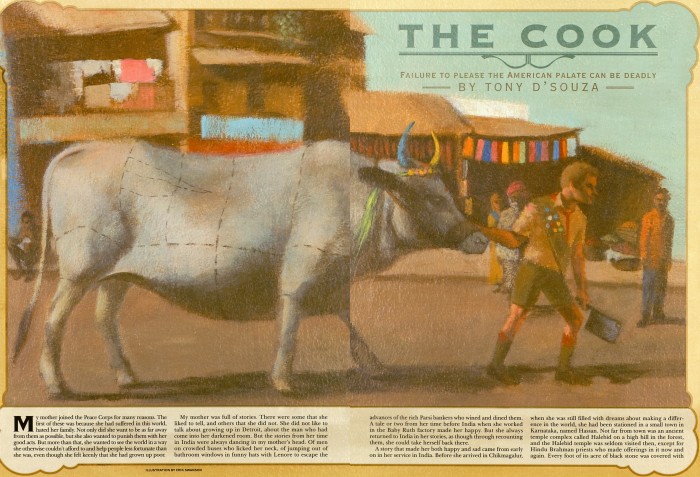
Peter Merchant, aside from the many other things he was or wasn't, was an Eagle Scout. He'd brought the uniform with him, and the morning after my mother's comment about Vietnam, he came out of his room wearing it. It was covered in badges and beads and all of that stuff, and he wore the shorts, loo. My mother understood when she saw him in it that it had to do with what she'd said. She looked at him, noted what he was wearing and left for the market. If Peter had gotten whatever satisfaction he'd thought he needed to get by dressing up in that outfit, my mother didn't care. If it wasn't for the Peace Corps, she would never have had to meet this person.
But Peter and his uniform wasn't just about my mother. It was also about his developing relationship with India. India did not do much to meet Peter on his terms, and Peter did not do much to meet India on its. He hated being touched by the people, and few were the times he attempted to go to the market that he didn't deal out a handful of shoves. Peter was also the tallest man in town. People followed him and laughed, and in the evening crowds, men lifted small children to their shoulders to point him out.
"Indians don't have a fully developed
sense of respect," Peter complained to Lenore as they ate peanuts and drank away another evening on their enclosed courtyard in the early days. "What you've got to understand is that this is a caste culture that is thousands and thousands of years old. They've had these low-self-esteem characteristics ingrained in them all of that time. Can't you see how the Indians have created their own conditions? At home, I thought it was because of the shortage of teachers. Now I think it's more than that."
Walking among the Indians was slow and hideous, a pothole every two feet, an endless minefield of cow dung and paan spit. Had anyone ever heard of a traffic light? How about a stop sign? Every little task in India that required only one guy to do back home here took 20; three guys to turn the tire iron and 17 to look on and shout advice, and then Peter would walk by and they'd drop what they were doing to clap and laugh. The truck they were working on was so trashed anyway it should have been unfit to drive. All he had come here to do was help these people. But who could help people like this?
It wasn't long before Peter subjected himself to the torture of haggling for a bicycle. And what a torture it was. When he'd asked the merchant, "How much for that bike? " the merchant had clapped a boy on the side of the head and sent him to bring back tea.
"Sit down, my friend," the merchant had said and smiled, patting a dirty stack of newspapers in the corner of the crowded bicycle shop.
"Can't you just tell me the price?" "That is what we are going to find out." But Peter had enjoyed a bit of emotional respite later as he zipped through the town, the breeze soothing his anger at the bike seller's skillful separation of him and much too much of his money. When my mother saw him on that bike for the first time, standing up to pedal, ringing his bell, kicking a cow out of the way as he whirled by her in her sari in the market in a blur, she, as with everyone around her. felt her eyes drawn to him. What a spectacular thing that big white man was. Going that fast. Kicking that cow. And it became more spectacular yet, because Peter started wearing his uniform.
My mother said to Lenore at the temple, "Why would you ever want to sleep with Peter Merchant?"
"I feel sorry for him. He's nice to me. We talk together. I know he's awful, but I can't help it. All of these things aren't as easy for us as they are for you."
My modier smiled. "It's like what Steve Stewart said to me in Wisconsin. 'Are you attracted to any of the girls here?' I asked
him, and he said, 'Yes, whoever will be stationed closest to me.' You only need to go into Peter's room, Lenore."
"Sometimes I think I might do that."
It was at this time Peter demanded that the cook, Krishna Arjuna or Rama Krishna, a Hindu name like that, prepare American food for them. Though she hadn't been sure of his name at the time, my mother would be able to conjure the cook's face in her mind for the rest of her life. The nose so veined and bulbous, it looked like it would ooze blood if touched. The thick hair like wool. The pockmarks sprinkled across his cheeks like freckles. He was a head shorter than the shortest of them, thin with a fat potbelly. He would flash a quick and betel-nut-stained smile when they'd compliment his green-coconut chutneys, his thick lentil dais. But the cook was otherwise shy. My mother knew these few things about him: He was Malayali from Kerala, he had been married for a long time, he had a wife and many children in his natal village in the mountains. Who had he been?
Peter in his Eagle Scout uniform had begun to swerve at dogs, to scatter groups of children with his bicycle. One afternoon, after coming back from the market, he went into the courtyard and dressed down the cook in English. He wagged his finger. His anger made his face turn red. The Indian's cooking was the reason why Peter hadn't had a solid bowel movement since the first moment he'd been here. It was the reason why all of them were always sick. How many times had they told him not to make the
food that spicy? Did he think they were kidding? Was he trying to poison them?
Peter said, "From now on, you will cook only American food for us. I've been in the market. Don't tell me that the ingredients aren't there, as I know you'll try to do," and the cook saluted the American in his Eagle Scout uniform and said, "Yes, sir!" Which was what Peter needed from him and the old man gave him.
What followed were some funny days with Peter spending the better part of them teaching the cook how to make American food in the courtyard. The blond American in his patches and tight shorts dripped sweat from his chin as he stood over the cook on his stool. The Indian peeled potatoes for french fries, mixed flour and water for pancakes with his fingers, which Peter had made him wash twice with soap, and glanced up again and again as though to ask if he were getting it right when he knew he couldn't possibly be. The scene looked to my mother, as she smoked and watched from the porch, like an organ-grinder training his monkey. Why had she thought it okay then to let Peter do that?
And then there was the ultimate thing of all, hamburgers, with the buns trimmed from the centers of thick chapatis and fried, and the meat minced fine with a knife on the cutting board and rolled into patties. The cook had never touched meat before. He had to stop in the mincing now and again to stifle his gags. What could Peter do but fold his arms and sigh? He'd take a break from his frustrations with the cook to do something inside the house, and every time that he did, the cook mixed spices into
the meat. Then Peter would come back to taste what the cook had grilled, and he'd scowl and say, "Didn't I tell you no? Why can't you get that simple thing through your thick Indian skull? No spices. Not in American food," and take the spiced meat and throw it over the gate to the waiting dogs. The dogs had never known such luck or gluttony as they snarled and snapped over the meat in their scrawny pack.
My mother sat on the porch in her sari with Lenore all of that time, fatigued from the heat of the day, watching what was going on with a mixture of amusement and abhorrence. She'd fan herself with a folded sheet of the day's Hindu newspaper, wanting to step in and stop it, yes, but also wondering how it would all turn out. She was eager despite herself to eat food from home. She and Lenore smoked cigarettes and drank Kingfisher beers that were cold from their butane refrigerator, and while she felt bad for the old man, she felt that Peter, no matter how much she disagreed with his choices, had as much of a right to live here in his way as she did hers. The pancakes and burgers they would eventually eat resembled food from home in only a tangential way, translated by a boy in an Eagle Scout uniform to a Hindu in a lungi in impatient English, a language the cook could manage only on his best of days. It was entertaining, and it was frightening. Look at what India could do to people.
Peter, in his struggles there, had unwittingly turned the old man into his symbol for the whole of India. Though India was a thing he could not control, the old man was something that he could. My mother understood this even as she watched it happen. Maybe it was the strange slowness of this new monsoon season, her first there, its foreboding gray sky, the way it muted the colors of the flowers, the colors of the extravagant fruits piled in the market, even the women's saris, the painted horns of the cattle, the yellow-and-green rickshaws with their slogans about Clod's benevolence stenciled on them in Hindi, everything muted and made small again. But too, it was my mother's time to settle herself in India, to sleep and wake in it under her mosquito netting, to discover again and again each morning that she really was here, and to let who she'd been at home recede into her memory. My mother herself had become muled in the monsoon, didn't anymore know who she was, if she ever had, or why she was really here or what would come of any of it. Nothing she knew was simple any longer. Peter demanded that the cook prepare American food, and my mother didn't say anything. So the rain fell in its first sprinkles in the late afternoon on the coals of the old man's grill, and the coals turned the rain to steam, and then the cook would carry the grill by its handles into the covered shed of the kitchen, and Peter would stand over him, wagging his finger to make sure he got it right.
"Don't you want to say something to him, Denise?" Lenore would say to my mother in the dark of their room at night, the sound of the crickets and the last oxcarts' bells as their drivers whipped them home coming to them from outside after the end of the rain.
"Peter will have his India, and we will have ours."
"I don't want to sleep with him anymore."
"Don't you?"
"Well, yes and no. I want to be touched by somebody is the thing."
"Then you'll be touched by somebody soon. Personally, I hope it's not Peter. But we are friends now. Even if it is him, our friendship won't be hurt by it."
As she turned on her side under her netting, my mother understood that she really was Lenore's friend. Peace Corps was a strange thing like that. It exposed her to all of these Americans she wouldn't have otherwise met. Certainly, they didn't live in the world as she would have wanted them to, but they were also here with her. It was more now with Lenore than just making do. Lenore was the only person in the world who would ever take these
first steps into this new life with her.
My mother walked all through Hassan in the mornings before the afternoon rains. The women in the market had finally graduated from calling her "the one who walks slow" to calling her Shanti, the first word of her organization's title, which she translated to them into Hindi to explain her presence there. How the name brought the blood up under her skin! Of the three of them, she spent the most time outside the compound by far, and wandering in the busy market, or into the shantytown of the working poor where children took her fingers to lead her to their families' shacks where she'd stand with them in the low doorways to smile down at their mothers over their pots; she also smiled at the idea that she was Peace stopping by to look in. Even then she knew that India would become the singular event of her life.
The old cook stopped my mother one afternoon as she walked through the courtyard to her room. She'd just come back from another one of her aimless walks through the town, through the rice paddies of its outskirts where the thin men in lungi.s whipped buffaloes to pull the plows until the paddies' wet
clods were churned to a soupy muck for the planting, and she'd seen a handful of new things that the others hadn't: a mendicant with a long beard tving a red string around the trunk of a flowering jacaranda in pooja, a troop of verve! monkeys at the main temple peeling and eating the bananas left at the feet of the statue of Lord Vishnu by worshippers in the alcove inside. Her ankles were splattered with mud from the road, and she was sweaty and weary. The old man had never really spoken to her before. But this day, he hurried across the courtvard to her, took her hands in his and said. "1 know the women call you Shanti-devi. You are the one becoming like us. Also more than us. Always will you be more because you are white. But you must help me. Peter is hating how I cook. He wants what I cannot do. You must come to my side. Tell him my cooking is good. Even if you feel I am stupid, you must aid me, Shanti-devi."
My mother said to him, "If I say anything to Peter, it will become worse. Peter has his way. Listen to him and do your best. Peter has no real authority over you, my uncle. If he did, you would not still be here."
"I am afraid, Shanti-devi. I do not know Trench fries.' I do not know 'pancakes.' Even now, I cannot cleanse my hands from the touching of the meat."
"No matter what Peter says, as long as I am here, you will have a job with us."
"I not sleeping. I must not lose this job. For myself, yes, but for my family also. This job does not exist. I sit at your feet. I am your very own child. How can it not be so? Without this job, I have nothing. The minister gave this job only because the low-caste reforms have come. Afterward, he will give it to someone close to him. I hold this job in my hands like water only. Protect me, Shanti-devi. I am your child."
My mother nodded and the cook pressed his hands together to thank her and let her go. My mother could not yet know what that conversation had really meant, the commitment she'd made to him in it. Her growing love for India was as colorful as the saris she was wearing more comfortably every day, but as she enjoyed the fall of the rain from the porch with Lenore, smoked cigarettes in it, my mother thought she could take a break from India, too, when she needed. That she was happy and existing here was enough for now. As she went on letting Peter drill the old man in American cooking, my mother only felt that she would soon enough leave this starting place to begin her real life on her own in India. Things like Peter and the cook would matter more then. That time was not yet.
What happened was this: The old man had always been a heavy drinker. Now with the red-faced American yelling at him at every turn, he felt that his livelihood was in jeopardy. After the Americans went to bed, he assuaged his fears by pouring fenny down his gullet. Night after night, week alter week. This new and heavier drinking ate into his savings, which made him ever more fearful, and so he spent even more time drunk than he had before. That he was a drunk they all knew. But his drinking at night hadn't seemed to infringe on his cooking.
One night, the smell of the meat again on his hands and feeling very far from his religion, from the family in the mountains he was working to send money to but hadn't in a long while now, the cook sat on his stool in the kitchen shed and drank a bottle of the strongest fenny to the light of the last coals in the grill.
He had done his best to cook American food, hadn't he? Still the American man in his uniform had nothing but scorn for him. He had done a fine job, he was a fine preparer of food. But what were these things, french fries, they wanted from him, what was this horrible hamburger? If his wife only knew what he had to deal with in these people, she would understand why he had not sent money. The leering face of the American above him was as terrible as a rak-
shasa. The American clearly hated him. He had even supined himself before the one called Shanti-devi, and while she had promised she would help him, she had done nothing. She must hate him too. What could he possibly do now to please that angry man? He needed this job as sorely as he had ever needed anything. Why was this what life was like? Why couldn't the American see that he was only doing his best? The cook poured fenny into his mouth. He wiped his chin on his wrist, again doused his troubles with more of it. All of that meat. How could they eat it? How could he have touched that meat for them? Only fenny could make life bearable. One knew that there really were gods in heaven, because the gods had given man fenny. And what could one do but laugh now, because fenny made even the red-faced American wagging his finger and shouting at him seem funny. Like the face of a white cow. An angry white cow's face yelling at him. Had he ever imagined that such a ridiculous thing would happen to him in this life?
The cook's heart palpitated six quick times as though he were trying to run up steps, and he pressed his hands to his sternum as he realized his heart really was a thing in his chest. Then it pounded one large time, and the pain of it rolled him off of his stool so that he could see the stars, which the clouds had parted to reveal. The cook remarked to himself how nice it was that he could see the stars in their thousands at this monsoon time of year, and the stars were beautiful, and their beauty made him happy. But also, his heart was not supposed to be doing what it was doing. The stone of the courtyard felt pleasant and warm under him, even though he knew he wasn't supposed to be lying on it. He thought of his job and his wife and the children and every beloved thing that made him necessary in this world. Then his heart beat one huge last time, and the cook was dead.
My mother came out in the early morning to see Peter and Lenore standing over the cook. The cook was clearly dead, his tongue hanging out of his mouth as though he'd been strangled. A single fly worried his nose, crawling in and out of his nostrils, a busy black bug. My mother looked up at the sky. The sky would be blue soon, a hot and clear morning before the rainy afternoon. Peter touched his sandaled foot to the cook's puff of hair. He said, "No more french fries."
Peter said, "He did this just to spite us. Now die police are going to come here and cause a big stink, and we're going to have Indians poking through all of our things and in our house, and they are going to think up some reason why we have to give them money. They'll talk about all of his kids and how we have to give them money, too. Maybe if he wasn't determined to
drink himself to death, he could have had a better job. A better life. And how hard was it not to burn a fucking pancake?"
My mother and Lenore watched as Peter picked up what remained of the bottle of fenny, screwed the cap on it. Then he pushed the cook's tongue into his mouth, closed the mouth with a pat of his hand and lifted the body from the ground to hold it on his shoulder like a child. The cook's lungi fell open to reveal his thin and pale legs. Lenore dropped her hands from her mouth to rush to Peter and fix that.
All around them in their courtyard, the light was rising. My mother looked at the stool under the tin shed where the cook had drunk away his last night. At home, they would have thought that stool was a toy, something for a child to play with. The cook's bed in the corner was a single sheet over a bare foam pad. The butane burner on the table, the pots and pans of the cooking stacked around it. The sacks of onions and potatoes against the wall, the big bags of rice in a tidy pile. The kitchen shed was as cluttered as a junk shop. This man had lived there. The birds in their breadfruit tree began to awaken and chirp. India had been right here all this time.
Peter lifted the latch on the big steel doors that kept their courtyard concealed from the road, banged through them with the cook on his shoulder. He carried the body through the town toward the bus stand. There were only the first morning people about, the fishmonger pushing his buckets of mackerel on a cart, the rickshaw drivers stretching and yawning as they stood from sleeping on the seats of their machines, the tea vendors with their clay cups and thermoses letting up the first sharp calls for "Chai! Chai! Chat!" and from the Muslim quarter on the other side of town came the muezzin's mournful and operatic "Allahu akbar" like an old man practicing scales. But even these few people's mouths dropped open at the sight of the tall white man carrying an Indian in a lungi on his shoulder. Peter explained it by holding up the bottle of fenny. "Ah," these people nodded and spit. The man was drunk. The white man's servant. The cook most certainly. Who didn't know a cook who wasn't also a drunk? Not anymore of that good living for this one. Things would be hard at first when he woke up, and then he would go to this cousin or that and find some new job, the way
that people always did. Maybe the next time, he would know better than to be a drunk. Even the rickshaw drivers knew that he wouldn't.
At the bus stand. Peter showed the bottle to the ticket wallah in his uniform. He'd had enough of this cook's drunkenness, he explained, was sending the man home to his family in Mangalore. Then he handed over the fare.
"I'm going to put some money in the pocket of his shirt," Peter said as he looked at the ticket wallah's steel badge. "Tell him it's in there when he wakes up. Then he can't say that I don't have a heart. But why should I have to stand for this sort of drunkenness?"
Peter carried the cook's body up the steps of the idling bus to Mangalore. There was half an hour yet before it departed, plenty of time for a drunk old man to have a heart attack in his sleep. He arranged the cook's face against the window, set the bottle against the wall of the bus beside him, put two 50-rupee notes in the pocket of his shin. The ticket wallah had that money in his own pocket moments after Peter left, just as Peter had known he would. The ticket wallah tilted his hat on his head, smoothed down the creases of his shirt, and his mustache twitched under his nose as he thought about his luck. Then he sat back down at his desk in the office, and his mind went on to other things.
Back at the house, my mother was throwing up in the latrine, Lenore was drinking and smoking, and Peter went into his room and began a letter to his father in Virginia. "Dad," the letter opened, "India is the most fucked-up place on earth."
Over at the bus stand, the seven am. to Mangalore began to fill with people. Fat women in orange saris pulled children in trains through the aisle, looking for their seats. Old men in pandit hats clutched their folded umbrellas and sat up front. Three young men with pomade in their hair were on their way to Goa. A middle-aged man in a worn-out suit looked at his wristwatch to see about the time. Parcels and rice sacks and chickens in crates surrounded the bus on every side. Four bicycles. Hands of green bananas in a pile. Even a full-size refrigerator. Every single one of those things would be lifted to the top of the bus. The men who would do the lifting were bare-chested harijans, their hair thick and woolly, their bodies lean and black. They themselves would ride to Mangalore perched on top of the bus for their labor and half the fare.
People were traveling for all sorts of reasons, for weddings and funerals, of course, but also to place land-rights claims before the magistrate, to have a hemorrhoid looked at by a specialist, to search for an overdue husband, and the cook was traveling because he was dead. The woman who sat down beside the body of the cook chose to sit
there precisely because the young men traveling to C'.oa had held up a rum bottle and hissed at her to come back to them. She was still nursing her very-first child, and her breasts were swollen with milk. Next to the body of the cook, she pulled her green sari tightly around herself, sighed and settled her sleeping child on her lap. She looked out the window. A yellow clog humped a black bitch in the yard. Wasn't that the way of this world? Another one was growing inside her too. But it would be nice to sit beside her mother in the kitchen eating jackfruit in Mangalore. pomegranates fresh from the tree, as it had come again time to do. Her cousin would take her on his motorbike to set her feet in the ocean.
The refrigerator was lashed on the middle of the roof, the last packages were lifted up and lashed down before it, the harijans sat in a pile at the end, and the thin driver came aboard and switched on the music. The music was Hindi and loud and would play all through the nine-hour ride. They would make two stops to piss and eat. Then the well-to-do would announce themselves to the poor, because the well-to-do would eat curries with their Fingers in the roadside restaurants, while the poor would crouch under trees outside and not eat. The bus lurched out of the station, crammed with humans beings inside and out, 10 of them lactating, almost all of them breathing, and a beautiful young mother with one child on her lap, another in her womb and the biggest set of cans in Hassan became instantly drowsy from the motion of the bus. When she woke from time to time with a start, she found she'd been sleeping on the shoulder of a kind old
man who alone among these people didn't seem lo mind.
Peter spent two nights in the Hassan jail. Neither my mother nor Lenore brought him any food, which meant something real, since prisoners at that time in India weren't fed by the state but by their families. Then Peter was transferred in handcuffs to Bangalore. A crowd formed from the gate of the jail to the police car, a black Ambassador with a blue light whirling on top of it. The police led Peter through the gauntlet of the crowd, and the people spat at his feet, and somebody got him across the face with a banana peel. But mostly they had only come to look. What kind of man put a dead body on a bus like a piece of trash? Here was the man. A man like this.
At the same time that my mother had been crying out the story to the police captain, who demanded, "Is that right? Is that right?" as his eyes widened, a girl on the morning bus to Mangalore covered her head with a fold of her green sari, pulled out her left breast in the tent of it and guided her long nipple into the mouth of her restless child. The bus turned a corner, following the road down out of the mountains, and she leaned heavily against the shoulder of the old man as she did. "Excuse, Uncle," she whispered to him, not loud enough to wake him if he were asleep, and not so quietly that she wouldn't be heard if he wasn't. In front, the driver took a swallow from his vodka bottle to clear his head, set it back down by his boot. Then he stomped the brake and wheeled the bus hard into the next curve. The dead body flopped onto the girl's lap. knocked her child to the floor, looked at her with
one eyelid flapped up and its mouth wide open beneath her fat breast, which dribbled milk into it. But even that wasn't enough. The girl jumped up screaming so her breasts Hopped out from her sari up and down, and the boys going to Goa thanked Jesus, and everyone on the bus. even the driver, turned their heads to see what was going on. But the ones who suffered most were, as always, the harijans up top. who neither got to see that girl's incredible breasts nor understand win they themselves were flying through the air as the driver slammed the brakes at the edge of the ravine, which the bus did not go over but the refrigerator did. taking all those chickens and bananas and rice sacks and wedding and funeral gifts with it. and leaving on the slope it tore down 16 shirtless brown men without an ounce of body lat among them but now plenty of broken bones.
On the bus, the man in the suit stood up and said, "My fridge!"
Peace Corps would foot the bill for that one. And gladly. Because the only man who died that day. as my mother sobbed to the police, had been dead the night before.
The U.S. ambassador along with the Peace Corps country director decided to let Peter spend two more days in the Bangalore prison. Then the ambassador made the necessary phone calls, and Peter flew home to Richmond. My mother and Lenore were pulled from Hassan because its residents had taken to throwing stones at their house as they passed. But not before my mother traveled with the cook's body, in a coffin she had paid for. into the mountains in Kerala to be cremated in his home village. She also paid for the wood of the funeral pyre, as well as lor the Brahman to come from the local temple and consecrate it. Once the Brahman had left, she watched the cook's body blacken and burn in the heat of the flame, and his wife made one symbolic suttee rush to the pyre herself, only to be restrained by a touch of the cook's sister's hand.
"Rama would be honored to know that you came," the wife said to my mother in Malayalam through a man who spoke Knglish. and the man wagged his eyebrows at my mother, smiled in a happy way and said. "Because you are white."
Lenore never did sleep with Peter Merchant. "I hope they let us stay together," Lenore said to my mother as they sat on the bench outside the Peace Corps country director's office in their blouses and jeans in Bombay. Then the director came out in his tie with a clipboard, and he waved my mother in.
"Where do you think you should be stationed next, Denise?"
"Somewhere where there are no Americans."
Falling in love with
India required being careful about what you looked at.

