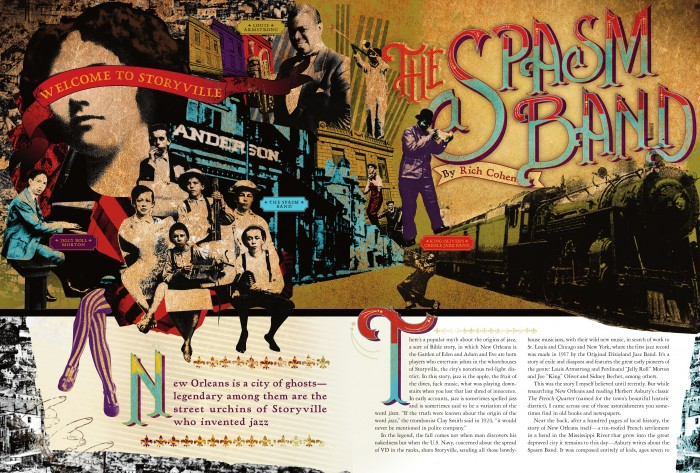
The Spasm Band
May, 2010
here's a popular myth about the origins of jazz, a sort of Bible story, in which New Orleans is the Garden of Eden and Adam and Eve are horn players who entertain Johns in the whorehouses of Storyville, the city's notorious red-light district. In this story, jazz is the apple, the fruit of the dives, fuck music, what was playing downstairs when you lost that last shred of innocence. In early accounts, jazz is sometimes spelled jnss and is sometimes said to be a variation of the word jism. "If the truth were known about the origin of the word jazz" rhe trombonist Clay Smith said in 1924, "it would never be mentioned in polite company."
In the legend, the fall comes not when man discovers his nakedness but when the U.S. Navy, concerned about rhe spread of VD in the ranks, shuts Sroryville, sending all those bawdy-
house musicians, with their wild new music, in search of work to St. Louis and Chicago and New York, where the first jazz record was made in 1917 by the Original Dixieland Jazz Band. It's a story of exile and diaspora and features the great early pioneers of the genre: Louis Armstrong and Ferdinand "Jelly Roll" Morton and Joe "King" Oliver and Sidney Bechet, among others.
This was the story I myself believed until recently. But while researching New Orleans and reading Herbert Asbury's classic The French Quarter (named for the town's beautiful historic district), I came across one of those astonishments you sometimes find in old books and newspapers.
Near the back, after a hundred pages of local history, the story of New Orleans itself—a tin-roofed French settlement in a bend in the Mississippi River that grew into the great depraved city it remains to this day—Asbury writes about the Spasm Band. It was composed entirely of kids, ages seven to
ew Orleans is a city of ghosts— legendary among them are the street urchins of Storyville who invented jaz;2;
11. Pale-skinned, wide-eyed srreet urchins, they were, according ro Asbury, the real inventors of jazz.
The band appeared on the streets of Storyville circa 1895, when the district was booming and the whores stood along the balconies and the virgins came down for the famous Naked Dance. Described by nightlife writers of the time, it amounted to a parade of the youngest girls shimmying through the parlor as the piano player enlivened the festivities. Outside the Spasm Band performed for nickels and dimes, banging our ratty tunes on homemade instruments—a cigar-box violin, pebble-filled gourd, whatever they could build. The singer crooned through an old gas pipe. Standing under a banner that read the razzy dazzy spasm band, they made quite a name. "They played with the horns in hats," writes Asbury, "standing upon their heads and interrupting themselves occasionally with lugubrious howls. In short, they apparently originated practically all of the antics with which the virtuosi of modern jazz provoke the hotcha spirit."
One picture of the band survives. Taken in an old theater in the last days of the century before last, it shows only six of the boys, many of whose real names have been lost, in rank: Chinee; Warm Gravy; Willie Bussey, known as Cajun, and his brother Frank, known as Monk; Charley Stein, who became a famous drummer; Emile Benrod, known as Whiskey; Harry Gregson, who sang but did not sing well; Emile "Stalebread ' Lacoume, who is a legend of New Orleans jazz to this day; and a kid who will forever be known only as Family Haircut.
Around 1900 a group of"
professional musicians, hired to play at a club in the decent part of town, decided to imitate the Spasm Band, going so tar as to copy its billing: Razzy Dazzy Spasm Band. When the kids showed up at the venue, grumbling, with rocks in rheir pockets—this according to Asbury—the manager of the club simply changed the name from Razzy Dazzy Spasm Band to Razzy Dazzy Jazzy Band.
"Thus it began," writes Asbury. "And now look! " Asbury believed that, in these kids, he had stumbled on the real fathers of modern music—it came
nor from Jelly Roll Morton, whose
"Jelly Roll Blues" was published as sheet music in 1915,
not from Louis Arm-
I
strong, who recorded with the Hot Five in Chicago in 1925, but from this ragged I collection of ne'er-| do-well punks.
1 became obsessed with this story. Was this really the first jazz band? I searched out every account, but the evidence was * scarce, so when the weather up north turned cruel, I decided to go to New Orleans to poke around the old dives, talk to some of the people who know the city best and see if I could uncover the true history of the Spasm Band and find the real fathers of jazz.
I went to school in New Orleans, and I love the city and dreamt of it, and in my dreams it is always shaded and tree-lined and the waters have receded and the houses glisten after the rain, and the music pours from the open doors and bars, for of all our cities, New Orleans is the most music-saturated, filled like a sponge; squeeze it and sound comes out—a run of notes, a piano in an empty room at Tipitina's.
I went to see Bruce Raeburn, who heads the Hogan Jazz
Archive ar lulane, the greatest such collection in the world. Raeburn is a bearded man, small and intense, sharp as a note. The son or a big-band leader, he drifted, in his youth, from New York to Los Angeles before finding his way to Lafayette, Louisiana and then to New Orleans, where he too became obsessed with first tilings.
The history of jazz is an underground history, its pioneers being poor and black and thus considered unworthy of notice. As a result most of it is oral history, recorded years hirer, and in studying the early days you sometimes feel as if you are reading the old Norse
sagas. A hundred years back, all recording and photographing stops and all the players turn into legends. When I asked Rae-burn about the origins, he kept referring to the recordings, each containing another version, another story, which together add up to something like the truth. In one, as I said, the music comes from Storyville, where musicians, piano players mostly, set the late-night doings to music, hence jazz's early association with sin. In another, the music starts at the end of the Civil War, when the Confederacy's marching bands ditched their instruments and fled, leaving the bugles and horns to streer urchins, who picked them up and played; in yet another, the music Starrs after Reconstruction, when the Creoles of color, who considered themselves less African than French, were reclassified as Negro and saw rheir neighborhoods turn into slums, where their own studied, traditional music got all mixed up with the rhyrhms that came out of the old slave grounds.
There are as many theories as there are people, but at bottom all these theories point to the same cause: New Orleans, not just what it is but where it is, the terminus, where the river ends. "The American vernacular we (continued on page 111)
SPASM BAND
(continued from page 88) associate with the Mississippi and the heartland in the 19th century, everything from the alligator horse ballads, which is what the flatboat men were known for, and the coonjines of the roustabouts who worked on the riverboats, the blues and the work songs—it all comes here," Raeburn said. "New Orleans is also part of the transatlantic world. As an early site of opera, it predates New York and Boston. Whatever was going on in Europe came here very quickly too, usually by way of Cuba. And it was part of the creolization, the fluidity of identity, the racial ambiguity, that we associate with the Caribbean. It was a fault line. You had the street vendors singing arias. Louis Armstrong in his solos from the 1920s with the Hot Fives, and King Oliver too, they were quoting arias on their horns. Well, where did they get that? From the streets! They heard Italian brass bands, they heard serenading. It all goes back to the eccentric, quirky features here that you didn't find anywhere else."
When I asked about the Spasm Band, Raeburn smiled. "Well, you know, in 1919, the States-Item, one of the papers down here, ran an article that claimed jazz started with the Spasm Band, and that's probably where the old legend comes from," he said before dismissing it as mostly fairy tale. I mean, yes, he said, there is some truth in it; the Spasm Band was real and played early, but it's a mistake to consider Stale-bread Lacoume and his cohorts or any other "white organization" as the founders, because "we know that jazz came out of the black and Creole communities."
I asked Raeburn how the story started, how the Spasm Band was named as the first.
He told me this was a matter of civic pride, the lament of a newspaperman at a moment when jazz was leaving the city and it seemed New Orleans was losing one of its great indigenous creations. In pointing to the old photo, the States-Item writer was like a pilgrim pointing to the ruins of Jerusalem and saying, "You see, this is where it happened, so this is the holy place, the only city that matters."
In fact, "spasm band" was not just the name of one particular set of musicians but the name of a city of kids playing cigar boxes and gourds on the streets of New Orleans. "A lot of bands that we used to call spasm bands played any jobs they could get," Jelly Roll Morton said later. "They did a lot of ad-libbing in ragtime style with different solos in succession, not a regular routine but just as one guy would get tired and let another have the lead. They were always looking for novelty effects to attract the public, and many important things in jazz originated in some guy's crazy idea tried out just for a laugh or to surprise the folks."
In this sense, the legend fails as reportage—the Spasm was not the first—but succeeds as folklore, getting at a greater symbolic truth: The Spasm Band, though one of many, was a stand-in for a generation of kids who expressed the real origins of jazz,
which was not in the ballrooms nor the private houses where music was taught but in the streets, where the vernacular was being remade. The real artistic breakthrough is not, after all, the invention of something new but the translation of something classical into a language that is unexpected and strange. Luisa Tetrazzini singing an adagio from La Traviata is beautiful. That same adagio played by Louis Armstrong on the trumpet is a revolution.
"If there was any one founder of jazz it was probably Charles Bolden, known as Buddy," said Raeburn. "He's the guy the early practitioners talk about in the histories as driving the market to a looser, more rhythmic, sensual, improvised hot sound. He was a cornet player. We know he was active in 1895 and that he played constantly, though he was never recorded. In 1906 he went insane while playing at a Labor Day parade. He was incarcerated in the sanitarium in Jackson, Louisiana the
following year and remained there until 1931, when he died."
John McCusker, a photographer for The Times-Picayune and a historian at work on a biography of pioneering bandleader and trombonist Kid Ory, agreed to take me on a tour. We started in the late afternoon, when the sun was red in the west. For the most part we skirted the French Quarter, peering down streets lined with balconies, wandering through a mist, a storm coming on. Here is the first thing you should know about the tour: It was terrifying. The neighborhoods where jazz was born are the worst in the country: the Seventh Ward, Central City, Treme. Not Chicago bad—Haiti bad. Not gang ridden—gang controlled. Damage on damage, some of it dating from before the hurricane, some of it resulting from the hurricane, some of it coincidental to the hurricane. Runs of abandoned houses, boarded
stores, desolate streets and shotgun shacks glowering in the shadow of the business district, which seems suddenly, with its soaring towers, to hang on the city like evidence of a former prosperity. Many people I spoke to divide local time into epochs, BK and AK, before Katrina and after. The city now feels reduced to essentials, to those either trapped in its broken neighborhoods or committed to and utterly convinced of its greatness.
At one point, as we stopped in Central City near a house once occupied by the great early cornet player and sound innovator King Oliver, McCusker, who is famous for his tours, said, "We're going to park here with two ways out and keep our eyes open and be ready to get going if we see people coming at us." Later, when we stopped in front of the Iberville projects, built on the ruins of Storyville in the 1930s, he said only three original structures were still standing, two sad houses on Basin Street, one of them a fish market and "another house in back, but the sun is heading down, and we're not going in there at night. People wander over from the French Quarter all the time and go in and get capped."
The tour was just me and McCusker in a RAV4, driving site to site, looking at houses that were ghetto a hundred years ago and are still ghetto now. Our first stop was Congo Square, on Rampart, across from the Quarter. The square, part of Louis Armstrong Park, is a stone parade ground where in the early 1800s slaves gathered in tribes and sang songs from the west coast of Africa. "Six blocks that direction, through the French Quarter, is St. Louis Cathedral, the oldest Catholic cathedral in the U.S.," said McCusker. "Now, you can imagine, every Sunday, the white people coming out of that church, with the sound of the church music and the marching bands— because there was an armory over there too—fading behind them as they came over here, toward the sound of the drums, and somewhere, on one of those streets, those two musics ran together and overlapped, and to me, that's the real beginning of jazz."
Next we went to the Eagle Saloon, on South Rampart Street, now just a ho-hum block balanced between the business district and the abyss to the west. The building is boxy and typical old New Orleans, but it is believed to have been the home of the Odd Fellows Hall, one of the many hundreds of
benevolent associations that filled the city. These were like unions—you paid dues and in return received a cemetery plot and a parade to the burial ground. Each association had a band that went to the grounds playing a dirge but came away playing a march, driven by the belief that it's good to honor death but better to love life. These ceremonies were the origin of the jazz funerals that are put on even now, with horn players sending offone of their own by playing, say, "Nearer My God to Thee" going and "Didn't He Ramble" coming back.
The associations threw an annual ball, kicked off by a big parade. The musicians were followed by urchins in spasm bands, known as the second line. When the pros left off, the second line answered with music of its own. This too—how the street responded—was a source of the improvi-sational looseness of jazz.
The Eagle Saloon was the home of Buddy Bolden, who hosted pioneering sessions on the third floor. These began when he stuck his cornet out the window and played a run of notes that, Bolden famously said, "calls my children home."
After Bolden went nuts in 1906, the saloon became the hangout of one of the important early jazz combos, the Eagle Band, fronted by Edward Clem (trumpet) and Frankie Dusen (trombone)—though it's wrong to say fronted, because in those days the musicians played in a row, like suspects in a lineup.
We went to the house where Jelly Roll Morton grew up, at 1443 Frenchmen Street. Jelly Roll, who spoke of himself as the indisputable father of jazz, was a Creole of color. When he was 15 he told his family he had gotten a job in a barrel factory but instead went at night to play piano in a Storyville whorehouse. When his family learned of it, they kicked Jelly Roll out of the house, ensuring that this place-—a wooden battleship of a house, spitting distance from Claiborne, sepia toned in the setting sun— was not where Jelly Roll made a real home but where he was cast out, the respectable world he gave up for his music. In all these places, in fact, the houses and street corners and clubs, it's not presence you feel but absence, that forsakenness of the world left behind.
We went by the home of clarinetist Sidney Bechet, who was as important, in his way, as Armstrong. He was one of the great early soloists, on sax as well as clarinet, and his
sound, which is warm and sultry, is what a lot of people have in mind when they think of jazz. The house is in the Seventh Ward, a sorry sight, gutted by fire and left to rot. There was once a plaque in front, but it has been ripped off and carried away.
As bad as it is, though, in the city, in these blighted neighborhoods, there is still something undeniably majestic about New Orleans. It's not that jazz came from here but all those discordant qualities—poverty and beauty, vibrancy and decay, a dirge going and a march coming back—that made the birth of jazz inevitable. It's a temper and tone you find nowhere else. It's a respite and a change, a vitamin for a nation with a deficiency. It is why, though it's been ruined many times, though it's been invaded and conquered and occupied and flooded and left for dead, it always comes back. It's used by every generation but never used up.
At the end of the tour—by then night had come—we went in search of Kid Ory's house in Central City. We could not get there because roadblocks had been thrown across the streets, but we kept trying, and as we tried we stumbled on an intersection flooded with light, boxed in by white trailers, between which officious-looking men wandered around with clipboards and headsets. I could see a folding chair, a camera and a buffet table piled high with melon.
"What's this?" I asked.
"Ah, they're filming the new show by David Simon, the guy who did The Wire," McCusker told me. "It's about all this, about what happened. It's called Treme." (Treme, one of the oldest neighborhoods in New Orleans, was once home to many of the city's free people of color; it's now a ragged slum.)
And of course this seemed perfect: What began with the Spasm Band, with the waifs inventing a new culture from cast-off debris, ends with long white Hollywood trailers.
The fact is, even when the city seems most forsaken, even when water fills to the crown of its buildings, even when it's washed over by poverty and crime, it remains alluring and alive. The legends of jazzmen and the kids who played at beingjazzmen, each of whom left his imprint, style and struggle, can still be felt and heard in the streets. Though the band has marched away, the music lingers on.

