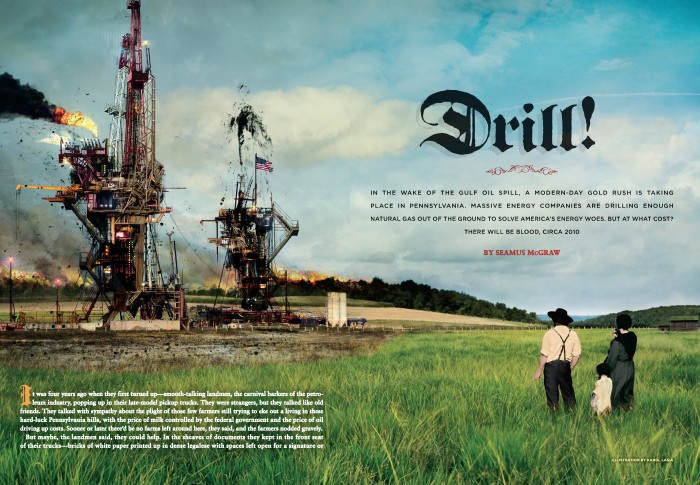
Drill!
August, 2010
IN THE WAKE OF THE GULF OIL SPILL, A MODERN-DAY GOLD RUSH IS TAKING PLACE IN PENNSYLVANIA. MASSIVE ENERGY COMPANIES ARE DRILLING ENOUGH NATURAL GAS OUT OF THE GROUND TO SOLVE AMERICA'S ENERGY WOES. BUT AT WHAT COST?
THERE WILL BE BLOOD, CIRCA 2010
t was four years ago when they first turned op—smooth-talking landmen, the carnival barkers of the petro--leum industry, popping op in their late-model pickup trucks. They were strangers, but they talked like old friends. They talked with sympathy about the plight of those few farmers still trying to eke out a living in these ' hard-lack Pennsylvania hills, with the price of milk controlled by the federal government and the price of oil driving up costs. Sooner or later there'd be no forms left around here, they said, and the formers nodded gravely. But maybe, the landmen said, they could help. In the sheaves of documents they kept in the front seat of their trucks—bricks of white paper printed up in dense legalese with spaces left open for a signature or,
two, a date and a notary's seal—there might be a lifeline.
The way the landmen explained it, some very smart men believed there was natural gas buried beneath these hills, deep down in a stratum of brittle rock called the Marcellus Shale. It was a long shot, but some of these smart men thought they might be able to get that gas out of the ground. If the wells turned out to be as promising as they hoped, well then, as one landman put it, those remaining dairy farmers wouldn't have to feed their cattle anymore: "You could just turn 'em loose and let 'em go."
By 2007 a few of those early wells had struck big—millions of cubic feet of natural gas a day. The smell of money wafted out of these Pennsylvania hills. Within months there were at least 20 players, companies like Chesapeake and Anadarko and, later, multinationals like ExxonMobil and even foreign companies
like Norway's StatoilHydro, all clawing to get a scat at the table for what was shaping up to be the hottest game of Texas Hold'em ever played in the American energy fields. Farms worth very little were being snatched up at incredible prices. The hills' silhouettes were now spiked with huge wells boring into the earth with Texas flags atop, flying in the Pennsylvania breeze. By late 2008, according to a Penn State study, gas and oil companies had gambled S700 million on the Marcellus Shale. A year later it was 10 times that much.
By the time I got my first whiff of the gas rush, the sky was the limit.
The heart of the Marcellus is a 54,000-square-mile shale deposit a mile below the ground that stretches from New York state to northern Kentucky and west from the Catskills to Ohio. Conservative estimates sav it mav
contain enough natural gas to fuel every gas-burning device in the country for decades. And the thickest, richest slice of it all, it turned out, was under the area west of Scranton, sitting beneath the hills that for 40 years have been the place I think of when I think of home.
When the landmen came calling— offering contracts to lease the farm my father and mother had purchased for next to nothing 40 years ago—I expected them. Like many around here, my family faced a choice. What would you do if a gimlet-eyed oilman showed up offering money to lease your land? You could stand to make millions. But at what cost? And to whom?
Natural gas is right now at the forefront of the debate among American energy experts. Men such as T. Boone Pickens are claiming that our own reserves are the
key to getting America off its addiction to foreign oil, that natural gas—which burns twice as cleanly as coal—is the key not just to meeting our power needs but to changing the face of global politics and avoiding future warfare with oil-rich countries that hate us.
"We have abundant natural gas reserves," Pickens has written in this very magazine. "Why don't we use it and get off foreign oil?" According to a recent Financial Times story called "Shale Gas Will Change the World," "we may have discovered a large part of the answer to one of the most vexatious problems in foreign and economic policy: energy security."
The fact is, Americans need their cars, hair dryers, electric toothbrushes and ovens. Energy has to come from somewhere. But have Pickens and others who support drilling for natural gas
domestically thought through the consequences of harnessing its power?
Many who live along the coastal communities of Louisiana, Florida and Texas supported offshore drilling before the nightmare explosion at a British Petroleum rig killed 11 men and let loose what will likely be the worst oil spill in history. As horrible as it was for such a thing to happen 50 miles off the coast, imagine what might happen if something along those lines, even on a much smaller scale, were to occur in the heartland of Appalachia? Or on your own or a neighbor's farm?
For all its benefits, and those are many, there's also peril in the Marcellus. It's an open question which of those will be remembered most. To a large extent, the verdict will depend on the people who live at ground zero of the great gas boom.
The people who live above the Marcellus Shale have always suspected there
might be a great cache of gas under the ground. The farmers, who up until the last generation used whittled divining rods to go witching for water, would sometimes catch a glimpse of gas bubbling up from some underground spring. The coal miners, who lived in constant peril of being blown to bits by a sudden explosion of mine gas, learned to fear it.
By the early 1900s geologists had recognized that the Marcellus Shale was both a capstone and a valuable source for oil and gas. No one gave much thought to capturing the gas—there was no technology available to do it. F.ven if there were, it was assumed, plenty of gas could be gotten easier and cheaper in other places.
But in the late 1990s the gas companies started employing a drilling technique called slick-water fracking. In essence, they pump up to a million gallons of chemically treated (continued on page 118)
Drill!
(continued from page 40) water at astounding pressure—more than 9,000 pounds per square inch—a niile deep to shatter the rock that holds the gas. The gas is captured and shipped by pipeline to your stove.
Within a few short years, shale plays in Oklahoma, Louisiana and Arkansas that had long been regarded as suckers' bets were overrun with landmen, roughnecks and the assorted con men who follow them. Places like Ilaynesville, Louisiana, a town that in 2003 had a population of 2,561 and a median household income of $20,406, were now being mentioned in the same breath as Saudi Arabia. But these places didn't compare to the bounty that lay in the Marcellus.
In spring 2008 I first sat down to discuss the possibility of leasing our family land with the advance guard from Chesapeake Energy, Marshall Casale, a guy with a wrestler's build and an altar boy's smile. When the landmen first came to this county they were offering leases at $25 an acre. Now leases were going for $2,000 an acre. The New York Times quoted one awestruck landowner who summed up the situation: "It's a modern-day gold rush in our own backyard."
Already at the time of our meeting, wells less than five miles northeast of my family farm had churned out millions of cubic feet of gas per day, enough to earn those landowners up to $30,000 a month in royalties (not including the income from leasing tInland). Just a few miles west, Chesapeake was drilling a well that would soon produce 10 million cubic feet a day, a billion dollars' worth of gas in just three months.
I arranged to meet Casale on his tuif, in part to size him up but also to get a sense of what these guys were like in their natural habitat. He asked me to meet him in the motel rm that seized as both his office and his temporary home in the old coal-mining town of Dickson CJty. I found liim sitting at a makesliift desk with a lille on it. Surrounded by stacks of maps and contracts, he waved me in.
In just a couple of months, he told me, he'd leased more than 7,500 acres for Chesapeake, lie pointed the barrel of his rifle at a map of the county, on which the areas colored in orange showed his wins.
"I haven't colored in your mom's place yet," he grinned.
And then his smile faded. Unlike most of the landmen, Casale is a native Pennsylvanian, a guy who seems to understand the instinctive fear that has grown out of this state's troubled history with energy companies. It's a sense deeply ingrained in Pennsylvanians, who were weaned on tales of the boundless avarice of the coal, iron and railroad barons.
My great-grandfather's life was robbed from him in the mines. On my father's side, for nearly three generations everyone worked for next to nothing in the pits while the mine owners got rich. Only a year earlier cousins of mine in Ireland had become national heroes when they took on the Irish government and Royal Dutch Shell to block plans to lay a natural
gas pipeline through their land. They had gone to prison for months before bringing the government and Shell to their knees, at least temporarily. For my meeting with Casale I had driven myself in an old Mercedes rigged to run on used french-fry grease; that'll clue you in to how I feel about energy companies.
For all his bravado, Casale understood, and he confessed he sometimes worried what all this would do to the old farm communities. As desperately as some of the fanners needed money, there was, he said, a danger in it. "I've signed farmers who were sitting there with broken-down equipment, a broken roof, losing money because they wouldn't put a fence up to keep critters out of their corn silo," Casale said. "You go and write them a check and they've got a brand-new tractor and a brand-new Ford truck, and the corn silo's still the same. You know that old adage, the shoemaker's kid doesn't have shoes? I hate to say it, but I see a lot of them worse off than when they started."
Sometimes, he told me, he found himself thinking, I'm killing this county.
And then the grin returned and he was back to talking about how challenging the game had become. When the Marcellus land rush started, just showing up was often enough, he said. All a landman had to do was make an offer and he'd get a signature. But lately landowners had become sawier.
A few days before our meeting, for instance, he was summoned to a remote farm in northern Wyoming County, where the landowner demanded to hear Casale's best offer. It was generous, but the landowner wanted more. Ten times as much. Casale wouldn't budge, but all the same he knew he was going to get the lease. lie was sure of it. "I'll wait a month, drop in. If it takes six months, I'll get him," he says. "Kverylxxly has a price. I'm sitting here cleaning my freaking rifle, and I hate to use this term, but I'm a sniper, man. I'm in there—one meeting, sometimes two—and there's a deal."
From his smile I knew he believed my family would sign and his drill would soon cast its shadow over our old house. I'd been impressed by his honesty. Casale understood: The gas the big boys wanted could do a lot of g


Aside from the potential for environmental disaster, drilling for natural gas scars the land and can in fact destroy it. The decomposing organic material that created the gas also infused the shale that holds it with radioactive thorium and traces of uranium and potassium. As those elements decay they produce radium and radon. Also trapped inside this r
There are other potential thorns in the buried roses as well: arsenic, cobalt, chromium, molybdenum, vanadium.
In some dark reaches of the shale there is hydrogen sulfide. That's another deadly toxin, one that strikes terror in the hearts of miners. In April 1971 in Illinois's Bar-nett Complex Coal Mine, seven men were killed by the stuff.
And then there are the problems that come along with drilling itself.
Less than live miles away from my mother's farm, in the village of Dimock, where intense drilling was under way, there had already been two significant diesel spills. In the months that followed there would be other mishaps. Most of them were minor. Some were not. All of them had been preventable, and yet they hadn't been prevented. I found myself wondering what it would take to make sure these accidents would not be repeated on my mother's precious land if we signed Casale's papers.
Take Ken Ely. I had known Ken, though only slightly, when I was a kid. Back then he was a barrel-chested middle-aged man with a bushy biker mustache and an ever-present plug of chewing tobacco who ran the local service station in the crossroads hamlet of Springville. lie was, he would later say, generally pretty happy. He was also generally pretty broke.
He owned a few acres on the hill outside Dimock, eventually sharing Iris home with his third wife, Emmagene, and a loyal bluetick coonhound he named after his second wife, Crybaby. Ely was skeptical when the gas men showed up, and at first he dismissed them. But eventually he signed on at $25 an acre and about 12.5 percent in royalties on any gas they retrieved. Iwo years later, by the time those few wells on his land came on line, the real riches of the Marcellus had become evident. Some of Ely's neighbors grumbled that they should have held out for better terms (such as the $2,000 an acre we'd been offered). But not Ely.
The way he saw it, there would be plenty of money to go around. The land was strong enough to recover from the ravages of drilling.
Sure enough, Ken Ely became a rich man when, in October 2008, a well on liis property yielded more than 6 million cubic feet of natural gas. But money wasn't everything, certainly not to Ely. His disillusionment had started months earlier when he had caught a young truck driver stealing some of his precious Milestones to build a makeshift road to haul water to a drill site on his land. Ely had warned the kid not to. After the third warning Ely got his squirrel gun and waited until one of the rodents perched on a branch light above the stone thief's head. He squeezed off a shot from 50 paces that felled the squirrel and sent the stone thief scurrying for cover.
"You're shooting at me!" the kid shrieked.
"Naw," Ely responded. "But if you thought that maybe you shouldn't have been stealing my stone."
And then, the same month the gas started flowing, one of the oil company's drivers accidentally killed Crybaby. Even that was not enough to push Ely to the brink. The last straw came on New Year's Day 2009 when enough methane collected in a neighbor's water well that an errant spark set off an explosion that sent a concrete well cover hurtling like a Erisbce. No one was injured in the accident, but within days the gas migrated
into water wells serving nine other homes.
It was then that Ely and several of his neighbors mountwl a full-court press on the driller, on local and state officials and in the media. Still, another disaster awaited. In September 2009 workers at a drill site in Ely's neighborhood spilled some 8,000 gallons of fracking fluid, some of which leached into a nearby water source, prompting The Neto York Times to point to Dimock as the "dark side of a natural-gas boom." The site was being operated by Ilalliburton and Baker Tanks, both of which were contracted by Houston-based (Jabot Oil 8c Gas. This time the Department of Environmental Protection sprang into action, temporarily suspending Cabot's operation in the area. This past spring the state levied Cabot with hundreds of thousands in fines and barred it from drilling new wells in the area for at least a year.
Ken Ely didn't live to see it. On the morning of May 20, 2009 the love of Kly's life rolled over in bed and found him cold. lie had died overnight of an apparent heart attack.
Upon healing of his death, I found myself drifting 30 years in the past to the memory of a frigid night I spent on my family's land, armed with a loaded .22 across my lap, in the same field where the oilmen now wanted to drill. Back then my father and I had been trying to double the size of our herd of beef cattle when a virus hit, wiping out our calves. They died faster than we could bury them, so that night we laid them out on the frozen ground. At my old man's request I spent the night keeping watch over their carcasses, armed with his rifle, waiting for predators and scavengers. Now I found myself wondering whether my father, from (concluded on page 122)
Drill!
(continued jmm page 119) the grave, might be expecting me to do the same thing again.
In May 2008 Casale arrived at my mother's farm to formalize his oiler. By that point most of her neighbors had either signed with one of the major producers or with one of the land groups that were forming to negotiate for better terms with those drillers. In other parts of the Marcel-lus region, mostly in those areas closest to the Catskills where the old failed farms liad been carved up into small lots that were populated by weekenders and retirees from New York City, there were those who refused to sign on principle. Ihey felt it was up to them to defend the pristine mountains. But in my mother's neigh-lx>rh
The temptation was staggering. Casale's lease offer would add up to a guarantee of nearly 10 times as much as my mother and father had paid for the farm and the 170-year-old farmhouse. And that didn't include the
royalty bid, the 15 percent that a landowner stood to make on the gas collected from the shale. It could mean $2 million, $5 million, even $10 million over the next 30 years. Or nothing if the well came up dry.
Casale and I sidled in through the front door, through the tiny foyer my mother has decorated with red wallpaper and a hanging red carnival-glass hurricane lamp, the sort of thing you'd find in a 19th century bordello, and sat down at the dining room table. My mother and my sister were already there, sipping coffee from a pair of matching china cups that, like the table, had been purchased 80 years earlier on my grandfather's meager mine earnings and handed down.
Casale reached down, hefted up his black briefcase, dropped it on the table with the thud of a body falling from a great height and snapped it open. "We've got all your addendum in here," he said. "But there is one change." We all looked at each other. "Remember I said $2,000 an acre?" Casale said. "That's changed. It's $2,500 an acre."
We had been sitting there for less than five minutes, and in that time my mother— should she choose to sign—had just made an extra $50,000, almost twice the per capita annual income of the county. Now we were
looking down the barrel of a loaded check worth $250,(X)0. There were a thousand reasons my mother had been reluctant to sign a lease with anyone. Then again, there were al least 250,000 reasons why she did.
She was surprisingly calm when she took the pen from Casale and scrawled her name in all the designated places on the contract. My heart was pounding. Al first I thought it might have teen the excitement, the thought of all that money that would soon come flowing. But then I realized what it really was. It was the thought that we were about to unleash something bigger than we knew, that would without a doubt change everything in ways we couldn't even imagine.
On an October day in 2009, my four-year-old son I Jam and I made our way back to the farm in my fry-grease-powered 1981 Mercedes to meet with engineers and well designers from Chesapeake. They were eager to get started. They had plotted out a well that would siphon all the gas from a mile-square area and had high hopes it would, within the next seven months or so, come close to if not match the billion-dollar well they had drilled a few miles to the west. As I jam peered out from behind a leafless blackberry bush, his red hair glowed in the midafternn autumn sun. lie had been eyeing the three burly gas men with a mixture of caution and curiosity. Finally he found his courage and stepped forward.
"I'm a superhero, you know," he announced.
"Well, that's good," the tallest of the three said in a honeyed Texas hill country accent, "because we could use a hand from a superhero." The men—an engineer, a site designer and a landman who had replaced the garrulous Marshall Casale—had been ignoring I jam and me as they studied their maps and measured out the paces, 300 of them, from the back of my mother's barn to this overgrown patch of berry bushes. They seemed satisfied this was the place they were looking for. Soon enough there would be a 120-foot-high tower of steel boring into the earth at this spot, and on top of it, no doubt, another large Texas flag would be flapping.
The tall man kicked away a mat of ragged grass and found a spot with just enough dirt for the sharpened end of a stake to get some purchase in the ground. He pulled out a two-foot piece of wood with an orange flag tied to the top, lifted a four-pound sledge and was just about to take a swing when he stopped himself. "Hey, superhero," he said. "You wanna drive the stake in?"
I jam looked at me. "Co ahead," I said.
The tall man with the Texas accent pressed the four-pound mallet into I jam's hand. With one hand he helped I jam heft the hammer while with the other he held the stake in place. "Now, give it a shot." I jam let go of the hammer and as the stake drove into the ground the superhero broke free and scrambled back to the safety of the blackbeny bush.
In summer—as you read this and as the horrific consequences of the BP spill in the Gulf continue to make headlines—the drilling will commence. I'll be there, thinking of my father and of Ken Ely, my .22 in hand.
Search results will appear here...