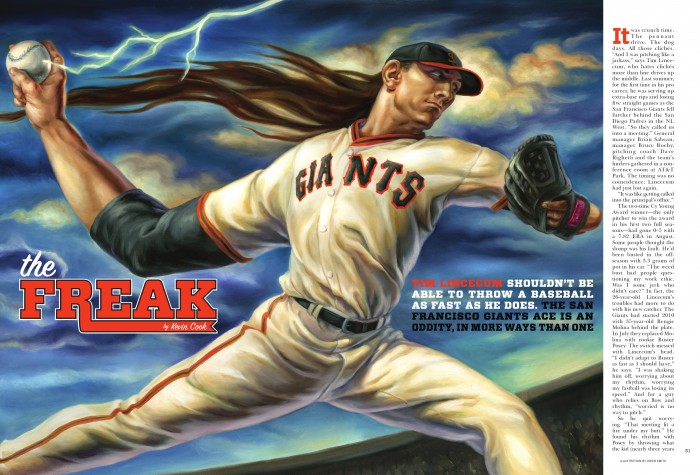
The Freak
May, 2011
n
was crunch time. The pennant drive. The dog days. All those cliches. "And I was pitching like a jackass," says Tim Lince-cum, who hates cliches more than line drives up the middle. Last summer, for the first time in his pro career, he was serving up extra-base rips and losing five straight games as the San Francisco Giants fell further behind the San Diego Padres in the NL West. "So they called us into a meeting." General manager Brian Sabean, manager Bruce Bochy, pitching coach Dave Righetti and the team's hurlers gathered in a conference room at AT&T Park. The timing was no coincidence: Lincecum had just lost again.
"It was like gettingcalled into the principal's office."
The two-time Cy Young Award winner—the only pitcher to win the award in his first two full seasons—had gone 0—5 with a 7.82 ERA in August. Some people thought the slump was his fault. He'd been busted in the offseason with 3.3 grams of pot in his car. "The weed bust had people questioning my work ethic. Was I some jerk who didn't care?" In fact, the 26-year-old Lincecum's troubles had more to do with his new catcher. The Giants had started 2010 with 35-year-old Bengie Molina behind the plate. In July they replaced Molina with rookie Buster Posey. The switch messed with Lincecum's head. "I didn't adapt to Buster as fast as I should have," he says. "I was shaking him off, worrying about my rhythm, worrying my fastball was losing its speed." And for a guy who relies on flow and rhythm, "worried is no way to pitch. "
So he quit worrying. "That meeting lit a fire under my butt." He found his rhythm with Posey by throwing what the kid (nearly three years
SHOULDN'T BE
ABLE TO THROW A BASEBALL
E DOE"
FRANCISCO GRffR ACE IS AN ODDITY, IN MORE WAYS THAN ONE
younger than Lincecum) called—the four-seam fastball that tops out at 97 mph, the low-90s sinker, the wicked curve, slider and changeup. He won five times in September, wound up leading the league in strikeouts for the third straight time and led the Giants to their flist World Series title since they were the New York Giants. All Lincecum did in the postseason was go 4-1 with a 2.43 ERA, including a Series-clinching 10-strikeout gem against the Rangers.
"Now we gotta do it again," he says. He'll start at Dodger Stadium on opening day, but the s h o w -d o w n everybody wants to
see comes in July, when the Giants face the pitching-rich Phillies in a rematch of last year's National League Championship Series. "People talk about their pitchers, but we're the champs, not them. They've got to keep up with us."
It's a long way from Liberty Field in Renton, Washington, where he failed to make varsity as a freshman, largely because he stood four-foot-1 1 and weighed 86 pounds. He didn't make it as a sophomore, either, largely because he'd added only 14 pounds to a frame that was now five-foot-two. His dad, who worked for Boeing, engineered a weight-training plan to build Tim's core strength and taught him to pitch with an extra-long stride— two feet longer than usual—that helped him use his whole body to catapult the ball to the plate. Once the boy grew into the stride that got him nicknamed the Freak, he mowed down hitters for Liberty High, the University of Washington and an elite amateur team, the Seattle Studs. The Studs were less successful with baseball groupies— commonly called the beef—than you might think. Lincecum blames the uniforms, which had a baseball emblem covering the n in Studs. "It looked like we were the S I l)s."
Drafted by the Giants in 2000, he
shot through the minors—where
players (continued on page 112)
LINCECUM
(continued from page 62) rode buses and the clubhouse buffet featured peanut butter sandwiches and ramen—in less than a year. Rockies prospect Ian Stewart called the five-foot-11, 170-pounder "the toughest pitcher I ever faced. Guys who've been in the big leagues call him the toughest they ever faced. That guy is filthy." In May 2007 Lincecum faced the Phillies in his major league debut. Ryan Howard and Shane Victorino took him very deep in an 8—5 loss. "I'll remember how far those balls went," he said.
The next season he went 18-5 to win his first Cy Young. It wasn't enough to impress his grizzled teammate Matt Morris. "You're still a rookie," Morris said.
"Come on, I've been in the league two years now."
"It's three years till you're not a rookie, rook."
Lincecum kept his mouth shut. The veterans could think what they wanted; he went to work on his changeup, throwing thousands until his straight overhand motion was exactly the same for his high-90s queso and a 10 mph slower change. Twitchy hitters would swing before the changeup arrived. He won 15 and lost seven in 2009, pacing the league in strikeouts again, holding opponents to a .206 average, leading the National League in wins above replacement, winning another Cy. Not even Morris (retired) was calling him rookie now. The Freak, whose mechanics defy decades of tradition— "People keep saying my motion's violent; I'm gonna get hurt"—refined his slider and zipped through the first half of 2010. An All-Star for the third straight time, he was 9-4 with a 3.16 at the break, soaking up the love he felt at home games. "When you get two strikes on a guy and the crowd's cheering, that sound can help you get the last one. It can get you through an inning, get you a win." He even enjoyed getting heckled on trips to New York and Philadelphia. "Those East Coast fans do their research! My teeth used to be pretty fucked-up, so they'd yell, 'Tim, you been chewing on rocks? Drinking beer with a straw?' I had to laugh." He got his teeth fixed, repaired his relationship with Posey and flashed his new pearlies at the Mets and Phillies as the Giants rolled to the postseason.
Meanwhile a Bay Area entrepreneur hawked T-shirts reminding people of Lincecum's weed bust, let timmy smoke, the shirts read. Some guys would have sued. But when the shirtmaker pitched a bunch of them through the window of Lincecum's silver Mercedes, Timmy thanked him. He doesn't wear them—not because he hates the shirts but because it would smack of a jock cliche. "I'd be referring to myself in the third person. That'd be weird," he says. "I guess I'd need one that says let vie smoke." But he's not going there, not after his run-in with the highway patrol.
Instead he goes up and down steps in
empty ballparks. Lincecum stepped up his workouts last fall. He wanted to get stronger in case the Giants made the Series for the first time since 2002. Now stadiums are his StairMasters. Between starts he'll slip into AT&T or some park on the road, warm up with a few stretches and then start jogging toward the upper deck. Up and down for miles, freaky footsteps echoing through empty stands. The upward trip builds hamstrings, quads and lower-core strength, while going down works calves, knees and stabilizers. He figures he needs to stay strong, particularly from the belly button down, to keep his violent motion from going haywire.
"It's not like I'm a pinpoint-accuracy guy." Not like the Phils' Cliff Lee and Roy Halladay, who walked 48 guys combined last year to Lincecum's 76. Unlike corner-painting control artists who prey on hitters' weaknesses, he rears back and fires as if to say "Try hitting this." "I'm more about my strength than the batter's weakness. I want to challenge you. That's what's fun." Hitters swear his four-seam fastball rises as it reaches the plate. That's supposed to be physically impossible ("It would take a shitload of backspin—maybe Aroldis Chapman could do it"), but the point is, it works. While some guys pitch to contact, hoping for ground balls, Lincecum makes you swing and miss. Year after year he fans more than a batter per inning. "The strike zone has four quadrants. I want to control them," he says. "I'll work the top of the zone with fastballs and the lower part with off-speed pitches. Throw a changeup inside or outside." In his first four big-league seasons, batters hit only .224 against him. Albert Pujols has done better: five for 14 for a .357 average. "But Pujols hasn't taken me deep. Knock on wood." Rockies part-timer Seth Smith has, though. Twice. Freaky game.
Timmy got a raise this year. His $14 million salary works out to $540,000 per biweekly paycheck, or about $62,000 per inning pitched. In December he spent about six weeks' pay on a $1.6 million condo with views of Seattle's Space Needle and Puget Sound, a championship pool table and a pair of video-game setups worthy of James Cameron. He's still driving the 2006 Mercedes he bought from a teammate, and the last time we talked he was rolling toward spring training, looking forward to stowing his hoodie and jeans in his corner of the Giants' rowdy clubhouse. On a typical day you'll find Barry Zito strumming a guitar in there, Brian "the Beard" Wilson playing dominoes and talking Spanish trash with some of the Latin players and Lincecum smacking the trackball on the Golden Tee Golf game. The starting pitcher gets to choose the clubhouse music; before Lincecum's starts it's MCMT, whose "Electric Feel" plays when he takes the mound.
Which he does his own way, of course. It may be as simple as telling an opponent he's awesome. "Down the stretch last year, when [Rockies shortstop Troy] Tulowitzki was hitting all those jacks—you had to get into it. I like whoever shines," says Lincecum, who still jumps off the couch when
he sees himself on SportsCenter. On the field, instead of coolly toeing the rubber after blowing a batter away, he'll gawk at the radar-gun reading on the Scoreboard. Damn, 98! Sometimes he'll do the same thing at the plate after striking out on 88 mph fastballs that seem as though they're going 150 mph. Although it annoys him to hear everyday players call pitchers "non-athletes," he hasn't proved them wrong yet. The career .130 hitter admits his idea of a hot streak is "a couple of lollipops over the infield."
Major league baseball allows pitchers to wear gold chains, puka shell necklaces and goggles while playing but not iPods. If that ever changes, Lincecum will be among the
first to pitch with his tunes plugged into his ears. But earbuds may be redundant. The music's already in him. "Pitching is all about timing and rhythm," he says. "When I'm starting my motion early in the game, I can still hear my come-out song running through my head. Sometimes it goes away fast—they hit the ball hard or bloop a couple on you, and you wind up pitching like poop. But when it's right, it's like a song."
FRONT FOURS
How some pitchers fared in their first four major league seasons
RCE : W-L ERR IP K BB WRR ERR + cy
CYYOL JNG (18 90-1893)
23 • 9-7 3.47 147.2 39 30 1.7 100 —
24 : 27-22 2.85 423.2 147 140 6.3 121
25 : 36-12 1.93 453 168 118 12.6 176
26 : 34-16 3.36 422.2 102 103 10.4 146 —
WHRT HRPPENED: WON 511 CRMES IN 22 YERRS.
BABE RUTH (1914-1917)
7 85 118 108
19 20 21 22
2-1 3.91 23 3
18-8 2.44 217.2 112
23-12 1.75 323.2 170
24-13 2.01 326.1 128
-0.2 2.5 7.4 5.8
70 114 158 128
WHRT HRPPENED: BECRME FULL-TIME RIGHT F
IELDER IN 1919.
154 5.8
129 7.6
26 1.6
34 0.3
HERB SCORE (1955-1958)
16-10 2.85 227.1 245
20-9 2.53 249.1 263
2-1 2.00 36 39
2-3 3.95 41 48
22 23 24 25 WHRT HRPPENED: HIT IN THE FRCE IN 1957.
141 166 190 94
TOM SEAVER (1967-1970)
16-13 2.76 . 251 170 '¦ 78 '. 6.4 122
16-12 2.20 : 278 205 : 48 : 7.5 137
25-7 2.21 : 273.1 208 : 82 : 7.6 165
18-12 2.82 1 290.2 283 : 83 : 6.0 143
17-9 2.60 218 276 73 5.4 137
24-4 1.53 276.2 268 69 11.7 229
17-6 2.84 250 200 80 4.4 126
15-7 3.21 179.2 148 53 3.8 119
7-5 4.00 146.1 150 65 2.0 112
18-5 2.62 227 265 84 6.9 169
15-7 2.48 225.1 261 68 6.3 173
16-10 3.43 212.1 231 76 3.5 119
22 23 24 25 WHRT HRPPENED: WON 311 IN 20 YERR5 WITH THREE CYS.
MARK FIDRYCH (1976-1979)
8.5 159
2.3 : 149
0.7 \ 161
-0.7 : 43
19-9 2.34 250.1 97 53
6-4 2.89 81 42 12
2-0 2.45 22 10 5
0-3 10.43 14.2 5 9
21 22 23 24 WHRT HRPPENED: HURT KNEE RND RRM; DIED IN 2009.
DWIGHT GOODEN (1984-1987)
19 20 21 22
WHRT HRPPENED: ELEVEN MISSED STRRTS IN 1987 DUE TO COCRINE REHRBILITRTION.
TIM LINCECUM (2007-201.0)
23 24 25 26
WHRT HRPPENED: Z-O IN 2010 WORLD 5ERIE5.
X X
Check Lincecum's progress this year at facebook .com/timlincecum.

