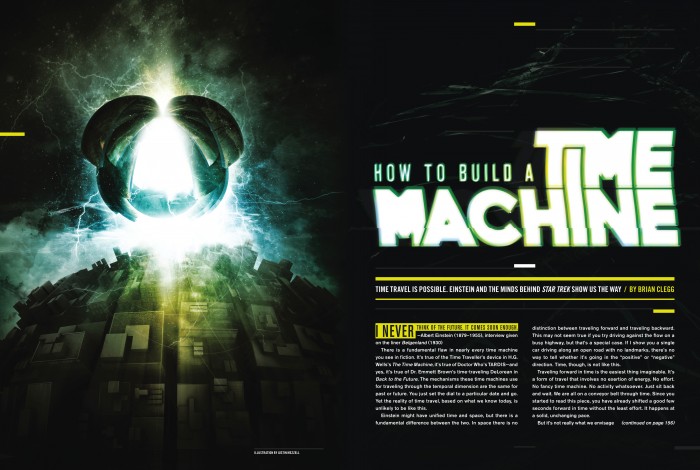
How To Build A Time Machine
December, 2011
TIME TRAVEL IS POSSIBLE. EINSTEIN AND THE MINDS BEHIND STAR TREKSHW US THE WAY
NEVER
—Albert Einstein (1879-1955), interview given
on the liner Belgenland (1930)
There is a fundamental flaw in nearly every time machine you see in fiction. It's true of the Time Traveller's device in H.G. Wells's The Time Machine, it's true of Doctor Who's TARDIS-and yes, it's true of Dr. Emmett Brown's time-traveling DeLorean in Back to the Future. The mechanisms these time machines use for traveling through the temporal dimension are the same for past or future. You just set the dial to a particular date and go. Yet the reality of time travel, based on what we know today, is unlikely to be like this.
Einstein might have unified time and space, but there is a fundamental difference between the two. In space there is no
distinction between traveling forward and traveling backward. This may not seem true if you try driving against the flow on a busy highway, but that's a special case. If I show you a single car driving along an open road with no landmarks, there's no way to tell whether it's going in the "positive" or "negative" direction. Time, though, is not like this.
Traveling forward in time is the easiest thing imaginable. It's a form of travel that involves no exertion of energy. No effort. No fancy time machine. No activity whatsoever. Just sit back and wait. We are all on a conveyor belt through time. Since you started to read this piece, you have already shifted a good few seconds forward in time without the least effort. It happens at a solid, unchanging pace.
But it's not really what we envisage (continued on page 156)
TIME MACHINE
(continued from page 125) when it comes to time travel. We want to get to our destination quicker. Perhaps surprisingly, this is also something you have done. On a regular basis you have sped up your experience of progressing into the future.
Assuming you didn't have a sleepless night, the chances are you passed through the past 24 hours at a rate of more than one objective second per subjective second. I don't need to invoke the way time drags if you are bored or compresses when you are interested—this is a more solid block of high-speed time travel. Because when you were asleep, you did not experience the hours ticking past. If you had seven hours sleep, you got through the past day and night in just 17 subjective hours. Yet can you really say you got through a day in 17 hours if it included sitting through a meeting that was, say, 45 minutes but felt like hours? Less fickle, less variable is the leap into the future provided by prolonged unconsciousness, as a few rare individuals can attest.
In 2003 Arkansas man Terry Wallis recovered consciousness after spending 19 years in a coma. At the age of 20, in July 1984, Wallis had been a passenger in a devastating car crash. He awoke to discover a whole new world. He had missed the Challenger accident and the Chernobyl nuclear reactor explosion. The Pan Am Lockerbie bombing and 9/11. Nelson Mandela coming to power in South Africa, and the Clinton administration at home. Although Wallis was not in a deep coma during most of the period, his experience of those 19 years was compressed into a much shorter space of time.
Comas can be medically induced but only for days or weeks. And even if a coma could safely be produced for, say, 20 years, would you really be happy to be in a state in which you were totally at the mercy of odiers for years at a time? Worse, being in a coma does not prevent the body from aging. Yes, you would wake up 20 years in the future but with a body 20 years older. Ahead of you would be 20 fewer years of your life to live—hardly ideal.
For some time now there has been a commercial route that is supposed to get around this: cryogenic storage. The idea here is that your body will be preserved at extremely low temperatures until the technology exists to defrost, revive and cure you of any illness you were suffering from, including old age— provided the essence of "you" was preserved in the frozen corpside: There is no certainty that a human body (and particularly a human brain) could be restored in the future. Nor do we know if the brain will retain the memories and personality of an individual indefinitely.
This approach has limited appeal for time travelers, as you have to be dead before you can start on your journey through time. (To be more precise, it would be legal only if you were dead before you used it—you could in principle undergo freezing while still alive.) For most this is too high a price to pay.
There has to be a more controlled way to get into the future—and there is, provided for us by Einstein's relativity. Special relativity tells us that the time on a clock that is moving toward or away from Earth is slower than time experienced on the planet. Here is a first
hint of painless time travel into the future. All we need to do is send someone off in a spaceship at high speed, and her clock will get further and further behind the time on Earth. She is moving into Earth's future.
That's the simplistic view. But special relativity is trickier than this. From Earth's viewpoint it's true that the astronaut is traveling away at high speed and that the astronaut's clock is falling behind. But from the astronaut's viewpoint, everything is the other way around. She is stationary. For her it is Earth that is moving away at high speed—and it is Earth's clocks that are running slow. If she had some way to transport herself instantly to Earth, she would arrive not in Earth's future but in Earth's past.
Yet relativity experiments have been undertaken using two incredibly accurate atomic clocks. One clock was flown around the world and ended up a tiny fraction of a second slower than its duplicate on the ground. Forty years of weekly crossings of the Atlantic leaves a frequent flier one thousandth of a second younger. And to establish the impact of relativity more dramatically, we have the evidence of the twins paradox.
Meet 25-year-old twins Karl and Karla. Karl stays on Earth while Karla travels off at high speed in a spaceship. When she returns home, perhaps 10 years have elapsed for Karla—but she discovers that Karl is celebrating his 75th birthday. The twins are now very different ages. Say Karla left in 2050. By her clock it is 2060 when she gets back to Earth. But on Earth it is the year 2100. Karla has traveled 40 years into her future.
The trick that makes the paradox work (and it does work) is in the details. Karla's spaceship accelerates up to a high percentage of the speed of light and travels away from home for five years. At the end of the journey it turns around and accelerates again to high speed but this time in the Earth-bound direction. After another five years of traveling, 35-year-old Karla returns to Earth to find her 75-year-old twin waiting for her.
The reason the twins are no longer the same age is that something has happened to Karla that didn't happen to Karl. A force was repeatedly applied to her ship to accelerate it up to speed and to slow it down. This force was not applied to Karl and Earth. The symmetry of their position was broken—the spaceship underwent acceleration that Earth did not. It's the acceleration that resets the Earth clock for Karla. She really has aged less than her twin who stayed at home—and she really has traveled into the future.
To make a twins-paradox trip work effectively, you would need to move at significantly more than half the speed of light. Exactly how fast depends on how long you want the trip to take. Get very close to light speed and you can achieve practically any time jump into the future with a relatively short journey time. But this ability comes with a weighty price tag. It's easy enough to get close to the speed of light. Particle accelerators have pushed protons to better than 99.9999 percent of light speed. But doing this to anything more massive than a particle takes a whole lot of energy.
We know this from the way a car uses gasoline—the more acceleration you need, the more energy it takes. Energy is measured in joules. To keep a 100-watt lightbulb running
for a second takes 100 joules. For practical reasons we'll have to switch to scientific notation, using 10", where n is the number of zeroes after the 1, so 102 is 100, 10" is 1,000,000 and so on. To get a 100-ton spaceship (the weight of a shuttle) to 90 percent of the speed of light requires 1.2 x 10²² joules.
This isn't a number that means a lot on its own. But let's look at how much energy all the power stations in the United States generate. Around 450 gigawatts. A massive 4.5 x 10" watts or joules every second. Impressive stuff. However, we need nearly 100 billion times this much energy to get our ship to 90 percent of the speed of light. We would have to run the power stations for 830 years. And we'd need a very long cable to connect all those stations to our ship.
When it comes to real spacecraft, the power produced by the biggest rocket motors ever built, those on the Apollo program's Saturn V rocket, was around 1.5 x 10" watts. Just how vast that is can be seen when we realize that it's about a third of the output of all the power stations in the U.S. But these engines, which had only enough fuel to run for a few seconds, would have to burn for 2,500 years to reach 90 percent of light speed.
So although traveling forward in time is simple and entirely achievable with today's technology, we need a phenomenal amount of energy to make a sizable jump. If we used gasoline to power our time ship, it would take around 60 billion tons of gas. But our calculations assumed we were moving a shuttle weighing only 100 tons. Just to move the gasoline would require nearly a billion times as much energy...which would require vastly more gasoline. And so on.
The only way to make it practical would be to follow in the footsteps of Star Trek. The USS Enterprise is powered by the most phenomenal source of energy in existence— antimatter—and this is the only hope if fuel is to be carried on the ship. Antimatter engines sound like science fiction, and the mechanism the Enterprise uses is fictional, but antimatter itself is real enough. Antimatter is the same as ordinary matter, but the particles that make it up have the opposite electrical charge to those in everyday atoms.
Where, for example, an electron has a negative charge, the antimatter equivalent, the antielectron (better known as a positron), has a positive charge. When matching matter and antimatter particles are brought together, they are attracted, smash into each other and are destroyed in an explosive flash. The particles' mass all goes to energy, and though electrons are light, Einstein's famous equation E = mcv! tells us that the energy produced will be equal to the mass of the particles multiplied by the square of the speed of light. That's a big number.
A pound each of matter and antimatter would generate the equivalent of a power station running for more than five years and offers the most compact way to store energy.
To take our ship up to 90 percent of the speed of light we would need 31 tons of antimatter. That's a manageable weight to carry onboard, though we have to bear in mind that at the moment the whole world's annual production of antimatter is less than a millionth of an ounce, so we aren't going to get to 31 tons in a hurry.
To make matters worse, we have no good way to convert the raw energy of the antimatter annihilation—which produces an intense burst of gamma rays—into movement. It's not a magic solution. Even if there were some way to harness that power, the mechanism involved would probably be extremely bulky and heavy. But at least it's merely a technology problem.
In practice there are more difficulties still. What happens when the ship gets to the end of its voyage and turns around? Ideally it should be able to turn the kinetic energy of its flight back into antimatter, but if that isn't practical, the alternative would be to use that much energy again to stop the ship, and even more for each part of the return journey. In all, four times as much energy.
The alternative is to find some way to power the ship without carrying the fuel. One possibility is to use solar sails. Imagine tacking across the solar system powered by the small but inexorable pressure produced by the Sun's vast electromagnetic wind.
We know that solar sails work, but the Sun alone wouldn't get a time ship up to speed. By the time you get to the outer reaches of the solar system, our Sun is no more than a bright star, giving far too little power. The sails would have to be boosted by a huge space-based bank of lasers. And this doesn't help with the return journey. There won't be any lasers to bring the ship back.
So how about picking up fuel as the time ship travels? A piece of technology dreamed up in the 1960s could do just this—the Bus-sard ramjet. Even the name sounds like something out of a space opera. A Bus-sard ship scoops up hydrogen from space and uses the pressure of the ship's speed to compress the gas until it undergoes nuclear fusion, releasing energy to power its journey. This is a great idea in principle, but all the known data on the quantities of hydrogen available and the potential for compression suggest that it's highly unlikely to work.
For that matter, fusion is a nightmare to control. Fusion power would be incredibly useful on Earth. It's the mechanism of the Sun, a form of nuclear power that uses cheap fuel and doesn't produce high-level radioactive waste. Yet despite researching nuclear fusion for 50 years, we have yet to produce a sustainable fusion reaction. Balancing the intense temperatures and pressures is incredibly difficult, as is keeping the fuel from touching anything else and blasting it out of existence. It would be a big step indeed to get it to work in a spaceship engine.
Even if we did get our ship up to speed there would be other problems. Navigation would be a nightmare, and there would be plenty of hazards that simply couldn't be avoided. There would be the constant danger of collision with dust—at this speed, the tiniest particle of matter would crash through pretty much anything. And as the time ship blasted into clouds of gas or, even worse, high-energy cosmic rays, the collisions would produce floods of deadly radiation, requiring extreme shielding.
Using special relativity to travel into the future is easy. We do it every time we take a plane journey. And it would be simple enough to make jumps of hours or days. The problem here is making the scale of the leap into the
future big enough to make the effort worthwhile. Getting into the past, though, is a whole different ball game. But it is not impossible.
A theoretical physicist will tell you it's just a matter of engineering. All you need is to make a wormhole—a tear in reality that links two points in space-time—keep it open with antigravity and fly through it. Or take a string of neutron stars, each the result of a stellar collapse producing matter so dense that a piece the size of a sugar cube weighs around 100 million tons. Form the stars into a cylinder and spin them at near the speed of light. Fly around the cylinder and you have a time tunnel into the past. These are feats that are millions of years beyond today's technology, but one man believes he can create the same effect as those spinning neutron stars.
He's Ronald Mallett, and his life has been dedicated to time travel. Mallett was just 10 when his father died unexpectedly in 1955. As he grew up he devoured science fiction and became convinced that if he could only build a time machine he could go back and warn his dad to see a doctor before it was too late. It's the kind of fantasy many a teenager in die same position might have. But Mallett wasn't any teenager. He purposefully set out to gain
the expertise to make this possible.
Mallett is now a professor of physics at the University of Connecticut. Most of his time in science has been focused on general relativity. This was Einstein's crowning glory, building on special relativity's revelations to explain the workings of gravity as a warp in space-time. General relativity, Mallett knew, offered the best chance of building a time machine to travel into the past. If you can warp time enough, you can loop back into an earlier moment.
Over the years, Mallett's work has seemed like regular research on Einstein's great die-ory. But as he grew in experience, Mallett was in fact searching out a mechanism to make time travel practical with today's technology. He would eventually identify a mostly ignored phenomenon called frame dragging. When Einstein formulated general relativity he discovered that whenever a massive object is moved it produces a small sideways gravitational pull. This pull is known as frame dragging, and it gets even more interesting when that massive object is rotated.
Imagine twisting a spoon in ajar of thick honey. As the spoon rotates it pulls on the nearest honey, dragging the gooey substance around with it. Einstein's sideways gravitational pull means that a massive rotating object will drag space and time into a vortex,
just like the spoon pulls the honey. This isn't just theory. It was recently demonstrated by NASA's longest-running project. Gravity Probe B was embarked on in 1962, and just this year it finally produced data that confirm the existence of frame dragging.
Mallett bided his time. It is only in the past few years that it has become respectable for physicists to talk about time machines. Earlier in Mallett's working life it would have been career suicide to have mentioned the possibility. But by the time he was in his 50s, science had caught up. Big names in the field such as Kip Thorne and Stephen Hawking openly talked about time travel (though they often spoke of "closed time-like loops," the equivalent technical term, which sounds less crazy). It was time to go for broke. For more than 10 years, Mallett has been working on a mechanism that would make use of frame dragging to produce a time tunnel.
Instead of spinning impractically heavy objects such as neutron stars, Mallett plans to use insubstantial light. Like matter, light produces a frame-dragging effect, and using experience gained in industry working with lasers, Mallett could see a way to stack thousands of tightly rotating rings of light that he calculated should produce enough of a twist in time to allow anything traveling through the rings to shift back into the past.
In a Hollywood movie, Mallett would triumph at the 11th hour and get back to see his father one last time. He knows that isn't going to happen. The theory has taken many years to develop, and it could be years more before a working model is built—even then the shift in time is likely to be very small. Mallett is 66 now. There is a real race against time if he is personally to complete the project. And even if he does succeed, he knows he can never use his time machine to meet his father.
All time travel into the past based on relativity hits a brick wall. The furthest back you can get is the point when the machine was first created. Such time machines are more like trains than automobiles. They can't travel everywhere and anywhere at will. They can only move down the track of the warp they create in the fabric of space-time. And that track starts when the machine is first switched on. Mallett has long known this—but it has not blocked that intense drive that came from his wish to see his father again.
Whether or not Ronald Mallett achieves his dream, the amazing fact remains that time travel is a reality, and on a small scale we can do it today. Frame dragging has the potential to provide a gateway to the past, while special relativity makes every frequent flier a time traveler and, even with today's technology, enables us to travel hours or days into the future. So next time you see a time-travel movie, don't sneer. It may be a technical challenge, but time travel is no fantasy. Should the human race survive long enough, it seems an almost inevitable part of our future. And if that doesn't inspire a sense of wonder, nothing will.
In the end, only time will tell.
From How to Build a Time Machine: The Real Science of Time Travel by Brian Clegg, available from St. Martin's Press in December.
Should the human
race survive long
enough, time travel
seems an almost
inevitable part of
our future.

