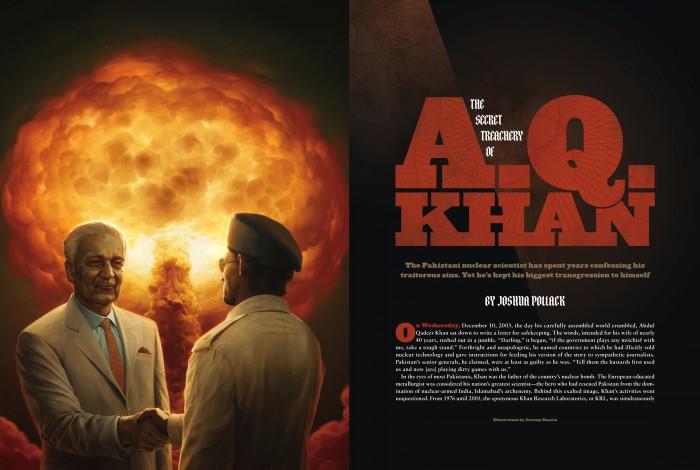
The Secret Treachery Of A.q. Khan
January / February, 2012
The Pakistani nuclear scientist has spent years confessing his traitorous sins. Yet he's kept his biggest transgression to himself
The Pakistani nuclear scientist has spent years confessing his traitorous sins. Yet he's kept his biggest transgression to himself
n Wednesday, December 10, 2003, the day his carefully assembled world crumbled, Abdul Qadeer Khan sat down to write a letter for safekeeping. The words, intended for his wife of nearly 40 years, rushed out in a jumble. "Darling," it began, "if the government plays any mischief with me, take a tough stand." Forthright and unapologctic, he named countries to which he had illicitly sold nuclear technology and gave instructions for feeding his version of the story to sympathetic journalists. Pakistan's senior generals, he claimed, were at least as guilty as he was. "Tell them the bastards first used us and now (arc| playing dirty games with us."
In the eyes of most Pakistanis, Khan was the father of the country's nuclear bomb. The European-educated metallurgist was considered his nation's greatest scientist—the hero who had rescued Pakistan from the domination of nuclear-armed India, Islamabad's archenemy. Behind this exalted image, Khan's activities went unquestioned. From 1976 until 2001, the eponymous Khan Research Laboratories, or KRL, was simultaneously
one of Pakistan's most sensitive nuclear facilities and Khan's personal fief. Without external oversight, he could easily conceal his side business: selling advanced nuclear technology to an assortment of foreign countries.
The events of December 10 shattered this illusion. That morning, the Daily Jinnah, a Pakistani newspaper, reported that the 151, Pakistan's CIA equivalent, had arrested senior managers from KRL on suspicion of aiding Iran's nuclear program. The article triggered an uproar. After two decades of illicit nuclear sales, Khan's cover was blown. The knock at his door could come at any moment.
In his letter Khan acknowledged providing Pakistan's gas-centrifuge-enrichment technology—a type of equipment that could be used to make nuclear explosives—to numerous international buyers. Khan wrote that at some point in the late 1980s he and his colleagues sent "drawings and some components" of centrifuges to the Iranians at the request of a top Pakistani general. Scribbling in the margin of the letter, Khan allowed that he "must have got money for it ($1 million)." In the late 1990s, he continued, another top Pakistani general accepted a $3 million bribe from North Korea through Khan and then directed him to provide North Korea with "some drawings and machines." Without giving any details, Khan also mentioned Libya in the letter. Pakistan's military men, he claimed, were ultimately responsible and now wanted a scapegoat: "They might try to get rid of me to cover up all the (dirty) things they got done by me in connection with Iran, Libya and N. Korea."
Over the next few weeks, more KRL staffers were arrested. Khan was placed under house arrest, interrogated by senior intelligence and military officials—debriefed was the polite word used in official statements—and finally made to confess. On February 4, 2004, he sat before a television camera and recited a statement in English. Khan admitted that "alleged proliferation activities by certain Pakistanis and foreigners over the last two decades" had occurred at his behest. "It pains me to realize in retrospect that my entire lifetime achievement of providing foolproof national security to my nation could have been placed in serious jeopardy on account of my activities, which were based in good faith, but on errors of judgment related to unauthorized proliferation activities."
Khan assumed sole responsibility and asked to be pardoned. The next day, Pervez Musharraf, the general who had seized control of Pakistan in 1999 and appointed himself president in 2001, granted that pardon before the national news media. Still, Khan remained under house arrest, beyond
the reach of foreign investigators, forbidden to say anything that might endanger national security.
Only when Musharraf's power weakened did Khan resume speaking about his past activities. Today, Musharraf lives in exile, and Khan is once again free to express himself— more or less. The Pakistani government continues to limit his travels, but he talks to reporters and writes newspaper columns. In one interview he asserted that the military agency in charge of nuclear security had drafted his televised confession on Musharraf's orders. "The statement was thrust into my hands to read. I immediately realized that it was mischievous to put all the blame solely on me.... I refused to read it out as it was and insisted that the words 'I did it in good faith' be inserted."
By now Khan has made nearly every possible claim about who bears responsibility for selling Pakistan's centrifuge technology. He did it at the behest of the military. He acted purely on his own. The military was solely responsible. It was all done by foreigners. Khan lost many things during his ordeal, including his freedom and his credibility. But throughout, he retained one crucial secret: the identity of a fourth country, after Iran, Libya and North Korea, to which he had provided the shortcut to a nuclear weapon.
The unraveling of Khan's deceptions started in Iran. In February 2003 the Department of Safeguards of the International Atomic Energy Agency launched an investigation of Tehran's nuclear activities. (Safeguards inspectors are charged with verifying that countries don't secretly acquire nuclear materials or divert them from peaceful uses.) The Iranians tried to reveal as little as possible. But in August the Safeguards team confronted Iranian officials with a significant discovery: Some of Iran's centrifuges and associated equipment were coated in microscopic traces of uranium. Radiochemical analysis showed that all the traces were enriched, some to a high level.
The Iranians were cornered. Either they could assume responsibility for unacknowledged enrichment activities or they could try to pin it on the source of their imported machines. In October the Iranians finally explained that the contaminated equipment had come from Pakistan. As evidence, they revealed original centrifuge drawings supplied years earlier by Khan.
The admission from Iran shouldn't have come as a surprise in Islamabad. Shortly after Musharraf gained control of the country, Pakistani investigators (continued on page 190)
A.Q. KHAN
{continued from page 66) had concluded that Khan was corrupt. A dossier prepared by the National Accountability Bureau found that Khan owned several expensive houses and had stashed $8 million in bank accounts in Pakistan, Dubai and Switzerland. He was suspected of demanding kickbacks from suppliers, in addition to making unnecessarily large purchases and then skimming off a share of the payments. There were inklings that Khan was doing business with other countries as well. The problem could become embarrassing for Pakistan, even dangerous, but Khan was a popular figure. Musharraf chose not to confront him. Instead, he declined to renew Khan's contract as head of KRL when it expired in March 2001. On paper he was elevated to a more senior role as a presidential advisor. As far as Musharraf was concerned, the problem was solved.
The Iranian revelations alone didn't expose all Khan's activities. On December 19 another customer emerged. That evening, President George W. Bush announced that Muammar el-Qaddafi of Libya had decided to "disclose and dismantle all weapons of mass destruction programs in his country." IAEA inspectors were soon on the ground in Tripoli, where they learned that Libya, too, had received centrifuge equipment from Khan and his suppliers. Two customers had been revealed within just two months, and there could easily be more. The IAEA leadership decided to investigate Khan's entire operation.
Before long, inspectors discovered that Khan's operations had undergone a major expansion in the late 1990s, continuing even after he lost control of KRL. Previously, Khan had shipped small numbers of centrifuges to his customers via front companies in freewheeling Dubai. (The contaminated gear found in Iran had traveled this path.) He sourced additional equipment from Europe, Japan, Turkey and perhaps South Africa. But in 1997 Khan agreed to provide Libya with a complete enrichment facility, from the ground up. It would feature 10,000 brand-new centrifuges based on Pakistan's second-generation P-2 model. To make this possible, Khan needed greater room to maneuver. "He had to go overseas," says David Albright, president of the Institute for Science and International Security and the author of Peddling Peril, an in-depth examination of the Khan network. "He just couldn't make enough machines in Pakistan. Making 10,000 P-2s at KRL's workshops for the Libyans would have been noticed."
Khan entrusted a longtime associate in Dubai with setting up a workshop to make the necessary centrifuge components. Buhary Seyed Abu Tahir, better known as Junior, was a Sri Lankan national who had been involved with Khan since the 1980s. At first he worked for his uncle S. Mohammad Farooq, ordering, receiving and reshipping centrifuge-related equipment for KRL and for Khan's foreign customers. But Farooq decided to accept a buyout from Junior and retire. By the late 1990s Junior had become one of Khan's key overseas operatives.
Khan turned to him to manage the fulfillment of the Libyan order. An effort to produce components in Dubai stalled for lack of skilled labor. After considering Turkey as a possibility, Junior selected a facility in Shah Alam, Malaysia. Conveniently, it belonged to a company partly owned by his Malaysian wife. Better yet, the majority investor was the son of Malaysia's prime minister, which would help to avoid scrutiny. After making the centrifuge parts in Malaysia, Junior's people would ship them to Dubai. From there, the shipments would proceed to Libya.
Ultimately, the IAEA was able to track down almost all of the centrifuge components and materials that originated with Junior's operation. But some records turned up that did not correspond to anything recovered in Libya, Dubai, Malaysia or locations in between—indicating other shipments. "The shipments were never found," says Olli Heinonen, who led the IAEA's investigation of the Khan network. "Were they destroyed? Dumped? Are they being kept somewhere? We don't know."
News reports about the missing shipments started appearing while the investigation was still under way. Reporters seized on the idea of a fourth customer. Other evidence seemed to confirm those suspicions. "Members of the Khan network would refer to 'the fourth customer,'" says Heinonen. "It was their code language. We still don't know who they meant." The obvious candidates were in the Middle East, long considered a breeding ground for secret nuclear programs. Based on Khan's travels, Syria, Egypt, Sudan, Saudi Arabia and Kuwait were all possibilities. Turkey sometimes made the list as well. But no solid evidence of any transactions came to light. One of the IAEA's strongest leads was in Hasakah, a town in northeastern Syria. Satellite photos showed a large building there that resembled the blueprints for Libya's planned centrifuge-enrichment facility; however, it turned out to be a cotton-spinning factory. The IAEA investigation left the mystery of the fourth customer unsolved.
Yet there is an overlooked possibility, previously ignored because it seemed too absurd to consider, but it might be the most compelling answer to the fourth-customer mystery. Only three countries are known to operate centrifuge technology similar to Pakistan's. Two of them, Iran and North Korea, are already accounted for among Khan's customers. The third and last country on the list: India, Pakistan's foe.
The nations of India and Pakistan were born in 1947 in a terrible spasm of blood and fear. After Britain's withdrawal from its South Asian empire, many who found themselves on the wrong side of the new borders fled their homes and headed for the other—Hindus and Sikhs to India, Muslims to Pakistan. Untold numbers were killed. The animosity between India and Pakistan parallels that of the Arab-Israeli conflict, with an equally long record of territorial disputes, war, terrorism and faltering diplomacy. The difference is one of scale. As a result of the 1948 Arab-Israeli war,
hundreds of thousands of Arabs left Israel for Arab countries, and hundreds of thousands of Jews left Arab countries for Israel. By contrast, in the four years after British India split into two countries, 14.5 million refugees crossed sides. In all likelihood it is the largest episode of ethnic cleansing since the end of World War II.
At the time of partition, A.Q. Khan was growing up in the central Indian city of Bhopal. After graduating from high school in 1952, he chose to follow three of his older brothers to Karachi, Pakistan. He would later recall the journey as a series of petty humiliations. In the account he gave to his biographer in the late 1980s, Khan and other Muslims leaving India on the same train were subject to intimidation and thievery. Policemen seized women's jewelry, he claimed, and conductors confiscated tickets until bribes were given. Anyone who protested was beaten. "The experience I had with the Indian police and railway authorities fully explained why Quaid-e-Azam fought so relentlessly for Pakistan," Khan said, referring to Pakistan's founder, Mohammed Ali Jinnah, who was called the Great Leader.
Not long after finishing college in Karachi, Khan moved to Europe to complete his education. He married a local girl, started a family and completed a doctorate in engineering, specializing in metallurgy. Fate took a turn when he landed a position at FDO, a Dutch company that developed gas-centrifuge technology for URENCO, a European consortium that supplies fuel for nuclear power reactors. Later, Khan would cite two events that motivated his return to Pakistan. The first was the 1971 war. It ended with India's rapid conquest of East Pakistan, which afterward became Bangladesh. "I was in Belgium in 1971 when the Pakistan army surrendered in then East Pakistan and faced utmost humiliation," Khan recounted during a 2009 television interview. "Hindus and Sikhs were beating them with shoes, and their heads were being shaved in concentration camps. I saw those scenes with horror."
The second event was India's nuclear test in 1974. By this time Khan was at FDO, working with centrifuges. Determined to even the score, he wrote to Pakistan's prime minister, Zulfikar Ali Bhutto, explaining uranium-enrichment technology and offering his services to his country. Impressed with Khan's enthusiasm, Bhutto sent word that they should meet. Late that year Khan brought his wife and two young daughters on a visit to Pakistan, where he met with Bhutto and learned about the nascent Pakistani nuclear program. A year later, without informing anyone at FDO in advance, he permanently relocated his family to Pakistan. One account claims he arrived with three suitcases full of papers. A co-worker at FDO also alleged that Khan had already been slipping centrifuge design information to Pakistani diplomats in the Netherlands.
In 1976 Khan persuaded Bhutto to grant him exclusive control over Pakistan's fledgling uranium-enrichment program. Relying mostly on his European connections, he set out to build a complete enrichment facility
through a global network of suppliers and front companies. By early 1983 KRL was producing enough highly enriched uranium to make nuclear weapons, according to Khan. His major achievement in life was now behind him. Almost immediately afterward, Khan started marketing his nuclear expertise abroad.
Khan's first known overture to another country took place in a meeting with Libyan officials in January 1984. The Libyans later described how Khan had explained the technologies involved in developing nuclear weapons and offered to sell them. The Libyans declined, concluding the technology was too challenging. But in 1989 they went back to Khan, striking a deal in 1991. Stringent UN sanctions imposed in 1992, however, made it too hard for Libya to receive the delivery. Not until the big 1997 contract—the event that drove Khan to set up component production under Junior Tahir's leadership in Malaysia—did the Libyan business get moving again.
Khan's next known prospect was Iran. The initial contact appears to have been made in 1985 through employees of Leybold-Heraeus, a German company whose offerings included specialized "feed-and-withdrawal" systems that carry uranium hexafluoride gas into and out of interconnected centrifuges. Khan was already one of the firm's best customers. After protracted negotiations, the Iranians decided to buy design documents and a few sample centrifuges from Khan, enough to kick-start their own program. The payout was a few million dollars, which Khan split with his partners, including Gotthard Lerch, a German engineer who had worked at Leybold. A second, more extensive deal with the Iranians was concluded in 1993 or 1994. This time, Khan and his people were expected to provide consultations on technical issues. Meetings continued until at least 1999.
Less is known about Khan's dealings with North Korea, whose first attempts to study
centrifuges began around 1987. Khan is said to have told a senior Pakistani general that he had supplied the North Koreans in the 1980s, but they couldn't use what they had bought. A more extensive transaction took shape in the mid-1990s, when KRL received ballistic missiles from the North Koreans. As partial payment, Khan later admitted, he sent centrifuges and other equipment to the North Koreans. In late 2010, North Korea showed American visitors what appeared to be an operational centrifuge facility. The machines resembled Pakistan's P-2 model.
Khan's dealings did have some false starts. In the late 1980s Lerch's associates made approaches to the South African nuclear program. But South Africa had already launched its own centrifuge efforts. Moreover, the program was canceled entirely in 1991. Khan himself reportedly made several visits in the 1990s to Syria, where he seems to have pitched the Syrians on a weapons program. Denying that any meetings occurred, Syrian president Bashar al-Assad claims to have rejected a written offer from Khan in early 2001.
Khan's best-documented failure involved Iraq. Shortly after Iraq's invasion of Kuwait in 1990, a Pakistani man passed a document to a senior Iraqi security official promising that Khan could supply an "A.B.," implying "atomic bomb," in about three years, for a cost of $150 million. The Iraqis' deliberations were interrupted by the start of the first Persian Gulf war. The IAEA uncovered records of the discussions in Iraq in 1995. When the story leaked to the press in 1998, the Pakistani government flatly denied it.
What motivated Khan to offer centrifuge technology to so many different countries? The public Khan, Pakistan's hero, can hardly be squared with the man who privately enriched himself at his nation's expense. But something deeper does connect them: Khan's insatiable craving for respect and
admiration. At the same time he began offering KRL's technology to new customers, Khan also embarked on a restless campaign of self-glorification. He memorialized himself in scores of institutions and edifices across Pakistan, funded from his mysteriously deep pockets. Khan's website exhaustively recites 63 gold medals bestowed on him from 1984 to 2003. It enumerates the many public buildings and academic awards bearing his name throughout Pakistan, his service on the boards of educational and research institutions and his sponsorship of community health and welfare organizations. Also mentioned: his funding of the restoration of the tomb of Sultan Shahabuddin Muhammad Ghauri, the Muslim conqueror of what is now Pakistan and northern India.
This obsession tends to explain Khan's need for large sums of money. Khan appears to have admitted as much to his interrogators. A summary of the Pakistani investigation, provided by the ISI to foreign governments, describes what happened to the cash from Khan's initial deal with the Iranians: "Some [of the money] was donated for various social, educational and welfare projects undertaken by Dr. A.Q. Khan in Pakistan." The same applied to the arrangement with Libya.
Khan's yearning for respect was instilled early in life. The youngest of seven children, he idolized his father, headmaster of a Bhopal high school who had once held a senior role in the national education system. "Whenever I went to the bazaar with my father, I would see people from all walks of life (shopkeepers, teachers, doctors, etc.), standing up as a mark of respect to my father," Khan recounted to his biographer. "They used to request him to stay with them for a few minutes and have a cup of tea. I was about seven years of age at that time and it left a permanent, deep impression on my mind."
Measured against this high standard, Khan found it difficult to be slighted. He explained his decision to leave India as motivated by distaste for being a second-class citizen. "There was no future for Muslims in Bhopal. My brothers advised me to come to Karachi. My father, after assessing the conditions in Bhopal, very reluctantly allowed me to go." But Pakistan didn't instantly embrace its newfound son either. In 1967, after receiving a master's degree at Delft University of Technology in the Netherlands, Khan brought his wife home to Pakistan, where he applied for a position at a new steel mill. He received no job offer and returned to Europe. But he didn't forget the episode. When he wrote to Bhutto in 1974, offering his help in creating a nuclear weapon, he couldn't resist complaining about the rejection of seven years earlier.
He struggled, too, with keeping his accomplishments to himself. In particular, he chafed at the idea of not being able to tell the world about Pakistan's nuclear capabilities, which Islamabad stayed quiet about to better preserve relations with the United States. The most notorious episode occurred in 1987. Indian journalist Kuldip Nayar baited Khan into speaking far too candidly about the then secret Pakistani
nuclear weapons program by pretending a prominent Indian scientist had told him not to bother making the trip: "Don't waste your time. They don't have anything. No bomb, no men, no rationale." Khan became outraged: "Tell them we have it. Tell them. Tell
them We have it and we have enriched
uranium. Weaponized the thing. Put it all together.... Mr. Nayar, if you ever drive us to the wall, we will use the bomb."
More trouble came in 1989 with the release of his biography, the provocatively titled Dr. A.Q. Khan and the Islamic Bomb. The book went to lengths to enlighten readers about Khan's historic role and personal greatness, as well as the perfidy of his opponents inside and outside Pakistan. But it was also prematurely frank about the military purposes of Pakistan's nuclear program. All
copies were removed from bookstores, and the author was briefly thrown in prison.
While his full stature as "father of Pakistan's nuclear bomb" couldn't be revealed, Khan devised another way to glorify himself. Here, he drew on his original inspiration: the admiration bestowed on his father. Khan set out to make himself into the visionary sponsor of higher education in Pakistan. One of his more ambitious endeavors was the founding of a private university, the Ghulam Ishaq Khan Institute of Engineering Sciences and Technology—a costly endeavor that coincided with Khan's nuclear sales abroad. In 1993 Khan told journalist Simon Henderson, "I have always been keen to go into education. My father was a teacher." But such thoughts couldn't compete with his deeper passion. As
Khan explained, "There is a tremendous amount of love [for me in Pakistan], and it is obvious everywhere.... I believe the most important thing is what my country, my people, think of me. I don't care what other people think of me. Once I'm gone, my name and my prestige and the love and affection that I have in this country will remain forever."
Not all of Khan's fellow countrymen, however, viewed his compulsive philanthropy as entirely selfless. "I often thought that this was not generosity in the real sense," Haroon Ahmed, Khan's estranged former psychiatrist, told investigative journalists Adrian Levy and Catherine Scott-Clark for their book Deception: Pakistan, the United States, and the Secret Trade in Nuclear Weapons. "He really did this so that if he was driving down the
Peshawar Road, let us say, the chances are he would pass a building bearing his name— and it would remind him that he was indeed the great Abdul Qadeer Khan."
For all his bluster, Khan could legitimately claim a victory over the Indians when it came to centrifuge technology. While the Indians had beaten Pakistan to the bomb, they had done so through mastery of plu-tonium production—a different route to creating a nuclear weapon. India's ability to enrich uranium remained limited. New Delhi started a centrifuge program in the 1970s, but the Indians weren't ready to break ground on their main enrichment facility until 1986. By that point, Pakistan's KRL had been churning out weapons-
grade uranium for at least three years.
India's enrichment program progressed slowly, but at some point before 1992 the Indians began experimenting with supercritical centrifuges, devices that can withstand very high rotational speeds. The program apparently continued to expand, with the Indians purchasing large quantities of supercritical centrifuge components from 1997 to 1999 and again from 2003 to 2006. Surprisingly, they were almost open about their shopping spree. In 2006 the Washington, D.C.-based Institute for Science and International Security revealed that the Indian government had used newspaper ads to solicit bids for centrifuge parts. The details of these advertisements, along with documents the Indians gave potential suppliers, provide strong clues about where
New Delhi's supercritical centrifuge technology came from. Despite some changes, the design is recognizable to the trained eye: It almost mirrors the G-2 centrifuge, a design that Khan stole from URENCO in the 1970s and later reproduced as Pakistan's P-2 centrifuge.
Centrifuge specs are not the only apparent link between India's enrichment program and Khan's operation. The cast of characters also overlaps, starting with Gerhard Wisser, a German living in South Africa. In collaboration with Gotthard Lerch in Switzerland, Wisser's engineering firm supplied new gas-handling equipment for KRL's centrifuges, delivered through Farooq's operation in Dubai. When Khan struck his 1997 deal with Libya, he called on Wisser for similar equipment. According to a South African
court document, Wisser also supplied India's centrifuge program with specialized equipment, starting in the late 1980s. What else he or Lerch might have sold to the Indians remains unknown, but the timing is consistent with India's earliest known work with supercritical centrifuges. Wisser seems to have had access to centrifuge designs, too; he tried to sell them to the South Africans around the same time.
Could Khan have been ignorant about Wisser's dealings with India? His own guilty conscience says otherwise. Though Khan has never acknowledged having a fourth customer, he gave his Pakistani interrogators at least two contradictory cover stories that explained how KRL's enrichment technology could have ended up in enemy
hands. The full transcript of Khan's interrogation, said to run hundreds of pages, has never been made public, but Musharraf's 2006 memoir provides important details. At first, Khan seems to have suggested his overseas network (Lerch, Wisser et al.) was autonomous enough to supply both India and Pakistan without either side knowing. But Khan later alleged he had been exploited by an Indian connection who was hidden inside Farooq's Dubai operation. "Ironically," wrote Musharraf, "the network based in Dubai had employed several Indians, some of whom have since vanished. There is a strong probability that the Indian uranium enrichment program may also have its roots in the Dubai-based network and could be a copy of the Pakistani centrifuge design."
Musharraf's tale of betrayal is slightly distorted. There are no indications any Indians were regularly employed by Farooq or his nephew Tahir. But some accounts describe Farooq as being of Indian origin, just like Khan. And indeed, after Khan could speak more freely again, he accused Farooq of having absconded. In a 2009 interview, he claimed Farooq didn't simply retire in 1992 but "cheated Tahir and fled to Singapore with all the money they had in their bank accounts. He later blackmailed Tahir." According to the ISI's partial summary of the interrogation, Khan emphasized that Farooq had access to copies of the centrifuge drawings. Khan also told his interrogators Farooq had supposedly transferred his share of the money from Libya to accounts in Singapore and India.
Lately, Khan has gone a step further, blaming the foreign members of his network for all the sales of KRL technology, not just sales to India. In this new version of events, Farooq has developed into one of Khan's primary villains—a thief, a blackmailer and an agent of the CIA. Conveniently, too, he was now permanently out of reach. "The bastard died of cancer that he deserved," Khan told a reporter in 2011.
Privately Khan could rationalize his culpability another way. He habitually cheated nearly all his customers. India would have been no exception. "Some of Khan's customers were clearly being misled by the network," says Scott Kemp, an expert on gas centrifuges at Princeton University. "He was consciously selling junk—providing customers with incomplete, sometimes rejected drawings, disused and sometimes broken parts, plus random knickknacks he tried to pawn off as centrifuge components.
Political figures in Iran and Libya believed Khan to be an authority and were willing to throw money at his schemes, but technical experts soon realized they would have to reinvent the centrifuge on their own."
Khan has basically admitted as much. In a statement to the Pakistani authorities in early 2004, he wrote contemptuously of the Iranians and Libyans: "At no time did I seriously believe they were capable of mastering this technology as they didn't have the required infrastructure, the trained manpower or technical know-how." North Korea, which received preferential treatment once it began supplying missiles to KRL, was another matter. Because the North Koreans already had plutonium-based nuclear weapons, Khan reasoned, selling them enrichment technology did no harm. In this way, the Indians fit the bill perfectly. They could already produce plutonium, and Khan considered their enrichment efforts hapless. He may have done his part to keep them hapless, too: India's centrifuge design has small differences from the P-2 that seem to make it more susceptible to failure.
Whatever the truth, no one is talking. Khan, no longer on the defensive, has stopped making admissions. He has even begun flirting with politics. His admirers now compare him to A.P.J. Abdul Kalam, an important figure in India's nuclear program. At a banquet in Khan's honor last April, the host declared, "We detained our nuclear scientist, but India repaid its debt to Dr. Kalam by making him president." But on his quest for ever-greater glory, can Kahn escape his last secret?

