Saigon Confidential
January / February, 2012
SAIGON CONFEIDENTIAL
FORTY YEARS AGO, AMERICANS COULDN'T WAIT TO GET OUT OF
My guide, True, elbowed me conspirato-rially. "This," he said, "is where they start freaking out." The heat approached 90 degrees, with the humidity hovering at 70 percent. "Aaaaaah!" Suzie screamed, now panic-stricken, her cheeks beet red.
Just as Suzie fell into full-on hyper-ventilation, two of the exhibit's employees reached down and heaved her out of the pit. She scrambled away like a POW on the run.
This is what it's like for tourists visiting Vietnam in search of exotic adventure. They find it, but it's often not what they expected. There's still a degree of menace in Vietnam, with unexploded land mines and boys on motorbikes who whisper in your ear, "Wanna go shoot an AK-47 and blow up a pig?" But the heart of old Indochina still beats in the scarred hills. Savvy visitors will find the trip is more than they could have imagined.
orty miles northwest of Ho Chi Minh City, in the Communist nation of Vietnam, a farm-fed herd of middle-aged American tourists hovered around a rabbit-size opening to the fabled Cu Chi tunnels—once an underground labyrinth used by Viet Cong guerrillas to fight off American soldiers, now a tourist attraction. The hole was about 13 inches in diameter, roughly the width of a robust U.S.-grade thigh. "Should I go in?" asked a plump woman with a Midwest accent. She looked
to be in her 60s, a healthy 160 pounds. Her husband egged her on. "Go on, Suzie, go on...." She squeezed in, Tevas first. Cameras snapped as fellow tourists praised her agility: "Atta girl! Knew you could do it, Su/.ie!"
In the distance gunshots could be heard. The next stop at the Cu Chi tourist trap was a shooting range where visitors could squeeze off rounds from an M-16 or a Russian-made AK-47, the Viet Cong's gun of choice, for a buck a bullet. Suzie's sweat-beaded brow furrowed as she began to struggle in the hole. She confronted the question countless Americans in Vietnam have pondered over the years: "So how am I gonna get out?"
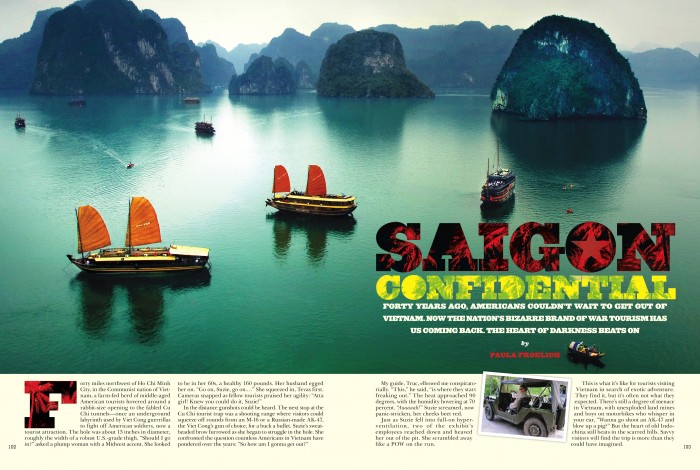
Thirty-six years after North Vietnam technically ceased being a war /one, tourism in our former adversary's jungles and rice fields is booming, accounting for more than $4 billion of Vietnam's income. Americans trek over onetime boneyarcls and battlegrounds while wearing Hawaiian shirts and scarfing down spring rolls, knowing that in the shadows anything is possible. No other country is so defined by one war—and so proud of it in an absurd Universal Studios theme park-like way,
with rides, gift shops and tours of "amusements" (killing fields).
At the southern tip of Vietnam is the tropical island of Phu Quoc. Developers have built resorts on its western edge, including the exclusive La Veranda, where honeyniooners go to get their tan on. The hotel's brochure lists activities: "snorkeling, reef diving, waterfalls, hiking in virgin forests...." At the
bottom of the list is "Coconut Tree Prison."
At the far end of the island, the prison memorial inclucles a staged war scene with American mannequins torturing Vietnamese mannequins. The exhibition
has explanations for each type of torment, no matter how self-evident. They include: "To break a prisoner's tooth," "To drive nails into a prisoner's body," "To boil a prisoner" and "To broil a prisoner."
Outside the memorial are the actual metal barracks where Viet Cong prisoners were kept. Here American mannequins are shown burying a Vietnamese mannequin alive while other mannequins stand around smoking plastic cigarettes.
To the north is the 17th parallel, Vietnam's Mason-Dixon Line. There's a grudge match between the vanquished south and the victorious north. "People in the south are lazy. They just want to party," northerners will say. "People in the north are too uptight," southerners will say.
There are subtler differences. "There are no street dogs in the north," True, my southerner
guide, said. "They have dogs as pets, but people have to guard them or they will be stolen for meat."
Lan, my guide in Hanoi, in the north, insisted, "No one eats dog." After some pressing he admitted, "Okay,
some do, but it's not common. It's the old way. It's dying out." An hour later, on the way to Ho Chi Minh's tomb, Lan offered me a bite of a mystery-meat pastry, which I declined.
The Vietnamese do not screw around when it comes to their beloved Ho Chi Minh, the revolutionary leader of North Vietnam during the war. After Saigon fell in 1975, marking the reunification of Vietnam as a communist nation, the government renamed the city after its war leader. Today Ho Chi Minh City is a bustling metropolis with luxury shops such as Cartier and Louis Vuitton sprouting on its main streets, overshadowing alleys that hide brothels where almost anything goes.
In the heart of Hanoi, the line to see the dear leader's body in a glass coffin is almost always a mile long. Let's be clear: At Ho Chi Minh's tomb, no shorts, no short skirts, no shoulder-baring tops, no hats, no talking past the steps of the mausoleum, and hands must be in full view at all times. No cameras, phones, twee/ers, nail files, fast walking/running or slow walking. As you enter, guards group you in twos. You file up the stairs and around Uncle Ho's body, which is tenderly lit a la Barbra Streisand. Not that you can see the corpse, as it's on an eight-foot-high platform surrounded by guards. Outside, some visitors stalled crying—in either awe or fear.
In Hanoi, the quaint colonial city that once served as the capital of French Indochina, I visited every museum, cultural site and market: the downed B-52 bomber rotting in a lake, the John McCain Memorial, the Hanoi Hilton, a random bomb crater. Finally it was time to see how the locals live.
"Lei's go to lunch," Lan suggested, "local style"—a euphemism for drinking. A lot. We sat cross-legged on tatami mats in an open-air cafe overlooking the lake into which John McCain had crash landed. Joined by I.an's friends—other tour directors and a high-ranking Communist official named Thang—we all started eating frog leg stew and spring rolls and taking shots of vodka and local rice wine, which tastes like sake mixed with kerosene.
Four hours and $25 later, six of us rolled up on a karaoke joint, where Lan, Thang, my driver (also named Thang) and a guy named Thuy crooned Vietnamese love songs while a group of scantily clad, bored-looking women looked on and clapped at appropriate times in between texting. I was later told the karaoke girls were "very impressed" by my lyrical abilities, but since they were being paid, I'm skeptical.
The next day, as I was leaving Vietnam, I thought of a veteran I'd met at a church while on my way to Khe Sanh. "Yeah, we stopped at Cu Chi," said the former marine, who'd served in the
Mekong Delta area during the war. "The shooting
range at the end—that shit ain't right.
Those guns used to be pointed at our heads." Now they're mounted at
exhibitions, ready to be ^^ shot by tourists who want the Real War Experience— without having to enlist.
TOUR VIETNAM
HO CHI MINH CITY
(formerly saioon)
The side streets around Lam Son Square and the Opera House in District 1 are full of girlie bars where you can chat up gorgeous women—for a price. They're called "A to X" bars: If you opt to make the conversation more private, everything but Y and Z can take place in the back. An absolute must-see is the view from the roof bar at the Rex Hotel. Historically important is the War Remnants Museum, formerly the American War Crimes Museum. The photography section and the Agent Orange area are so graphic, they routinely reduce adults to tears. Stay: The Caravelle Hotel was home to the majority of the foreign correspon-
e Vietnam war. D " '
bar with outdoo
(19 Lam Son i hotel.com)
(4 Nguyen Thiep Street, District 1, ncorporation.com)
Situated ri^^^^^^^Hrized zone line, Hue was oR|PiPm||H968 Tet Offensive, during which thousands of civilians were massacred. The Citadel, a fortress on the Perfume River, was the site of fierce fighting and is being carefully restored. Down the river is Thien Mu Pagoda, the tallest pagoda in Vietnam and the unofficial symbol of Hue. Three hours away by bus is the war museum at Khe Sanh, where some 500 American soldiers died trying to hold the McNamara Line. Stay: La Residence Hotel, a French colonial mansion on the banks of the Perfume River, housed the area's governor in colonial days. It's a step back in time, with all the comforts of a five-star hotel.
(24 Tran Cao Van Street, mrcumandarin.com)
PHU QUOC ISLAND
The perfect beach getaway, this tropical island sits in the Gulf of Thailand. It's full of verdant rain forest, waterfalls, virgin sand, pepper farms and quaint fishing villages. The memorial at the Coconut Tree Prison—a former POW camp at the far end of the island—is like Guantanamo Bay before it was a twinkle in George W. Bush's eye. A cab ride there and back will cost you $40, but it's worth the trip. Stay: The gorgeous La Veranda Resort is situated right on the beach. At sunset the outside bar is as close to heaven as you can get.
resort.com)
mock to relax on while you have a few Tsingtaos afterward.
You can't go to Hanoi without seeing the Hoa Lo Prison, a.k.a. the Hanoi Hilton. The majority of the prison was torn down to make room for a high-rise, but what's left is jaw-dropping. Used first by the French to hold Vietnamese separatists, then by the Vietnamese to hold American POWs, it has an execution room and torture chambers. A picture of American POWs giving the camera the middle finger was removed two years ago after someone finally told the Vietnamese government what it meant. While in Hanoi, you must also see Ho Chi Minh's tomb and the John McCain Memorial. Stay: The Sofitel Legend Metropole is one of the few remaining French colonial structures in North Vietnam. Be sure to ask for room 218, formerly the Italian embassy.
Eat: Quan An Naon. where locals
(IB Phan Boi Chau, Hoan Kiem, ngonhanoi.com.vn)
SPECIAL THANKS TO ASIA TRANSPACIFIC JOURNEYS FOR ARRANGING OUR WRITERS TRIP
Tourists can squeeze off rounds from a
Russian-made AK-47 for a buck a bullet.

