The Playmate As Pop Art
June, 2012
Forty-five years ago, Playboy asked 11 artists to interpret the centerfold, we revisit their work to determine how tastes have changed
FORTY-FIVE YEARS AGO, PLAYBOY ASKED 11 ARTISTS TO INTERPRET THE CENTERFOLD. WE REVISIT THEIR WORK TO DETERMINE HOW TASTES
HAVE CHANGED
n the middle of the 1960s, Hugh Hefner began collecting fine art in the "Playmate mode," of which there was no shortage at the time, since the odalisque, in full or in part, was making its debut on the American art scene. Hitherto everything had been pretty much splashed paint, but now things were changing. Hefner bought the work of senior provocateur Salvador Dali and old-school troublemaker Larry Rivers. He also acquired younger pop art stars including Andy Warhol, George Segal, James Rosen-quist and Tom Wesselmann. Hefner himself, of course, was not totally innocent in this resurgence. He had sexualized the suburbs, and now these artists were sexualizing "pure art" So Ho in a perverse and poly-
morphous manner appropriate to the underground context.
So Hef had his influence. It took playboy's Playmates to remind Wesselmann that the previous three centuries of American art had been amazingly chaste—there had been no "fine art" nudity of consequence. There was an occasional official icon of Justice or Liberty and Thomas Eakins's painting The Swimming Hole (1885), which portrays luscious naked boys cavorting around the water, and that was it. Early on, it seemed, American artists had opted for painting real estate rather than pulchritude, and having detected this deficit, Wesselmann proceeded to paint hundreds of ironically titled "Great American Nudes," most of
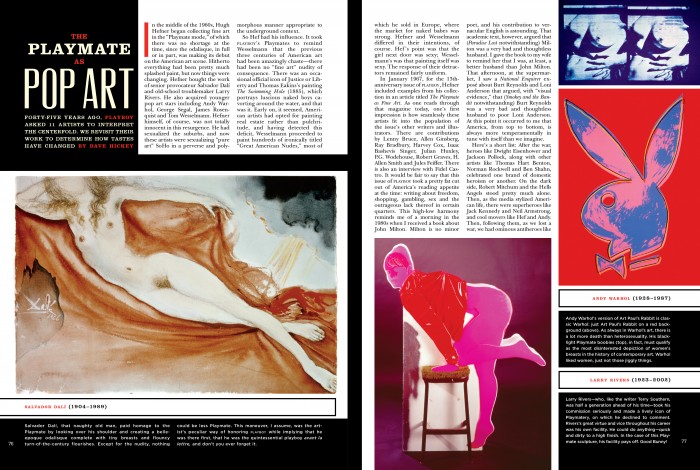
SALVADOR DALI (1904-1989)
Salvador Dalf, that naughty old man, paid homage to the Playmate by looking over his shoulder and creating a belle-epoque odalisque complete with tiny breasts and flouncy turn-of-the-century flourishes. Except for the nudity, nothing
could be less Playmate. This maneuver, I assume, was the artist's peculiar way of honoring playboy while implying that he was there first, that he was the quintessential playboy avant la lettre, and don't you ever forget it.
which he sold in Europe, where the market for naked babes was strong. Hefner and Wesselmann differed in their intentions, of course. Hef's point was that the girl next door was sexy; Wessel-mann's was that painting itself was sexy. The response of their detractors remained fairly uniform.
In January 1967, for the 13th-anniversary issue of playboy, Hefner included examples from his collection in an article titled The Playmate as Fine Art. As one reads through that magazine today, one's first impression is how seamlessly these artists fit into the population of the issue's other writers and illustrators. There are contributions by Lenny Bruce, Allen Ginsberg, Ray Bradbury, Harvey Cox, Isaac Bashevis Singer, Julian Huxley, P.G. Wodehouse, Robert Graves, H. Allen Smith and Jules Feiffer. There is also an interview with Fidel Castro. It would be fair to say that this issue of pi.ayboy took a pretty fat cut out of America's reading appetite at the time: writing about freedom, shopping, gambling, sex and the outrageous lack thereof in certain quarters. This high-low harmony reminds me of a morning in the 1980s when I received a book about John Milton. Milton is no minor
poet, and his contribution to vernacular English is astounding. That academic text, however, argued that (Paradise Lost notwithstanding) Milton was a very bad and thoughtless husband. I gave the book to my wife to remind her that I was, at least, a better husband than John Milton. That afternoon, at the supermarket, I saw a National Enquirer expose about Burt Reynolds and Loni Anderson that argued, with "visual evidence," that (Smokey and the Bandit notwithstanding) Burt Reynolds was a very bad and thoughtless husband to poor Loni Anderson. At this point it occurred to me that America, from top to bottom, is always more temperamentally in tune with itself than we imagine.
Here's a short list: After the war, heroes like Dwight Eisenhower and Jackson Pollock, along with other artists like Thomas Hart Benton, Norman Rockwell and Ben Shahn, celebrated one brand of domestic heroism or another. On the dark side, Robert Mitchum and the Hells Angels stood pretty much alone. Then, as the media stylized American life, there were superheroes like Jack Kennedy and Neil Armstrong, and cool movers like Hef and Andy. Then, following them, as we lost a war, we had ominous antiheroes like
ANDY WARHOL (1928-1987)
Andy Warhol's version of Art Paul's Rabbit is classic Warhol: just Art Paul's Rabbit on a red background (above). As always in Warhol's art, there is a lot more death than heterosexuality. His black-light Playmate boobies (top), in fact, must qualify as the most disinterested depiction of women's breasts in the history of contemporary art. Warhol liked women, just not those jiggly things.
LARRY RIVERS(1923-2002)
Larry Rivers—who, like the writer Terry Southern, was half a generation ahead of his time—took his commission seriously and made a lively icon of Playmatery, on which he declined to comment. Rivers's great virtue and vice throughout his career was his own facility. He could do anything—quick and dirty to a high finish. In the case of this Playmate sculpture, his facility pays off. Good Bunny!
Dick Nixon, Imelda Marcos and Keith Richards, and we got scared. Cars went from dangerous and splendid to safe and ugly. Oppressive patriarchy was rampant. Bad white guys abounded. Bad husbands like John Milton and Burt Reynolds were excoriated, and all my friends died of AIDS. Today the bad guys are congressmen, senators and bankers. The blood panic over the AIDS plague has segued into a teenage blood panic over svelte vampires.
Even today, it seems, these rhyming moments of good guys and bad guys, love and hate, optimism and dread, are still pretty much pervasive. They suggest that steady emotional tides and fashions drive American culture, and that they still exist. Unfortunately, the middle has disappeared, and the points at which the extreme left over-
laps with the extreme right are casually suppressed by niche marketing and internet cabals. So playboy of the 1960s and 1970s was, I think, the last magazine that, like The Saturday Evening Post, tried to please everyone. It did so under the legendary aegis of Hefner and his consigliere, Art Paul, the art director of playboy for its first 30 years and the man who designed the Playboy Rabbit, which Warhol later mimicked in a painting. Paul rejected any distinction between high art and low art, between high design and low design. He was celebrated by Print magazine as the father of the "Illustration Liberation Movement" and served as a trustee of Chicago's Museum of Contemporary Art. As a matter of principle, Paul would seek out anyone from Saul Bass to Robert Rauschenberg
to do anything. While Mad Men hucksters were running the fine art business, Paul, a Bauhaus advocate and student of Moholy-Nagy, was designing a racy magazine, and there couldn't have been a more benign opportunity. My favorite Art Paul design fiat was to print a photo spread of a nude Anita Ekberg on matte paper, to give it that "fine art" flavor—the perfect middle option. On his deathbed, the actor David Garrick purportedly remarked to a friend, "Dying is easy; comedy is hard." To this I would add that, in publishing, the edges are easy; the middle is damned hard.
As proof it can be done, one should consider the cultural impact of that 1967 issue's contributors. Did Ray Bradbury have more influence on Star Trek or on Raymond Carver and Thomas Pynchon? Did Warhol have
more influence on the future of fine art or on the windows along Madison Avenue and the couture they display? Did Lenny Bruce have more influence on Richard Pryor or on the chocolate-smeared Karen Finley and a million other performance artists? Did Allen Ginsberg have more influence as a Beat poet or as a flagrant prophet of gay liberation? Did Jules Feiffer have more influence on the "new comics" or on the snarky banter of haut bourgeois Manhattan? My point is that there was a middle then, and Hef and Paul nailed it. America was like a jelly doughnut— crispy on the outside, sexy jelly on the inside.
It's hard to deny that most Americans woke up one morning in the early 1950s exhausted with the vestigial heroism of World War II. They were feeling very horny and a little bit guilty
GEORGE SEGAL (1924-2000)
George Segal was an old softy. He made plaster-cast sculptures of working people, so his Playmate is a working model, tired and resting in a chair between takes. Since the plaster cast adds 30 pounds and the camera adds another 30, Segal's Playmate looks a bit chubby in photographs (she's enceinte, actually). She is best seen in person, where the plaster is evident and the model's exhaustion palpable. Of all the works in the Playmate suite, Segal's has the biggest heart.
TOM WESSELMANN (1931-2004)
Tom Wesselmann's giant profiled lips exhaling cigarette smoke do not imply a giant woman. Roy Lichtenstein's giant brushstrokes imply a giant painter, but Wesselmann's lips are the incarnation of sin, intimacy and tumescent desire. Like an image on a pagan temple, they bear the iconicity of sleek, desperate longing. As the pagan priest might tell you, the lips suck you in; they say it all.
about it, as well they should have. Warhol noted that his silk-screened Playmate breasts could be seen only under black light "to keep the cops away," which was no joke in Warhol's day, especially if you were a swish homosexual. In any case, the bond between Hefner and the pop artists is tighter and more symbiotic than one might expect. In Hefner's eyes Dali must have represented the gifted imposter he himself aspired to be and ultimately became. Larry Rivers was a jazz pal. Hef and the younger popsters invented and shared a Zeitgeist—and, if one believes the gossip, an obsession with work, sex, freedom, jazz, glamour and amphetamines. There was so much work to do, so many beautiful girls and boys to boink, so much cool furniture to arrange in one's penthouse and so little time—an attitude to which I at-
tribute the longevity and enormous productivity of these exotic creatures high and low. They all kicked butt.
None of this, however, takes Hefner's covert agenda into account or acknowledges the fact that Hefner, from the
beginning, set out to civilize himself and in the process civilized America's youth. He encouraged foreplay before the assault. He offered tips on upgrading one's bachelor pad. West Coast pop artist Edward Ruscha credits Hefner with introducing him to Knoll and Eames and the design stars of that generation. A friend of mine who is a professor at an Ivy League college credits Hefner with moderating the sexual combat of late adolescence. "They still hit on you," she said, "but first there would be dinner, wine and jazz." Today I regard these pop artists as the bastard children of Hef's agenda and Art Paul's education, still hipsters but further out there, one toke over the line. Without Hefner and Paul, however, it's unlikely such foolishness would have flourished
or that pop art would have been so embraced. Somehow, in the tides of culture, as Hefner was moving up and the popsters moving down, they met in the middle. They deserve one another in the best possible way.
JAMES ROSENQUIST (b. 1933)
Jim Rosenquist's Playmate painting can be read as a little story from left to right. One turns the strawberry shortcake into an equally delicious well-breasted female torso that makes one's pickle glisten.
The wire basket, I assume, is where the bad photos were tossed in the process of this transformation. It ain't rocket science. It's not even hard reading, but it's first-class Rosenquist quirky.
In the 1980s, as the nuts and bolts of playboy's oil-paint illustrations passed out of kitsch-land and into "historical popular culture," it was inevitable that young artists would pick up on this newly traditional way of painting. John Currin (above left) and Lisa Yuskavage do the best job of it, transforming the traditional playboy illustration style of Martin Hoffman into high art images that are at once sexy and drenched in nostalgia for a more permissive time.

