Playboy Classic: Jack Nicholson
December, 2012
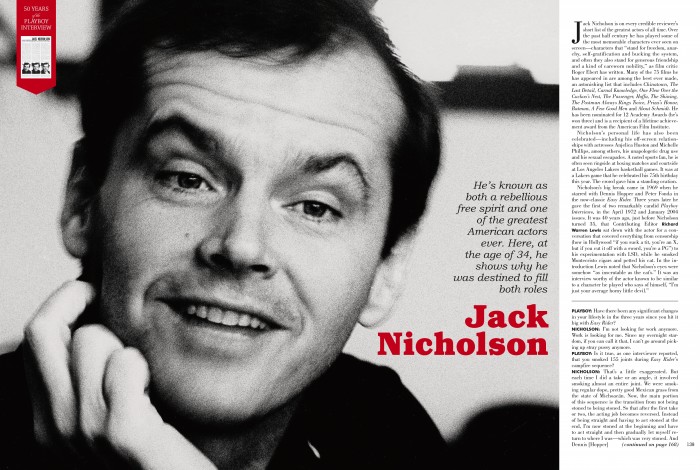
He's known as both a rebellious free spirit and one of the greatest American actors ever. Here, at the age of 34, he shows why he was destined to fill both roles
He's known as
both a rebellious
free spirit and one
of the greatest
American actors
ever. Here, at
the age of 34, he
shows why he
was destined to fill
both roles
Jack Nicholson is on every credible reviewer's short list of the greatest actors of all time. Over the past half century he has played some of the most memorable characters ever seen on screen—characters that "stand for freedom, anarchy, self-gratification and burking the system, and often they also stand lor generous friendship and a kind of careworn nobility." as film critic Roger Kbert has written. Many of the 75 films he has appeared in are among the best ever made, an astonishing list that includes Chinatown, The hist Detail. Carnal Knowledge, One Hew Over the Cuckoo's Nest, The Passenger, Hoffa, The Shining, The Postman Always Rings Twice, Prizzi's Honor, Batman. A Few Cood Men and About Schmidt. He has been nominated for 12 Academy Awards (he's won three) and is a recipient of a lifetime achievement award from the American Him Institute.
Nicholsons personal life has also been celebrated—including his off-screen relationships with actresses Anjelica Huston and Michelle Phillips, among others, his unapologetic drug use and his sexual escapades. A noted sports fan. he is often seen ringside at boxing matches and courtside at I.os Angeles Lakers basketball games. It was at a l.akers game that he celebrated his 75th birthday this year. The crowd gave him a standing ovation. Nicholson's big break came in I960 when he starred with Dennis Hopper and Peter Fonda in the now-classic Easy Rider. Three years later he gave the first of two remarkably ('andid Playboy Interviews, in the April 1972 and January 2(X)4 issues. It was 40 veal's ago. just before Nicholson turned .'?.). that Contributing Kditor Richard Warren Lewis sat down with the actor for a conversation that covered everything from censorship (how in Hollywood "if you suck a tit. you're an X. but if you cut it off with a sword, you're a PG") to his experimentation with LSD. while he smoked Montecristo cigars and petted his cat. In the introduction I,ewis noted that Nicholson's eyes were somehow "as inscrutable as the cat's." It was an interview worthy of the actor known to be similar to a character he played who says of himself, "I'm just your average horny little devil."
PLAYBOY: I lave there been any significant changes in your lifestyle in the three years since you hit it big with Easy Rider!
NICHOLSON: I'm not looking for work anymore. Work is looking for me. Since my overnight stardom, if you can call it that, I can't go around picking up stray pussy anymore.
PLAYBOY: Is it true, as one interviewer reported, that you smoked 155 joints during Easy Rider's campfirc sequence?
NICHOLSON: That's a little exaggerated. Hut each time I did a take or an angle, it involved smoking almost an entire joint. We were smoking regular dope, pretty good Mexican grass from the state of Michoacan. Now. the main portion of this sequence is the transition from not being stoned to being stoned. So that after the first take or two. the acting job becomes reversed. Instead of being straight and having to act stoned at the end. I'm now stoned at the beginning and have to act straight and then gradually let myself return to where I was—which was very stoned. And Dennis [Hopper] (continued on page 168)
NICHOLSON
(continued from page 139)
was hysterical off-camera most of the time this was happening. In fact, some of the things you see in the film—like my looking away and trying to keep myself from breaking up—were caused by my looking at Dennis off-camera over in the bushes, totally freaked out of his bird, laughing his head off while I'm in there trying to do my Lyndon Johnson and keep everything together. PLAYBOY: You once told a reporter you had smoked grass every day for 15 years. Do you still?
NICHOLSON: To a certain degree. I'm a social smoker. But I can go for months at a time without even thinking about it. PLAYBOY: How do you feel about the anti-marijuana laws?
NICHOLSON: It's insane to have laws that are making criminals out of a huge percentage of our population, particularly when it's something that involves morality. I'm old-fashioned in that I don't want to see the entire world addicted to drugs—like the synthetic existence described in Brave New World—but I think it's an enormous leap from a little grass to that grim picture. I don't think there's anything to prove that marijuana leads to the use of harder drugs. It hasn't been true in my case, although probably I never would have encountered any other drug if I hadn't gotten involved in smoking marijuana. But I'm not addicted to any of it. I know when to say, "No more of this."
PLAYBOY: Isn't cocaine the currently fashionable drug in Hollywood? NICHOLSON: I see it around. PLAYBOY: Have you tried it? NICHOLSON: Yeah, it's basically an upper, but it doesn't do too much to me. I don't think it'll be fashionable for long, because it's expensive and we're in a depression; whether the world chooses to call it a depression or not, there's no money around. Cocaine is "in" now because chicks dig it sexually. The property of the drug is that, while it numbs some areas, it inflames the mucous membranes such as those in a lady's genital region. That's the real attraction of it. In his book, My Wicked, Wicked Ways, Errol Flynn talks about putting a little cocaine on the tip of your dick as an aphrodisiac. But his conclusion is that there really isn't any such thing as an aphrodisiac. I sort of agree with him, though if you do put a numbing tip of cocaine on the end of your cock because you're quick on the trigger and need to cut down on the sensation, I guess it could be considered a sexual aid. And it's an upper, so you've got added energy. PLAYBOY: Five or six years ago, the popular sexual upper was amyl nitrite. Have you had any experiences with that drug? NICHOLSON: I've never taken any poppers; I'm afraid of them. Whenever I say that to friends of mine, they look at me like I must be insane, so I guess it's big in the sexual area. It ups the respiratory system to a tremendous degree, from what I understand, and makes the heart pound. I just don't like fast rushes. I really know very little about drugs except how they individually
affect me. I'm attuned to that because of my training as an actor, to know how I feel and why I feel and where the feelings are emanating from. In that regard, I've had a lot of experiences with acid. PLAYBOY: When did you first try it? NICHOLSON: I was one of the first people in the country to take acid. It was in laboratory experiments on the West Coast about nine or 10 years ago. At that time, I was a totally adventurous actor looking for experience to put in his mental filing cabinet for later contributions to art. I was very curious about LSD. Some of the people I knew were in therapy with it. I went to downtown L.A. and took it one afternoon. I spent five hours with a therapist and about five more at home in the later stages of it. I hallucinated a lot, primarily because of the way the therapist structured it. He put a blindfold on me, which makes you much more introspective, gives you more dreamlike imagery. Imagine what acid is like when you know nothing about it. You think it's going to be like getting stoned on grass, which I had done. But all of your conceptual reality gets jerked away and there are things in your mind that have in no way been suggested to you: such as you're going to see God; or watch sap streaming through the leaves of trees; or you're going to feel the dissolving of certain bodily parts; you're going to re-experience your own birth, which I did on my first acid trip; you're going to be frightened that your prick might be cut off, because you have castration fears. PLAYBOY: Can you describe what the castration fears felt like?
NICHOLSON: At first, I just didn't feel too hot. I said to the therapist, "I feel a kind of fluttering in my genital area." It was sort of like a queasy stomach. At that level, it's alarming, but it's not terrorizing. Then I began to get more uncomfortable and cold in that area. At one point, I came back to consciousness screaming at the top of my lungs till I had no more breath to exhale. I thought I'd have to try to remedy this genital discomfort myself by cutting my cock off. I got into interpreting that psychologically with the therapist, what it meant, and he said it related to homosexual fears. It was really a kind of paranoia. The drug just aggravated it. Taught me a lot about myself. PLAYBOY: Have you dropped much acid since then?
NICHOLSON: Some, but not as much as most of the people I know. I still take it occasionally, but I have a certain awe of it. PLAYBOY: What makes you persist? NICHOLSON: Once you've related to acid, there are certain things you perceive that would be impossible otherwise—things that help you understand yourself. Also, maybe there's the element of challenge. You get into it because you don't want to feel something is too frightening to deal with. If properly used, acid can also mean a lot of kicks. During the shooting of Easy Rider in Taos, New Mexico, for example, Hopper and I dropped a little of the drug and a couple of guys drove us up to D.H. Lawrence's tomb. It's on the side of a mountain and there's this great huge granite tomb where his wife is buried.
Lawrence is indoors in a kind of crypt. When we got up there, we were just starting to come on. The sun was going down. Dennis and I get very sentimental about each other at these moments; we love to cry about old times and talk about how it's gonna be. So we were up there rapping about D.H. Lawrence and how beautiful it was. We decided we were going to sit on the tomb with D.H. From then on, this was where we were going to make our stand in life, and if they wanted to go on with the movie, they'd have to come here and get us, 'cause this was where we were and this was where we'd be. We looked at trees and talked about art and the nature of genius and asked ourselves why people couldn't be more open. After a while, the guys in the van came back to get us. PLAYBOY: We heard you were equally into the part for the scene in Five Easy Pieces in which you're confronted with a sullen waitress. NICHOLSON: Yeah, the one where the waitress says, "No substitutions," and I end up having to ask for a chicken-salad sandwich on wheat toast—hold the butter, lettuce, mayonnaise and chicken salad—just to get an order of wheat toast. Finally, boom, I sweep the table clear of glasses, silverware and dishes. Actually, something like that scene had occurred in my own life. Years ago, when I was maybe 20, I cleared a table that way at Pupi's, a coffee shop on the Sunset Strip. Carole Eastman, the screenwriter of Five Easy Pieces and an old friend of mine, knew about that incident. And Bob Rafelson, the director, and I had gone through something like the bit with a "no substitutions" waitress, although that time I hadn't dumped the dishes. So, knowing me, Bob and Carole just put the two incidents together and into the script.
Bob and Carole are among a number of actors, writers and directors I've hung around with for years whom I consider my surrogate family. I have very familial feelings about them and Charles Eastman, the writer; Robert Towne, the actor [turned writer-director]; Monte Hellman, who most recently directed Two-Lane Blacktop; and Roger Corman, who produced most of my previous films. People in that group were writing plays and reading them in coffeehouses. A bunch of us literally built a small theater.
PLAYBOY: Was the theater and coffeehouse scene pretty much your whole life then? NICHOLSON: No. I was also part of a generation that was raised on cool jazz and Jack Kerouac, and we walked around in corduroys and turtlenecks talking about Camus and Sartre and existentialism and what going on the road would be like. We stayed up all night and slept till like three in the afternoon. We were among the few people around seeing European pictures. We went to Dylan's and Ravi Shankar's early concerts. We smoked a lot of dope, usually in the toilet or out in the backyard or driveway, 'cause it wasn't cool to do it in public. There were a lot of parties. Many more parties than I go to now. We'd get 19 half gallons of Gallo Red Mountain and get everybody drunk. I guess you could call them orgies by the strictest definition. I gave parties
that hundreds of people attended; there were a lot of rooms in my house and people would take their own little private trips. I don't know what they were doing. I know what I was doing, though, and I guess that could be called an orgy. But it wasn't something where everybody's there and naked and fucking one another all over the place. I've never been in that scene. I've tried intellectually to promote it a time or two, because of thrill-seeking impulses, but they never really came together. I've never been in an orgy of more than three people. PLAYBOY: How were you supporting yourself during this period? NICHOLSON: Unemployment checks helped. And I was doing pretty well betting the horses. I guess I earned most of my living from TV. There was lots of television work around in those days. I used to do court shows and improvised stuff like that. I was a great correspondent in Divorce Court. I got my first film, The Cry Baby Killer—with Roger Corman as executive producer—right after I started acting. I played a high school boy who kidnaps a woman and a child—sort of a Desperate Hours situation. I got killed at the end. PLAYBOY: How do you feel now about your work in your early low-budget films? NICHOLSON: I'm probably more pleased about it than I should be. The beauty about most of those early films is that I was—for the most part—working with the same group of actors and writers who hung around the parties and coffee shops. In fact, in the first and only film I directed— Drive, He Said—I used a number of my old cronies. And I was more than pleased that I was in a position to do so. PLAYBOY: Drive, He Said was originally rated X by the Motion Picture Association of America. Why?
NICHOLSON: Because it had frontal nudity and it had someone who was fucking have an orgasm. The orgasm is audible, not visible. The person says, "I'm coming." I'm convinced the rating system is 100 percent corrupt. The censors say they're protecting the family unit in America when, in fact, the reality of the censorship is if you suck a tit, you're an X, but if you cut it off with a sword, you're a PG.
PLAYBOY: Was any footage eliminated in order to qualify for the R rating? NICHOLSON: There have never been any cuts. So far, I haven't allowed any censorship. The authorities in Canada wanted 45 cuts, so it's not being distributed there. As of this moment, it's not being distributed in England either, because I refused to censor the fucking sequence in the car. They don't mind the fucking, they mind the coming. That's what's fascinating to me. In other words, you can have the sequence, you can have everybody moaning and saying, "It feels good," and "Screw me," but you can't have someone saying, "I'm coming." PLAYBOY: A few critics suggest that this scene brands you as one of the last of the old school raised on the idea that sex is dirty—something to be done in the backseat of a car in a drive-in. Are they right? NICHOLSON: No, I don't think there's anything dirty about sex. I don't dislike sex in the backseat of an automobile and I don't
know why anyone would think it's dirty. It's certainly not dirty to me. PLAYBOY: But the way you've shot the scene—with the girl bent over the front seat, the guy behind her, grinding away— has been called rather unattractive. Some of those same critics said it might be fun to do it that way, but it wasn't fun to look at. NICHOLSON: That was the most forthright, frank way of presenting it. I've fucked in the front seat of a two-seater sports car, and that's how I happen to know it's practically the only place in the car, the only position in which it can be accomplished. Many people, in fact, have gone out of their way to tell me that the scene totally turned them on. I think it's the most erotic scene that's been shown in a legitimate film to date, and yet all that's visible is the two people's faces. The whole point of the film is that this is a young man involved in an erotic relationship with an older woman from whom he is emotionally unable to detach himself, even after she's tired of him. So that when I did the scene, I wanted it, in the clearest, most succinct way, to show that these people were involved in a sexual relationship. PLAYBOY: One of your lines in Carnal Knowledge goes: "Love is so elusive that it may not exist at all." Do you think that's true? NICHOLSON: No. I don't know if I could give a succinct definition of love, but I feel that it's there in my own life and in my relationships with people. Even if they outlawed love tomorrow and found some way of eliminating it from everything but the mind, it would have existed in my life. PLAYBOY: Presumably you were in love during some portion of your six-year marriage. What prompted the divorce? NICHOLSON: My marriage broke up during the period when I was acting in a film during the day and writing a film at night. I simply didn't have time to ask for peace and quiet or to say, "Well, now, wait a second, maybe you're being unreasonable." I didn't have the 30 minutes I felt the conversation needed. If the other person can't see that I haven't got the time right now, I can't explain it to her. I've blown a lot of significant relationships in my life because I was working and didn't have time to deal with a major crisis. Another source of trouble is that your increasing celebrity becomes a threat to your partner, and you can't turn the celebrity off to save the relationship. Nor should you. I'm not terribly thirsty for the limelight, but obviously you don't get into the movie business if you want to be a recluse.
PLAYBOY: Having had one failed marriage, would you be wary of getting married again? NICHOLSON: I'm currently involved with somebody—Michelle Phillips—who has the same feeling about marriage as I do. I don't think either of us particularly wants to get married. As my feeling for Michelle deepened, I told her up front, "Look, I don't want to constantly define the progress of this relationship. Let's keep it instantaneous." And it's working beautifully. PLAYBOY: What would your reaction be if Michelle—or a future spouse, for that matter—made it with someone else? NICHOLSON: I'm not all that willing to
share, but my suspicion is that I wouldn't let something that incidental—if that's what it was—destroy something that's much more substantial to me. I don't know if I can live up to it. As I say, I'm not after all the women anymore. I've had days in my life, or three or four days at a time, or weeks, when I've been with more than four women. Everyone knows that's a pure ego trip. A couple of years ago I told a reporter that for years I'd balled all the girls I wanted to. Well, man, every chick I related to really resented that statement. I mean, no chick wants to be a part of some band of cunts. And I certainly don't blame 'em for that. PLAYBOY: Does that make you feel some kind of need to explain what you're really like? NICHOLSON: Not really. I've done enough of that.
PLAYBOY: Then why are you spilling your guts in this interview? NICHOLSON: At this moment, I'm wishing I wasn't. Maybe because I know when the interview is read, it will add as much confusion as to who I am as it will reveal truth. PLAYBOY: Don't you reveal as much of yourself in your performances as you do in an interview such as this one? Friends have suggested that in the scene in Five Easy Pieces where you break down and cry in front of your father, with whom you have not communicated for years, you were summoning up memories of your own father. Were you?
NICHOLSON: Of course; who wouldn't in a scene like that? I had never really had a relationship of any significant longevity with my father. He was very rarely around. He was involved in a personal tragedy of alcoholism, which no one hid from me. I just sort of accepted it as what he was like. He was an incredible drinker. I used to go to bars with him as a child and I would drink 18 sarsaparillas while he'd have 35 shots of Three Star Hennessy. PLAYBOY: Did the absence of a father in the household leave any traumatic imprint on you?
NICHOLSON: I don't think so, no. If it did at all, it would be that I didn't have anybody to model myself on after my own child was born.
PLAYBOY: Why didn't you attend your father's funeral?
NICHOLSON: I was living in Los Angeles at the time and the financial aspects of the trip made it prohibitive—or at least gave me a reason for it to be prohibitive—and I didn't particularly want to fly east just to go to the funeral. I never attended any funeral until a couple of years ago, when my mother died and I went back to New Jersey. PLAYBOY: Have you deliberately avoided funerals?
NICHOLSON: Yes. Well, none had ever come along that I felt I needed to attend out of respect for the deceased, and I certainly was never attracted to funerals as occasions. When my mother died, the funeral was a good experience for me. I was fully in touch with what was happening. I felt the grief, the loss. After I asked at a certain point for everyone to leave, when she was in the funeral home for what they call the viewing, I stayed for an hour or so sitting next to the casket. I
really tried to let it all come through me and see what my feelings were, and I was very enlightened by the experience. I felt that during her lifetime, I had communicated my love very directly to my mother. We had many arguments, like everyone does with any parent, but I felt definitely that I had been understood. There were no hidden grievances between us. I had always fulfilled whatever her expectations of me were, as she had mine of her. I didn't feel any sense of, "Oh, I wish I had done this or that," at the moment of bereavement. I felt as good as you could feel about the death of anyone. PLAYBOY: Are you able to think ahead to your own death?
NICHOLSON: My mind has difficulty sinking into that. I always imagine myself locked in a casket underground, scraping at the inside of it, or I sense an incredible feeling of searing agony from being burned. I've never liked the idea of being dead, of short-circuiting out.
PLAYBOY: Then you have no particular regrets?
NICHOLSON: It's funny you should ask that, because with my 35th birthday coming up I've been thinking a great deal about what I've done with my life—the various successes and failures I've had in everyday living as well as in my career. One of my biggest regrets is that I'm not academically trained: It's hard for me to talk in intellectual terms because I'm not a high-powered intellectual. I also regret that I don't have more contact with my daughter. She's eight now. I hope to be having more success in that area. Turning 35 is a major milestone. It's probably the last time you can consider abandoning what you've started and getting into something totally new. I've thought recently about getting out of films and going into some other business, like maybe ranching—an alternative I've considered in the past. One of my problems is that I'm a romantic. I constantly allow myself to believe that things could be better. But one has to examine what one does with that romanticism. Do you try to enhance it? Or do you drop it and become more pragmatic? It's not that I feel I've done less than I'm capable of. I don't want to brand myself a failure. But in the future, I hope I have a little more peace of mind than I've had during my first 35 years. PLAYBOY: Since you've given the prospect of your 35th birthday so much thought, how would you like to spend it? NICHOLSON: If I'm in my regular groove, I'll be with a bunch of my friends uncorking a bottle of champagne and smoking a terrific joint. That would help a lot. And, of course, Michelle will be there. No music. Just nice and quiet. Very clean air. But I really don't want to project my 35th birthday, man. Better it should be a surprise— just like whatever I've accomplished in my first 35 years has been a surprise. That'll take the sting out of it and set things up nicely for the next 35. Come to think of it, maybe 35 isn't so old after all.
Excerpted from the April 1972 issue.

