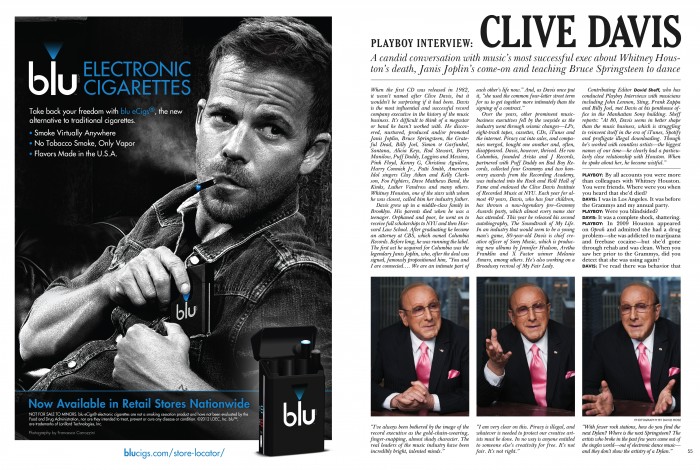
Clive Davis
April, 2013
A candid conversation with music's most successful exec about Whitney Houston's death, Janis Joplin's come-on and teaching Bruce Springsteen to dance
A candid conversation with music's most successful exec about Whitney Houston's death, Janis Joplin's come-on and teaching Bruce Springsteen to dance
When the first CD was released in 1982, it wasn't named after Clive Davis, but it wouldn't be surprising if it had been. Davis is the most influential and successful record company executive in the history of the music business. It's difficult to think of a megastar or band he hasn't worked with. He discovered, nurtured, produced and/or promoted Janis Joplin, Bruce Springsteen, the Grateful Dead, Billy Joel, Simon W Garfunkel, Santana, Alicia Keys, Rod Stewart, Barry Manilow, Puff Daddy, Loggins and Messina, Pink Floyd, Kenny G, Christina Aguilera, Harry Connick Jr., Patti Smith, American Idol singers Clay Aiken and Kelly Clark-son, Foo Fighters, Dave Matthews Band, the Kinks, Luther Vandross and many others. Whitney Houston, one of the stars with whom he was closest, called him her industry father. Davis grew up in a middle-class family in Brooklyn. His parents died when he was a teenager. Orphaned and poor, he went on to receive full scholarships to NYU and then Harvard Law School. After graduating he became an attorney at CBS, which owned Columbia Records. Before long, he was running the label. The first act he acquired for Columbia was the legendary Janis Joplin, who, after the deal was signed, famously propositioned him, "You and I are connected. ...We are an intimate part of
each other's life now." And, as Davis once put it, "she used the common four-letter street term for us to get together more intimately than the signing of a contract."
Over the years, other prominent music-business executives fell by the wayside as the industry went through seismic changes—LPs, eight-track tapes, cassettes, CDs, iTunes and the internet. Piracy cut into sales, and companies merged, bought one another and, often, disappeared. Davis, however, thrived. He ran Columbia, founded Arista and J Records, partnered with Puff Daddy on Bad Boy Records, collected four Grammys and two honorary awards from the Recording Academy, was inducted into the Rock and Roll Hall of Fame and endowed the Clive Davis Institute of Recorded Music at NYU. Each year for almost 40 years, Davis, who has four children, has thrown a now-legendary pre-Grammy Awards party, which almost every name star has attended. This year he released his second autobiography, The Soundtrack of My Life. In an industry that would seem to be a young man's game, 80-year-old Davis is chief creative officer of Sony Music, which is producing new albums by Jennifer Hudson, Aretha Franklin and X Factor winner Melanie Amaro, among others. He's also working on a Broadway revival of My Fair Lady.
Contributing Editor David Sheff, who has conducted Playboy Interviews with musicians including John Lennon, Sting, Frank Zappa and Billy Joel, met Davis at his penthouse office in the Manhattan Sony building. Sheff reports: "At 80, Davis seems in better shape than the music business, which is struggling to reinvent itself in the era ofiTunes, Spotify and profligate illegal downloading. Though he's worked with countless artists—the biggest names of our time—he clearly had a particularly close relationship with Houston. When he spoke about her, he became wistful."
PLAYBOY: By all accounts you were more than colleagues with Whitney Houston. You were friends. Where were you when you heard that she'd died? DAVIS: I was in Los Angeles. It was before the Grammys and my annual party. PLAYBOY: Were you blindsided? DAVIS: It was a complete shock, shattering. PLAYBOY: In 2009 Houston appeared on Oprah and admitted she had a drug problem—she was addicted to marijuana and freebase cocaine—but she'd gone through rehab and was clean. When you saw her prior to the Grammys, did you detect that she was using again? DAVIS: I've read there was behavior that
hinted there was a problem, but she was quite coherent with me that whole week. Her spirits were great. She was very much looking forward to coming to the party. There was no indication of drugs. PLAYBOY: Were there no red flags at all? DAVIS: As I said, she was coherent and there was no indication of drugs, but of course she did have a problem with cigarettes. We were trying to get her to stop smoking. We were working with her on that.
PLAYBOY: Cigarettes would seem to be a trivial concern for someone with a history of serious drug problems. DAVIS: It was a serious problem because it affected her singing—the upper range of her singing. She would say, "I kicked the drug habit, but this is more difficult." She had cut back on cigarettes, but the week she died she came to my bungalow and said, "I understand I can't just cut back. I've got to stop. I promise I will." PLAYBOY: Earlier, when she admitted her addiction, had you been aware of the extent of her drug use? DAVIS: I signed her in 1983 but only became aware of any problem in maybe the mid-1990s. By that time we had quite a successful collaboration going. We were very close. Many artists come with their songs, and you might steer them, help them find a producer, suggest songs, but when you're more involved, producing the albums, supervising them, and you spend much more time on the firing Hne with them, it does lead to a close relationship. In spite of that, I didn't know she was in trouble. I didn't know how bad her problem was. It was after a Michael Jackson concert at Madison Square Garden in the late 1990s when I knew. She showed up ghastly thin. I met with her. I did what I could. PLAYBOY: Which was? DAVIS: She called me her industry father, and I felt like that. We talked about the drugs she was using, but that doesn't mean she could respond to my concerns, because you can't deal with drugs in a logical way—you can't just talk to a person and ask them to stop. It doesn't work that way. A person has to get an awareness of their problem. PLAYBOY: Was she aware? DAVIS: Not then, or maybe she didn't want to admit it to me. They say a person has to sink to the bottom. Whether they do or not, I don't know. But I tried to help her. I tried to work with the family to help her. She did better for a long time, at least as far as I knew. PLAYBOY: Your annual Grammy party was scheduled to begin hours after you learned that she'd died. Did you consider canceling it?
DAVIS: It didn't occur to me. She loved that evening. She had come to the party every year for I don't know how long. She performed or was a guest at it. An evening devoted to music was something she loved.
PLAYBOY: Was it difficult for you to fulfill your role as host?
DAVIS: Yes. The challenge for me as MC was to muster the energy to do what I had to do. I was stunned, but I had to do it. I knew everything had changed, of course. We turned the evening into a tribute to her. And it went on. The show must go on, right? You've got to do what's appropriate in her memory, and that is what we did.
PLAYBOY: Houston is one of many performers who died young, many of them because of drugs. In fact, the first act you signed, Janis Joplin, overdosed and died. Were you aware of her drug and alcohol problems?
DAVIS: No. That degree of closeness was never there with Janis. I knew she drank Jack Daniel's, but it never dawned on me that there was a serious drug problem. I think the only artist during that era whose problem I knew about was Sly [of Sly and the Family Stone]. I knew him as an industrious, energetic guy who called me at home on weekends, and when he'd make plans to go to the studio, he wouldn't show up. But
I was so green when it came to drugs. I didn't really know about them then. When people visit the head of a record company, they're usually on their best behavior, even artists. They would keep that away from me, so I never saw that side. There was nothing in my relationship with Janis or with Sly that prepared me for the severity of her death or for his ultimate involuntary retirement. PLAYBOY: More recently, Michael Jackson and Amy Winehouse both died because of substance abuse. Earlier there was Keith Moon, Jimi Hendrix and many others. Is there a particular kind of pressure in the music business that has led so many stars to self-destruct? Is it the fame or the scrutiny they're under? Is it a false sense of invulnerability? Entitlement? Or are artists in general more sensitive and therefore more prone to use drugs to cope?
DAVIS: I don't know if it's harder for people in the music business than in any other business. I don't know what the statistics would show. Do more people in this business struggle in life? Do they have more problems with drugs? I don't
know. Yes, there are people who died, but there are many who live long lives and have careers that extend over their lives. People like Bruce Springsteen. There are many. I don't think the music business has more casualties compared with film or TV. I'm reading these stories about Macaulay Culkin. There was Judy Garland, Marilyn Monroe. What about writers? There are certainly great writers who had alcohol problems—Eugene O'Neill and Tennessee Williams. PLAYBOY: Do some stars have a harder time handling fame than others? DAVIS: Yes, and I have seen the extra pressure that comes with fame, which can be seductive and corrupting. If fame is added to the equation, maybe it becomes difficult for some people to cope. PLAYBOY: There are many stories about fame and rock stars—their excesses, and not only in relation to drugs. They've famously destroyed hotel rooms. Some insist on only red M&M's in their dressing rooms. Have you had to deal with that kind of behavior?
DAVIS: My experience with all the hotel-room stuff is limited to what I read in the magazines. The biggest argument I had was probably with Ray Davies and his brother of the Kinks. I'm not trying to be lily-white. I just didn't see it. Maybe I was lucky with the artists I worked with. Patti Smith would occasionally urinate onstage, though never when I was there. I don't know exactly how she pulled it off or what it meant. PLAYBOY: Was it sometimes hard to get artists to take the business side seriously? Rock stars are often portrayed as treating the business executives—the "suits," as they refer to them—dismissively. DAVIS: If you're saying they're disdainful of the business side, I would take issue with that. It might not have been fashionable for them to admit that business entered their thinking, but the major artists always made sure they had the best lawyers and the best business negotiators to get the best deals possible. They all did think about it. Most of the artists I've worked with were very astute. PLAYBOY: It takes more than a good business sense for someone to discover artists of the caliber of the musicians with whom you've worked. Do you attribute your track record to an ear for hits? DAVIS: I was unaware at first that I might have an ear for music. I never thought about it. But just trusting my instinct, I started signing. It's common sense, knowing a hit.
PLAYBOY: How do you know a hit? DAVIS: Part of it is hard work. I still to this day take home tapes of all the hits in every genre to listen to, because music keeps changing. Many of my peers, and many artists, will deliver songs that could have been a hit five or 10 years ago, but they're not at all aware that music has changed. So a lot of it is preparation. It's hard work. I study what people
are listening to. I've always listened to every hit in the Top 40—to every record that makes the chart, whether it's a hit or not. I don't mean the top 10 hits of the Top 40. I always listen to the new entries and R&B, hip-hop and rock so I keep my ears current.
PLAYBOY: But listening to a lot of music isn't enough. If it were, there would be countless successes in your business, when in fact there are few. DAVIS: I didn't necessarily have an ear, but I think I developed one. Whether there was a natural ear that was triggered, I don't know the answer to that. But when you see a Joplin or a Springsteen, you know. And the statistics start mounting and give you confidence. You think, My God, yeah, I did say yes to Santana.
PLAYBOY: Did you listen to music when you were growing up? DAVIS: I didn't collect records, but I listened to the radio. I always listened to [1940s and 1950s DJ] Martin Block. I would listen, but I was not an avid music fan to the point that there was any sign music was going to become the passion of my life. It was not a calling I knew existed within me. It was something I discovered later.
PLAYBOY: Did you become a fan of any particular artist?
DAVIS: Sinatra was one. At first he just seemed like a pop craze—women screaming and the teenyboppers and bobby-soxers—but it became clear that he was unique. He combined pop music and jazz. He crossed every barrier. Beyond him, my background was much more in the theatrical tradition. I was bowled over when I saw Oklahoma! and Carousel. My respect for songwriting came from the tradition of Rodgers and Hammerstein, Rodgers and Hart, and Cole Porter. I think America's greatest contribution to music has been, alongside jazz, the great American songwriters in the theatrical tradition. PLAYBOY: When did you first begin to think about signing musicians? DAVIS: I had finished my freshman year of college and lost both parents within 10 months of each other. I had a support group with a sister and an aunt with whom I was close, but that was a tough time. I was in a Jewish family and grew up in the public school system of New York, and there was a work ethic that I was left with that said the way you rise above your station is to become either a doctor or a lawyer. I never loved science, but I did love politics and government, so I became an attorney. By some accident, the company I worked for owned a record company. Soon I was running it. That's when I went to the Monterey Pop Festival. It was the 1960s and the time of Haight-Ashbury, but I had no idea what awaited me. I thought the Monterey Pop Festival was a social event where I would see Simon & Garfunkel and the Mamas
and the Papas and be with my friend [the producer] Lou Adler. My life changed there. I sensed a total social, cultural, musical revolution, and my peers in the music business had no idea. They didn't see it; they just were not there. That's probably the epiphany that changed my life. Janis Joplin was performing there, and I went on to sign her. PLAYBOY: There's a legendary story that Janis Joplin propositioned you. What happened? DAVIS: She volunteered. Let's just say that.
PLAYBOY: And?
DAVIS: I declined. But in spite of that, I knew she was brilliant. When she sang you just felt something. It's hard to describe it when you hear it, but you know. It happened with Whitney, Patti Smith. There are the cliches—yes, you feel a tingle in your spine.
PLAYBOY: Did you feel it when you first heard Bruce Springsteen? DAVIS: The Bruce Springsteen we know now isn't the one I saw that first time. I was impressed by his lyrics but not by him as a performer. I never knew Springsteen would develop into a rock-
and-roll performer second to none. He started out as a folksinger standing quietly onstage, singing his songs.
In 1971, when Bill Graham closed the Fillmore East and Fillmore West, journalists were saying, "Is this the death of rock and roll?" Of course it wasn't. In 1973 I decided to take over the Ahman-son Theater in Los Angeles for seven consecutive nights. Every night I put on shows that paired artists, mixing and matching classical, rock, pop and jazz. I put on Miles Davis, Mahavishnu Orchestra, New Riders of the Purple Sage, Bruce Springsteen, Johnny Mathis, Loudon Wainwright. I did it to show the vitality and variation of rock. Three acts each night. It became clear the music was not dead.
For one of these shows, Bruce performed. His career had just begun. He gets on the stage with his guitar and just stands there. He plays and sings his songs and does nothing else. Emboldened by the confidence I was gaining from my signings, afterward I said to him, "Bruce, when you're onstage like that you can't just stand there. You've
got to move." He was listening, but I didn't think he was really absorbing what I was saying. Two years later, still before he had broken big, he was playing the Bottom Line in New York. It had maybe 500 seats. I'd started Arista Records by then. I'd signed Bruce when I was still at Columbia, so I wasn't working with him at the time, but his manager, Jon Landau, said, "You've got to come. Bruce very badly wants you to come."
I went down to the Bottom Line and was astonished. This was not the Bruce Springsteen I had signed. He was not sitting quietly on the stage. He was not walking around the stage. He was jumping on tables, literally jumping off the stage. After the concert I went backstage, and he looked up and said, "Did I move around enough for you?" He became a great performer, one of the best. But that's not why I had signed him. I signed him for his lyrics.
PLAYBOY: How do you sell an artist to the public based on his lyrics? DAVIS: I went on closed-circuit TV to speak to all the Columbia branches. The employees were in their offices, and I read every lyric to every song on the album. I said, "This is not another Bob Dylan." There were too many of those. If you ask me who American music's poet laureate for these past decades has been, it would be very tough to decide whether it's Dylan or Springsteen. The two of them are in a rarefied category together, but they're very different. I was trying to show that this new artist's imagery was like nothing anyone had ever heard before. But even though I knew he was a brilliant songwriter, at that time I didn't know where he was going as a live performer. PLAYBOY: Was there a particular Springsteen song that sold you on him as a songwriter?
DAVIS: When Bruce sent me what was to be Greetings From Asbury Park, N.J., I said, "You know, the quality of what you're doing is great, and I love it, but let me just draw your attention to the fact that we need, in my opinion, one or two more songs for this to have a commercial impact." I said, "You've got to be very careful when you do those. You are capable of writing great melodies as well as lyrics, but would you consider doing one or two additional songs that might be more radio-friendly, because we're going to need them to help spread the word about you?" He took it in the right spirit. He immediately went back to the drawing board and came up with "Blinded by the Light" and "Spirit in the Night." I vividly remember listening to those two songs and being thrilled that they were being added to the album. PLAYBOY: What artists did you have the greatest influence on as they developed? DAVIS: Barry Manilow is one. I had just formed Arista Records when he was brought to my attention. Barry was
unknown. He'd had one album that might have sold 10,000 copies. He was mainly an arranger and a piano player for Bette Midler. My appraisal of him came when he was opening for Dionne Warwick in Central Park. He was a gifted entertainer. I could see that. A gifted showman. I signed him because I thought he was unusual in his charisma and in his delivery. My plan was that I would find songs for him to record—hit songs. What I didn't know was that the most important thing for him was songwriting. Since he considered himself a songwriter, he didn't necessarily want to hear "You write good songs, but they aren't hits, and you need hits—a continuity of hits." PLAYBOY: How did you convince him to record songs he hadn't written? DAVIS: He was resistant, but I was head of this brand-new company, and he had the insecurity of not knowing whether his contract would be picked up. And so he agreed.
PLAYBOY: Who else besides Manilow did you choose songs for? DAVIS: I found so many songs that Barry couldn't use them all. I thought, I've got to look for a female singer. I found Melissa Manchester. I gave her hit songs, but like Barry she also considered herself a songwriter. Her resistance to my advice led to her separating from Arista. Next I signed Dionne Warwick. That led to Aretha, and Aretha led to Whitney. PLAYBOY: How did you begin working with Houston?
DAVIS: I signed Whitney nine years after I'd started Arista Records. She and I formed a creative partnership. I'd find 20 songs and bring them to her and together we'd narrow them down to 12 or so that she would record. From the beginning we worked like that. When you're involved like that, you work very closely and become close—it's an intimate relationship. I would pick the producers, supervise the albums. PLAYBOY: As trends changed—folk rock, rock, disco, hip-hop, whatever it was— did you look for specific genres of music? DAVIS: You follow what's happening. You are constantly trying to determine what's radio-friendly. PLAYBOY: What's the most radio-friendly music today?
DAVIS: You don't have to be a rocket scientist to know that today's Top 40 is dominated by electronic dance music. PLAYBOY: It's followed years when hip-hop and rap emerged. What did you think when you first heard them? DAVIS: I knew hip-hop was coming and that urban music was changing. I signed Gil Scott-Heron, who was very influential on rap. I started LaFace Records with L.A. Reid and Babyface [Kenneth Edmonds], who wrote for TLC, Usher and Outkast, which became a real hip-hop breakthrough. PLAYBOY: You had LaFace, so why did
you next enter into a relationship with Sean Combs, forming a new rap label, Bad Boy Records?
DAVIS: His mission was really to develop the creative hip-hop revolution, and he did that. When we met, all of what he played for me was unique and special. He had Craig Mack's single "Flava in Ya Ear" that he played for me, and he had about four or five cuts from the Notorious B.I.G. He also had this vision for hip-hop to become the music of our time. I like ambition. I liked the largeness of his perspective. I was working with someone who was close to the streets, far closer than I was and closer than anything I had as part of my arsenal. Both L.A. and I knew we needed to get to the streets, and partnering with Puffy was the best way to do that. PLAYBOY: As violence broke out between the East Coast label Bad Boy Records and the West Coast-based Death Row Records, were you ever threatened? There were casualties on both sides, including Tupac Shakur and Notorious B.I.G. DAVIS: The tragedy of the killings and the violence were horrifying. But I
never had a bodyguard. Looking back, it shocks me that I was not aware of any lurking danger.
PLAYBOY: Whether at Columbia, Arista, J Records—another label you created— and then Sony, though you kept on top of new music, you continued to work with older stars such as Aretha Franklin, Rod Stewart and Barry Manilow. Was it for nostalgia's sake?
DAVIS: Aretha is a national treasure and has the greatest voice in the world. Some talents transcend a given moment. Why shouldn't Aretha continue on the radio? Radio was not hospitable to a song like "Respect," but I was able to extend her many, many years, and we're now working on an album. You find a way to do something different with them to make them relevant. It happened with Rod Stewart and Santana too. PLAYBOY: You've managed to keep some older artists relevant but not necessarily the older technology. When you started out, music was on vinyl. Vinyl is making a minor retro comeback, but it was essentially pushed aside by eight-track tapes, cassette tapes, CDs and then
digital music. How do you stay ahead of these evolving technologies, and how do you know which ones to bet on? DAVIS: I never spent any time in the technological world. I've concentrated only on the music. The demand had to be there for your music. The format didn't matter.
PLAYBOY: When Apple launched iTunes, some record companies wouldn't sign on at first. It was years before the Beatles allowed their music to be sold on iTunes. Were you resistant when it launched? DAVIS: No, because you can't fight change, nor should you. You embrace it. PLAYBOY: How concerned are you about illegal downloading of records? The industry has fought pirating since it went after and eventually shut down Napster, yet people download billions of dollars worth of music a year. DAVIS: It's damaging. There's a public perception that you should get music for free. That perception is tremendously threatening. I just read that even with the availability of iTunes, more music than ever is pirated. The New York Times said there's more piracy through file-sharing networks than what is sold legitimately. That is scary, a major concern. PLAYBOY: Is it stoppable? DAVIS: We've made progress. In 2011 we ended up selling more digital, CDs and records combined than we had the previous year. Last year it was level. One hopes the decline is over and that we're now overcoming it.
PLAYBOY: Should kids be arrested if they pirate music?
DAVIS: I am very clear on this. Piracy is illegal, and whatever is needed to protect our creative artists must be done. In no way is anyone entitled to someone else's creativity for free. It's like going to the theater and feeling you should be able to see A Streetcar Named Desire for nothing. We must all protect our musicians. It's terrible that technology has allowed a segment of the public to feel they should get music free. It's not fair. It's not right. We have to legally enforce these laws. Are you going to accept it if a 17-year-old robs a bank? If a person is not law-abiding at 15, 16, 17—whatever age—they have to be, and should be, held accountable. Creativity must be protected, and people should not be allowed to steal music any more than they should be allowed to steal anything else. PLAYBOY: Is the solution to shut down file-sharing sites and prosecute those who illegally download, or is it to convince kids and others that piracy is stealing and they should pay for music? DAVIS: It requires all of that. PLAYBOY: But if, after years of attempting to solve the problem, more music is pirated than sold, the efforts aren't working. DAVIS: New technology may help. Some of what is changing is the way people get music, so maybe they'll be less inclined to download (continued on page 129)
CLIVE DAVIS
(continued from page 58) it. Spotify and streaming are generating revenue. But the most important fact in all this is that we're dealing with something that is still a basic need. I know that music is a need. We're not dealing with a product that is dated. Now it's a matter of finding a solution as to how to get music in a commercial, profitable way—fair to the originators and satisfying to the consumers—so it can continue to grow. But the need for music is still there.
PLAYBOY: Because it's now harder for artists to make money selling records, does the lion's share of their income come from performing?
DAVIS: That's accurate for established artists, for veteran headliners, whether it's Madonna, Springsteen, Elton John or Rod Stewart. They fill arenas all over the world, which makes a fortune compared with their record sales. Lady Gaga is a big breakthrough, so she still probably makes more from live performances, but her albums sell 2 million, 3 million, 4 million copies. That was pretty significant as a breakthrough. The biggest-selling rap artist is probably Lil Wayne at 2.5 million. Eminem does some touring, but his albums are major sellers. Others are Kanye West and Jay-Z.
PLAYBOY: Are they on your iPod? DAVIS: I don't have an iPod. I have an iPhone and an iPad.
PLAYBOY: Is that what you use to listen to music?
DAVIS: I listen on CDs. I have a home in Westchester, about an hour away, and I go there on weekends. I'll listen in the car going there and coming back. I also use Spotify on occasion. I watch videos to see what competitive artists look like as they break. PLAYBOY: Do you go to clubs? DAVIS: That was a long ago thing. Now you get videos, though for established artists, or an artist on your roster who is performing, you go. Barbra Streisand goes back so many years that I have to go to the Hollywood Bowl when she performs there. Alicia Keys is touring, and I'll see her. I just saw Sting and Tony Bennett at a charity dinner.
PLAYBOY: You've worked with the biggest stars in the world by now. You're about to turn 81. Do you think about retiring? DAVIS: Look, your health has to be good to enable you to come to an office every day. I am still at the office a minimum of eight hours every day. Besides, you can work in this job as long as your track record is good. You get report cards every Tuesday and Wednesday. Tuesday is radio, when they release the Top 40; Wednesday they release the SoundScan results, which track sales. PLAYBOY: Is it harder to break records these days, when radio stations have such formulaic playlists? On most stations, DJs have little opportunity to play what they want.
DAVIS: Actually, the size of the playlist has always been pretty much the same. What you do miss is the free-form album stations.
There are definitely fewer rock stations. With fewer rock and free-form stations, how do you find the next Dylan? Where is the next Springsteen? The artists who broke in the past few years primarily came out of the singles world—out of electronic dance music—and they don't show the artistry of a Dylan or a Springsteen. Also, albums aren't what they used to be. The public will buy 5 million copies of a single but only a few hundred thousand albums at most. There's not the curiosity to hear more of the artist. People buy only the particular song they like. There are exceptions, but it's a serious problem when it comes to developing careers, not just breakthrough singles. I'm trying to think of the last solo folk-rock artist to break. It might be harder to break a Patti Smith now—someone completely new. PLAYBOY: Has anything replaced radio as a way to break artists?
DAVIS: Yes. Online is one way. The web gives people an opportunity to hear and see an artist, but not too many artists break off the web, at least so far. Besides online, a lot of new artists have come from reality-TV competitions. No one has developed meaningfully from the competitions in the past two or three years, but before that we found Kelly Clarkson, Carrie Underwood and Chris Daughtry. I did The X Factor with
Leona Lewis for her debut album. Still, it's not easy to break artists who don't fit in the mainstream. It's not easy to break a rock artist; reality shows are pop music. But like I said, people want music. That hasn't changed. Music is as vital as ever, which is why I'm encouraging students to go into this industry by starting the Clive Davis Institute of Recorded Music at NYU. I want the best people to go into this business, and I want them to understand its potential.
Popular music has a remarkable history. It's tied with the culture's development, yet it hasn't been treated with the same seriousness as other music forms. There was no place to study music—except for very elitist music, maybe classical or jazz at Berklee or the conservatories. Mainstream contemporary music, however, which has so much of an impact around the world, wasn't taken seriously as an art form. There was no place to seriously study it, to be trained so you could push this industry further. Now there's a school of popular music where the future of the music business is learning and collaborating.
I endowed the institute for another reason. I've always been bothered by the image of the record executive as the gold-chain-wearing, finger-snapping, almost shady character. Well, that's not what it's like. It has always bothered me that the profession I chose has that stereotype. I
look back at the people who have shaped this business: Warner Bros. Records under Mo Ostin and Joe Smith, A&M Records with Jerry Moss and Herb Alpert. Going back years before me there was Alan Livingston of Capitol Records and, more recently, Richard Branson of Virgin, Chris Blackwell of Island, and David Geffen. I can go on and on. These executives were behind music that we still listen to and that changed the culture. You can argue that the history of music is far more in-depth than that of film. The real leaders of the music industry have been incredibly bright, talented minds, and entrepreneurial. The future leaders should know that tradition, and they should have more opportunities at an early age to learn more, digest more, put their talents to use. They should know they can be part of what comes next, the most exciting next thing. PLAYBOY: What excites you now? DAVIS: I was very glad to see the arrival of Mumford & Sons. And Adele—I was very glad to see how she soared over everybody else. I have nothing to do with those artists, but it's encouraging for the future of music that artists outside electronic dance music are finding success. Brittany Howard, the lead singer of Alabama Shakes, is also strong.
PLAYBOY: When you're listening to the radio and songs come on by artists you've worked with—Aretha, Bruce, Janis, Whitney—do you feel a particular pride? DAVIS: The answer honestly is yes. I do have a definite sense of pride. Like the Mamas and the Papas; sometimes "California Drea-min'" comes on. A song like that or a Simon & Garfunkel song. I'm reminded that what Paul Simon did was incredible. Paul Simon should always be considered in the same breath as Lennon and McCartney. And there's a thrill when I hear Bruce Springsteen. There's an extra thrill when you're involved with them personally, when you were there from the beginning. PLAYBOY: Are you as excited as when you discover something new? DAVIS: Hearing the old music is not necessarily better than the feeling of finding someone new, working with someone great coming up. Over the past three or four years I did "Bleeding Love" and "Better in Time," which broke Leona Lewis after she won The X Factor. I worked with Kelly Clarkson with "My Life Would Suck Without You" and "Already Gone." I did "Spotlight" with Jennifer Hudson. I did Whitney's final album, and I supervised her recent greatest hits album. I did a network-TV special, A Grammy Salute to Whitney Houston. I've just signed Aretha to do another album. I signed Rod Stewart. I'd never worked with him before, and then I did five volumes of The Great American Songbook, which sold almost 20 million copies. I'm still working with Santana. I'm just locking up the rights to bring My Fair Lady back to Broadway. I've written my autobiography. It remains exciting. I'm still looking for the next thing, the next artist.
/ didn't know how bad
Whitney's problem was. It
was after a Michael Jackson
concert in the late 1990s when
I knew. She showed up ghastly
thin. I did what I could.
/ didn't necessarily have an ear, but I think I developed
one. But when you see a
Joplin or a Springsteen, you
know. And the statistics give
you confidence.
/ never spent any time in the technological world. I've concentrated only on the music. The format didn't matter. You can't fight change, nor should you. You embrace it.

