They Call It El Raid
June, 2014
IRAN PUNK
MUST the AYATOLIAH think
PHOTOfiRAPHTBY
A
s Dawn of Rage played a Tehran amphitheater last summer, Iran's morality police arrested the metal band's three members, as well as more than 200 spectators, just for being at a rock concert. The cops stripped several fans naked, searching for satanic tattoos. They confiscated cell phones. The musicians were behind bars for five days. "I'm not scared," said Dawn's lead singer, Pouria Kamali, after he was released. "Metal is totally forbidden in Iran, and everyone knows that someday the Basij may arrest them."
The music of dissent will always find a way, anywhere, even in Iran, where the Supreme Leader Ayatollah Ali Khamenei has decreed, "Promoting and teaching music is not compatible with the highest values of the sacred regime of the Islamic Republic." The rockers featured in the follow-
ing photos are free repressed country. They wear lipstick and go-go boots. They listen to English bands such as
Foals and Radio-head, and they live
in constant fear that the Basij, the religious police, will knock at the door. The penalty for playing the devil's music is 40 lashes.
Shot earlier this year, these photos capture Iran's indie rockers at a critical juncture. In November 2013, two members of Iran's most vaunted rock band, the Yellow Dogs, were murdered in Brooklyn. The victims were brothers Arash Farazmand, 28, and Soroush Far-azmand, 27. Another musician, Ali Eskandarian, 35, was also killed. Their attacker was a failed rock bassist, Iranian emigre Ali Akbar Mohammadi Rafie, who carried his assault rifle in a guitar case. The Dogs came to the U.S. as political refugees in January 2010. Since then, the nation's new president, Hassan Rouhani—a moderate elected in 2013—has pledged to support creative expression. "There is a direct link between art and freedom," Rouhani said
in January. "We should know that art is not a threat and artists do not put the security of the country in danger." Two weeks after Rouhani's speech, small miracle happened: Iranian state television showed a 10-second clip of musicians playing traditional Persian instruments. The clip aired without introduction and without context. Since 1979 the government had deemed the display of instruments ghena—that is, a sinister enticement to dance. Also in January, an Iranian country-rock band, Thunder, played a state-authorized gig in Tehran for 1,400 fans. There was a smoke machine, and the male musicians wore 10-gallon hats as a female guitarist wailed away on her ax while wearing a head scarf. Afterward, Thunder's lead singer, Ardavan Anzabipour, was ecstatic. "This has not happened for 35 years," he savs. "These are not the small-
town cretins the ministry had under Mahmoud Ahmadi-nejad. They are real
musicians. And now
we are going to play in some smaller cities, for more conservative
people." Anzabipour believes the tour could open the door for edgier musical genres—metal, hip-hop and indie. "Things could change in five minutes here if the top guys say yes to rock music," he says.
Skeptics disagree. Rouhani must answer to Khamenei, the ayatollah. Although Rouhani stepped into office promising free speech and the release of political prisoners, he has largely failed to deliver. Rock and roll in Iran is still shadowed by the ayatollah's boot heel, and it sings with the keen, fresh rage of wild youths who feel as though they will be trapped forever. "The people running this country are fundamentalists," laments musician Mareza Hariri. "They will not change. All we can do is have fun underground."
The photographer's identity has been withheld for protection.
,m Niknafs first heard Judas Priest
ge of 14, on a bootleg cassette.
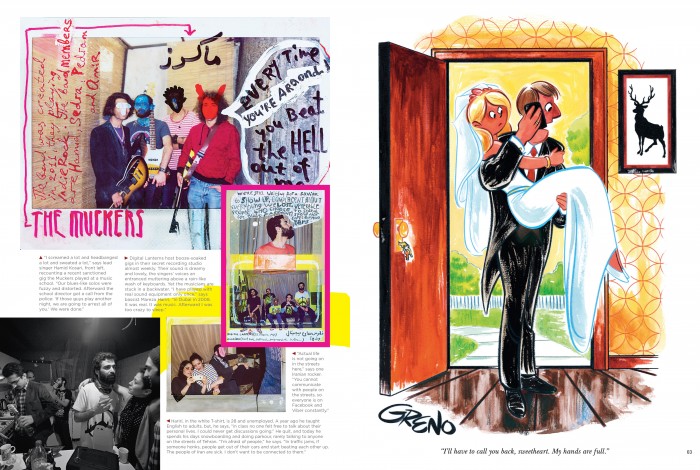
He found heavy metal's black disdain so exquisite that he began saving his lunch money. "When you went through alleyways here," he says, "everyone whispered in your ears, 'New cassettes, new music.'" He bought 100 tapes—Megadeth, Metallica, Iron Maiden—and the music still thrums through him as he fronts Digital Lanterns. Here he's singing "You Cannot Adopt Me," directed at unnamed powers.
Mardakheh is
„_. ,_r Achromatic,
words are from a song about the Iranian gove 2009 crackdown on the Green Revolution. "It's called 'Shields and Guns,'" he says, "as in riot police. Hell doesn't refer to Iran specifically but to difficulties we all face as artists. You keep the light alive by b*ig creatlV by being heard in tms world.

